You might, or perhaps might not be aware that Scott Adams, the Dilbert cartoonist died on Jan 13, 2026, at the age of 68. It was expected, he knew it was coming and was in his last days, he had terminal prostate cancer.
The interesting twist here is that he decided to take Pascal’s wager and do a very public deathbed conversion.
When he died, the following message was published via his twitter account…
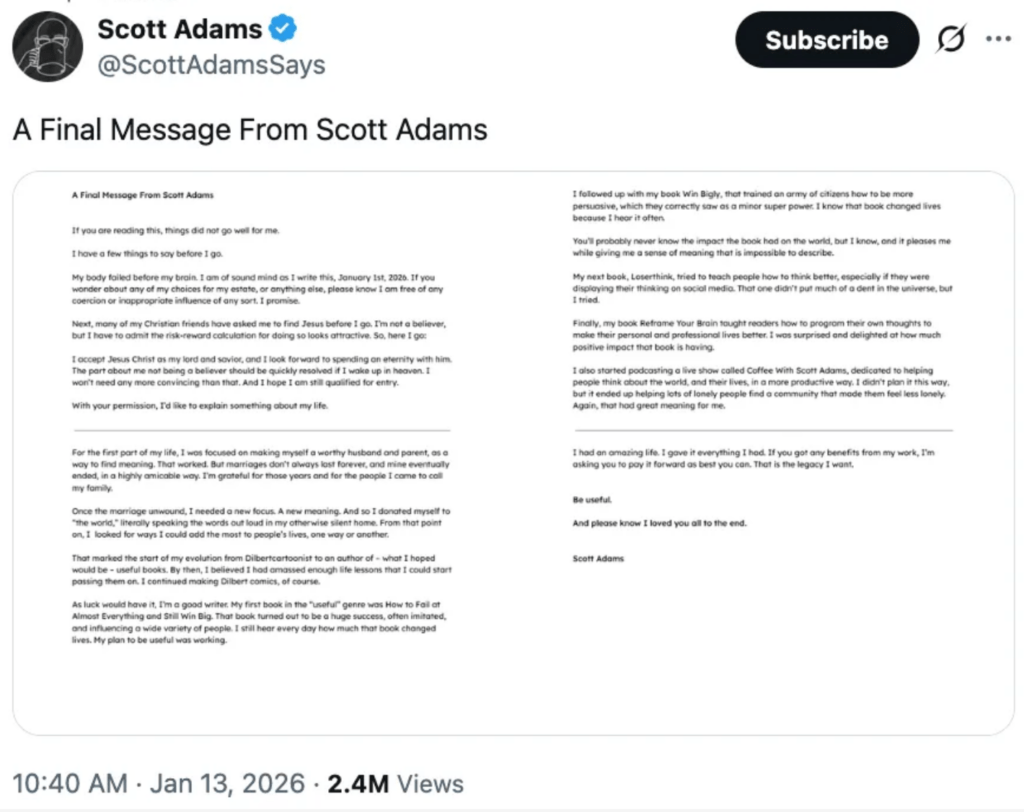
Well yes, the font there is tiny and unreadable, so here you go, it is the first part there that is of interest …
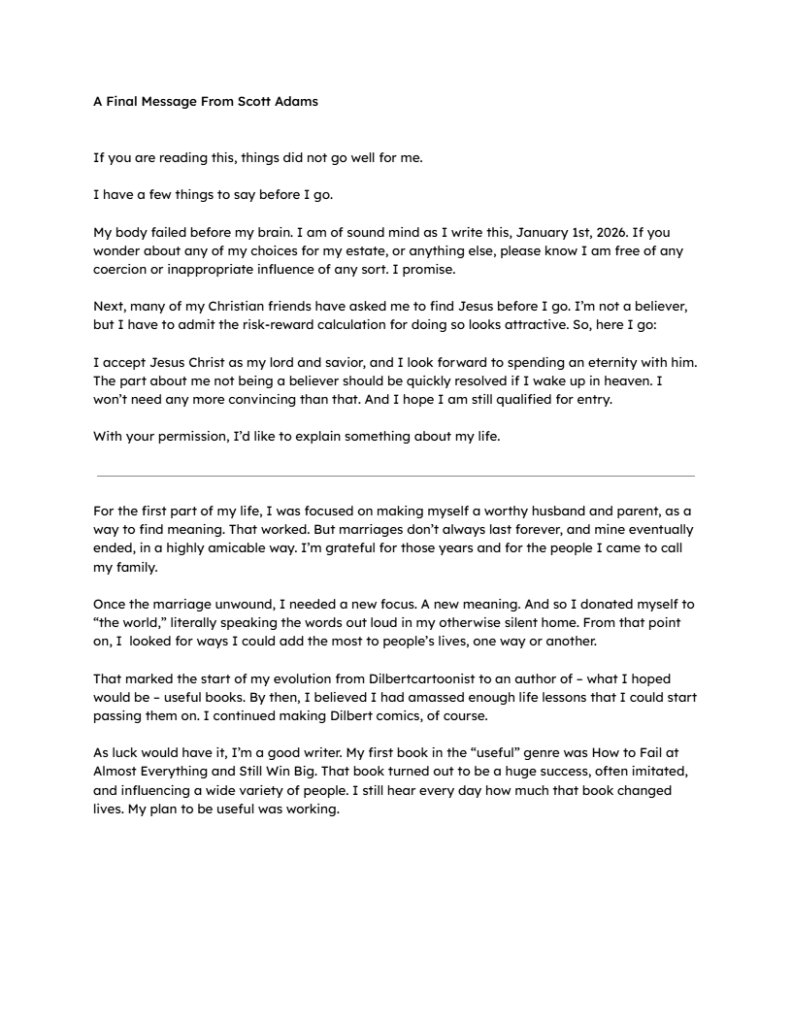
…Next, many of my Christian friends have asked me to find Jesus before I go. I’m not a believer, but I have to admit the risk/reward calculation for doing so looks attractive. So, here I go:
I accept Jesus Christ as my lord and savior, and I look forward to spending an eternity with him. The part about me not being a believer should be quickly resolved if I wake up in heaven. I won’t need any more convincing than that. And I hope I am still qualified for entry…
The reference he makes to risk/reward is Pascal’s Wager.
The idea is this – If you convert and become a Christian, then what?
- If there is no God, then it has cost you nothing
- If however there is a God, then you win eternal life
Sounds enticing.
The argument is also deeply flawed.
Permit me to lay out a few of the very obvious issues with it. Yes, many of you know all this, but not all readers do, so for completeness, here it is.
What’s wrong with Pascal’s Wager?
Here are some of the many problems with it.
1) It assumes this is a binary choice – God or no God
The problem is that there are plenty of Gods to select from. Add to that list the possibility of an unknown God as well. It also assumes that there is a god that operates a reward/punishment scheme.
- What if the true god rewards skepticism?
- What if it is not Christianity but some other variation of belief that is the correct one and believing in the wrong god lands you in that other God’s hell.
Evangelicals love to play this card, but tend to forget that the guy who created it was a fanatical Catholic who would have deemed the decision to embrace the Evangelical variation of Christianity as a heresy that would result in them going to hell.
Even betting on the wrong variation Christianity may be just as risky as not betting at all.
2) Belief is not a choice
There are magical invisible all-powerful fairies that dance in my garden at midnight. If you believe they are there then you will be rewarded with eternal life.
Given the risk/reward possibilities here you can happily just believe in them because I told you … right?
You can of course fake believing and pretend, but the all-powerful fairies will know you are faking and so they will not reward you.
3) Would a God prefers fear-based fakery instead honesty?
There is no credible empirical evidence that there is a god. The intellectually honest position is doubt and non-belief. An assumption that a threat of hell that motivates you to pretend to believe to gain a reward is acceptable assumes a god that is deeply flawed. In theory a morally perfect God would disapprove of opportunistic belief and would instead value intellectual integrity.
It is far more rational to assume that an actual reward is granted for honest doubt and not fakery deployed for self-preservation.
4) It is not zero-cost for believing
Belief has the potential for a huge impact. For example lifestyle restrictions, or even worse, complete rejection of evidence-based reality (anti-science is rather common within some strands of belief these days).
I could continue to pick through a few more issues, but let’s pause that and move on to something many people do not know.
Pascal’s Wager is not what you think it is
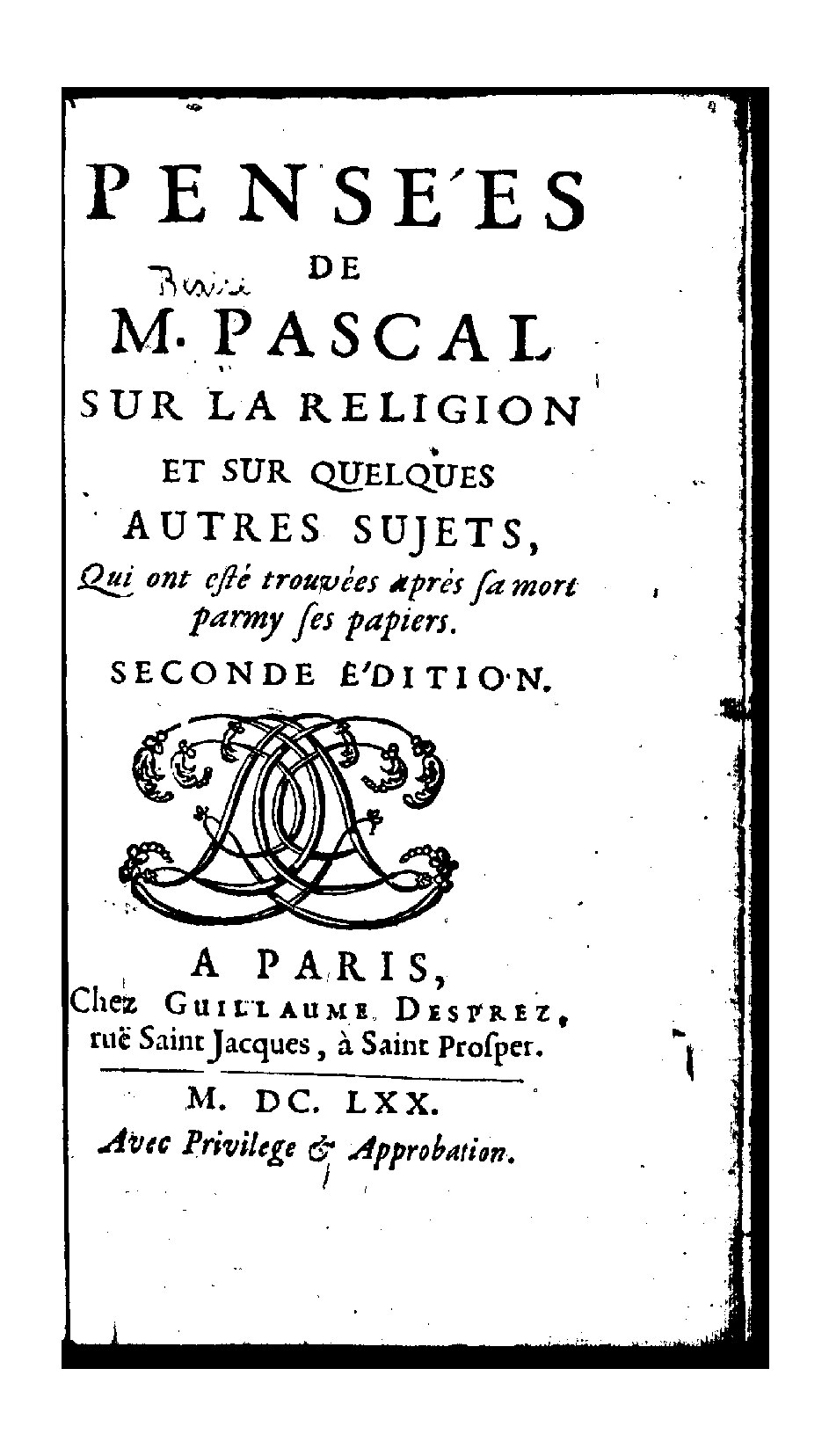
It was first published within Pensées (“Thoughts”) in the year 1670. The real significance of that date is that Pascal died eight years earlier in 1662. The idea is not something he actively promoted during his lifetime.
Permit me to explain.
When he passed away in 1662, Pascal had been working on the text of a Christian Apologetics book. At that point in time all he had were early draft notes. Others picked up what he had been working on and published it all. What is not wholly clear is where he was going with it all, and what the correct ordering of his notes should really have been.
A Key point is this: Pascal’s Wager, as it is commonly deployed today is not rational and yet Pascal himself was a mathematician, physicist, inventor, philosopher, and Catholic writer, so what did he actually intend with this idea within his notes, would he have even used it or scrapped it as a bad idea for the final book?
One thought is that he intended to put the argument at the start of his book for those sitting on the fence undecided as a pragmatic suggestion that they might as well behave as if it was true and so prepare their hearts for actual belief.
We don’t know because all we have are his early draft notes.
When published many quite rightly criticised the idea for various rather solid reasons, some of which I have already gone over.
OK, let’s get back to Scott Adams.
Why did Scott Adams take Pascal’s Wager?
Was he really so terrified of hell that he simply decided “Ah F**k it, I’m dying, so I might as well convert because I have nothing to lose“, or was something else going on?
I’m leaning very much into “Something else was going on” here.
He knew he was in his last days. He also knew that his legacy was going to be truly horrible.
Here are a few notable items from the life of Scott Adams …
- He morphed into a very passionate Trump sycophant – so much so that he has described his support for Trump as a factor in ending his public speaking career, as well as negatively impacting his income and friendships. (See here and also here (at 1:45 mark))
- He was deeply racist: In 2023, his comic strip was cancelled by newspapers including the Washington Post after Adams was accused of making racist comments about black people. Adams called black Americans a “hate group” and suggested white Americans “get the hell away from black people,“.
- What stance did he take during COVID? … Oh come now, if you don’t know then you can see where this is all going. Yes, your guess is correct, he was anti-masking and anti-COVID-19 vaccines. He says that he believed that people unvaccinated against COVID-19 “came out the best” compared to vaccinated people. Reality and facts come knocking to call BS on that turd of a claim – PolitiFact called him out on that.
- As for the Holocaust, yes he did indeed play the “It was not as bad as some claim“ card.
Speaking of cards, he did of course also play the usual card and so he also described himself as getting “canceled” in 2023 when many newspapers decided to drop his Dilbert strip after his horrible views went public.
“By Adams saying he’s been canceled, its him not owning up to his own responsibility for the things he said and the effect they have on other people,” said Ward Sutton, who has contributed illustrations to The New York Times, The New Yorker and Rolling Stone.
“He’s trying to turn himself into a victim when he himself has been a perpetrator of hate,” Sutton added.
He said newspapers are not obligated to run Dilbert, and they have the editorial right to cut ties with Adams if they no longer want him as a voice in their paper.
Similarly, Hector Cantú, best known for his Latino-American comic Baldo, said he believes in freedom of speech, but not freedom from repercussions.
“Don’t gloss this over by saying it’s politics or it’s cancel culture,” he said. “If you’re going to offend people, you risk paying the price.”
There is more, but even that much is sufficient for you to get the big picture here.
The guy was in his last days and well aware that all this would be his obituary and what he would remembered for, so what could he possibly do to alter that fate?
Easy, play Pascal’s Wager and do a dramatic death bed conversion to make that the headline. It taps into a ready and willing, and very gullible audience to sing his praises.
So did he really take Pascal’s Wager?
No, I don’t believe he did, I’m convinced it was his final PR stunt.
As for myself, would I ever seriously consider taking up Pascal’s wager?
Hell no, not only do I have no desire to spend eternity with the 80% of truly obnoxious evangelical Trump supporters like Adams, because that “heaven” really would be hell, but I also have no desire to piss off Fek’lhr who would immediately dispatch me to Gre’thor for doing such a dishonourable self-serving act.
If you are looking for a better wager to take, then this is a far superior suggestion …
“Live a good life.
If there are gods and they are just, they will not care how devout you have been, but will welcome you based on the virtues you have lived by.
If there are gods, but unjust, then you should not want to worship them.
If there are no gods, then you will be gone, but will have lived a noble life that will live on in the memories of your loved ones.”
– Marcus Aurelius (121-180)
Pascal’s Wager is an equally strong argument for any deity you can think of, or for any god you care to invent, as long as you stipulate a severe-enough penalty for nonbelief.