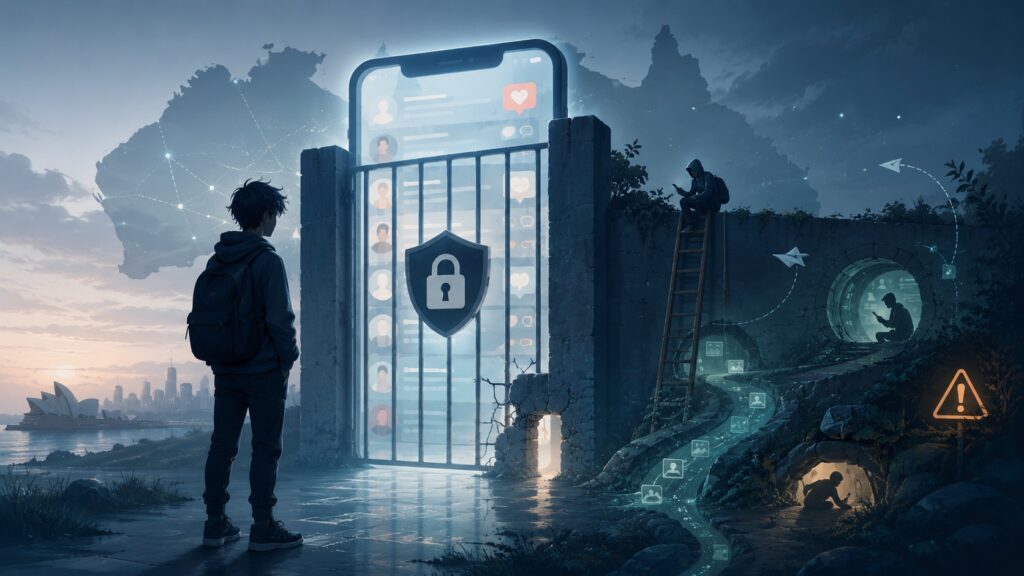
Roughly six months ago Australia introduced a national minimum age of 16 for social media accounts. It is often called a “ban”, but the regulator frames it as a delay to having accounts, not a ban on using the internet generally. In other words, Google, Wikipedia, and Claude are all fine, just no access to Facebook, X, Snapchat, etc…
Very obvious questions arise.
Why did they do this, is there any solid scientific basis for doing this, and also more importantly looking back after six months, how well has it all worked out?
Let’s take this step by step.
What Did Australia Do?
Starting on December 10, 2025, age-restricted social media platforms were required by law to take “reasonable steps” to stop Australians under 16 from creating or keeping accounts. The legal burden was placed on platforms, not children or parents. Under-16s or their parents would not be fined if a child gets access. It was the platforms that could be penalised if they failed to take reasonable steps to prevent under-16 accounts. The original maximum penalty was A$49.5 million.
So far no platform has been fined, but Facebook, Instagram, Snapchat, TikTok and YouTube are all under investigation for non-compliance.
- ABC AU, March 2026: Five social media platforms investigated over compliance with under-16 ban
Reuters also reported (June 29, 2026), that Australia is to give the regulator more power to pursue Big Tech over under-16 account ban because so far it has not been all that effective. The proposed changes would double maximum penalties to A$99 million and give the eSafety Commissioner stronger powers to demand internal documents, including board minutes and emails.
A$99 million is roughly $68 US million. You might be tempted to think that somewhere inside Big Tech somebody will be crunching the numbers and working out how much it will cost them to take meaningful action vs how much it will cost them to do nothing except pay the fine. The issue for them will not be the cost, but rather the possibility of them facing a legal court order that forces changes, and also a reputational hit that non-compliance brings. The threat this brings to them is potentially real.
Where we are right now is that the eSafety Commissioner is gathering evidence that social media companies are failing to comply with the account ban in a move towards enforcement action.
Why has Australia taken this path?
The objective of the law was to reduce children’s exposure to social media features linked to harm: addictive design, algorithmic content feeds, bullying, pressure around appearance, harmful content, and mental-health concerns. Those very much in favour of doing this argued that children should not have to navigate these systems before 16.
It was all driven by a mix of child-safety concerns, political pressure from parents, media campaigning, and a belief that platforms had failed to self-regulate.
The government argued that younger teenagers were being exposed to platform designs that worsen anxiety, depression, body-image pressure, compulsive use and sleep disruption.
A major emotional and political force was testimony from bereaved parents who said social media, cyberbullying or harmful online content contributed to their children’s deaths. Australian media campaigns such as “Let Them Be Kids” amplified those stories and pushed politicians toward a harder age limit.
Another concern is that children don’t just talk to friends online. It was that platforms use recommendation engines, infinite scroll, notifications and engagement-maximising features that can push children toward harmful material, including self-harm, eating-disorder, violent, sexualised or extreme content.
The account ban was also framed as a way to reduce children’s exposure to predatory adults, unwanted contact and exploitative interactions on mainstream platforms. That is why the law focuses on account-holding: logged-in accounts allow personalised feeds, direct messaging, following, targeting and repeated contact.
Australian politicians also concluded tech companies had not done enough voluntarily, hence the law puts responsibility on platforms.
It is all very much a political response to widespread parental anxiety. The public mood shifted toward “something must be done”, and a bright-line age of 16 was simpler to explain.
Has it been effective so far?
No, it has not really worked, so far.
The big practical problem is enforcement. Media reports from June 2026 say many under-16s are still accessing platforms, often by using fake ages, alternative accounts, or other workarounds. Via Reuters we learn that studies suggest about 85% of 12–15-year-olds are still using social media despite the account ban.
- Reuters, June 27, 2026: Australia toughens kids’ social media ban, doubles potential penalties for tech firms
Why has it been so ineffective?
The loopholes are rather obvious and very predictable, so here is a quick tour.
Fake age or new account details. The weakest systems still rely on self-declared date of birth. Children can simply say they are older, or create fresh accounts with different details. I’d argue that any platform conforming to the law this way is not actually conforming to the law at all.
Borrowed adult access. Some use a parent’s, sibling’s or older friend’s account, phone number, device, email address, or identity check.
Multiple or backup accounts. If one account is removed, another may already exist or can be created elsewhere. This is one reason account-removal numbers can sound impressive while actual usage remains high.
VPNs and location workarounds. Where rules depend on country or region, some children try to appear to be somewhere else. When you have nation-specific restrictions, all it will really do is motivate many to use a VPN.
Platforms without strong checks. If one service enforces the rule more seriously than another, children drift to the weakest platform, messaging app, gaming chat, or anonymous service. This creates a motivation to have weak checks that tick a box but also still permit access.
Age-estimation gaps. Face scans, document checks, app-store checks and behavioural signals all have trade-offs. If they are too weak, they miss children; if they are too strong, they raise privacy and fairness concerns. Australia’s eSafety guidance explicitly recognises age assurance, privacy, circumvention and unintended consequences as implementation issues.
As for what now happens, yes it all feels a bit like a modern-day version of prohibition.
The actual concern has a real foundation, and so many other nations are actively watching to see what happens because they would very much like to enforce something similar.
For example the UK Government has announced that they also plan to enact a similar account ban that will start in spring of 2027. As for how they do it, I don’t honestly see how it can be any better. Children will use fake details, borrowed adult accounts, VPNs, older siblings’ devices, private browsers, sideloaded apps, web versions, gaming chats, and smaller platforms.
In May 2026, a paper looked into all of this and concluded that young people are not passive targets of regulation, but instead actively test and negotiate the systems built to exclude them:
- Cornell University, arXiv, May 2026: From Phreaking to Sneaking: Children’s Circumvention of Social Media Age Verification Systems
The abstract reads …
Australia’s social media ban is now in force. It requires platforms to take reasonable steps to stop users under 16 from holding accounts. Drawing on five focus groups with fifteen young people aged 12–16, this paper examines how children understood the ban’s effectiveness, impact, and legitimacy as they encountered the platforms charged with enforcing it. Participants widely saw the ban as unfair and ineffective.
Through platform access controls, they learned how the ban worked, where it failed, and how they and their peers could evade it. We also asked participants to imagine better approaches to age verification and youth digital governance.
This paper develops sneaking as a theoretical lens for these practices. The concept names more than evasion: it captures the social encounter between children, platforms, techno-regulation, and the access controls that mediate digital participation.
Our findings show that children are not passive subjects of platform regulation. They interpret, test, and negotiate digital infrastructure. They also expose a central weakness in age-based platform regulation: technological controls struggle to solve the social and governance problems they are asked to contain.
Is a Watertight Social Media Account Ban even possible?
Short Answer – Probably not.
A near-watertight social media account ban would require a combination of things that become intrusive very quickly: verified digital identity for everyone online, device-level controls, app-store enforcement, platform enforcement, blocking web access, anti-VPN measures, controls on borrowed adult accounts, and penalties or surveillance strong enough to deter workarounds. That starts to look less like child protection and more like a national identity-and-monitoring system for internet use.
The best that can be done is to make it a lot harder, and hence the best that could be achieved is to reduce access and reduce time spent online. In other words, a watertight ban is a fantasy, but reducing some harm might be achievable.
If a ban came to the US, then what would happen?
I suspect the politicians would sell the concept so that they can tick a “I’m kid safe” box, but then end up delivering a messy and utterly ineffective “solution” that does nothing truly meaningful. Big Tech would almost certainly lobby hard to preserve its business model, much as other powerful industries have resisted regulation when regulation threatened revenue. Both Tobacco and also Fossil fuels are notable and familiar examples.
Beyond the enforcement, there is also another question to consider.
Is the claim that Social Media is bad for kids an unfounded fear, or is there some scientific evidence that demonstrates that it really is bad?
What’s the Harm?
What does the best available scientific evidence reveal?
Briefly, there is good scientific evidence that some kinds of social media use are harmful for some children. Here is a quick summary.
Mental health: depression, anxiety and distress
Many systematic reviews find an association between heavier social media use and worse mental-health outcomes, especially depression, anxiety, low self-esteem and psychological distress. A 2025 review of reviews found that most included studies linked youth social media use with adverse mental-health outcomes, particularly depression and anxiety.
- Behavioral Sciences, April 24, 2025: Effects of Social Media Use on Youth and Adolescent Mental Health: A Scoping Review of Reviews
But, (yes, there is a huge “but” here), much of this evidence is correlational.
That means it can show that heavy social media use and poor mental health often go together, but it does not establish which causes which. A child who is already lonely, anxious or depressed may spend more time online, so the direction of causation is hard to untangle.
Is this enough to justify banning all social media access for all under 16s?
Probably not.
So what else?
Heavy use appears riskier than moderate use
The evidence of harm is stronger when looking at high-volume or compulsive use, rather than ordinary use. Reviews commonly find that frequent or problematic social media use is linked with worse mental well-being. One 2023 review found that social media use was negatively associated with mental well-being, and that among girls it was associated with higher depression risk.
- Springer Nature, April 20, 2023: The associations between screen time and mental health in adolescents: a systematic review
This supports a “dose and design” view: the harm is not just “a child has an account”; it is hours of use, addictive scrolling, algorithmic feeds, social comparison, sleep disruption, and repeated exposure to content that can be both upsetting or unrealistic.
Let’s consider sleep disruption.
Social media can harm sleep by keeping children awake, encouraging late-night checking, exposing them to emotionally stimulating content, and making phones hard to put down. Poor sleep is then independently linked to worse mood, concentration and school performance.
This does not prove every young social-media user is harmed, but it gives a credible mechanism: social media → later bedtime / worse sleep → worse mental health and functioning.
There is more.
Body image and social comparison
There is fairly strong concern around platforms that emphasise images, appearance, popularity metrics, beauty filters and influencer culture. The risk seems particularly relevant for teenage girls, though not only girls. Research and policy reviews repeatedly identify body dissatisfaction, social comparison and lower self-esteem as important harms. A 2024 review found frequent social media use was associated with lower self-esteem, depressive symptoms and anxiety, while also noting that moderate use can sometimes support social connection.
This is one of the areas where the “platform design” issue matters. A chronological feed of friends’ posts is not the same as an algorithmic stream of idealised bodies, beauty content, dieting content and popularity signals.
Harassment and bullying are also areas of deep and very real concern.
Cyberbullying, harassment and harmful contact
There is very strong evidence that cyberbullying and online harassment harm children. The debate is less about whether bullying is harmful — that is obvious and well supported — and more about how much social media increases the scale, persistence and intensity of it.
Social media can make bullying follow a child home, make humiliation public, preserve screenshots, and allow anonymous or semi-anonymous abuse. The National Academies report highlighted online harassment, platform design, transparency, digital literacy and accountability as key areas for policy action.
- National Academies, 2024: Assessment of the Impact of Social Media on the Health and Wellbeing of Adolescents and Children
Addiction is also a real issue.
Addictive or compulsive design
Another major concern is not simply “social interaction”, but the design of the platforms: infinite scroll, autoplay, likes, streaks, algorithmic recommendations, push notifications and personalised feeds. These features are designed to maximise engagement.
The evidence here is partly behavioural and partly inferential: children who show problematic or compulsive use tend to have worse mental-health outcomes. But proving that a particular design feature causes a particular harm is difficult, partly because platforms do not give researchers full access to internal data.
The scientific evidence of harm is not unanimous
This is important. Some high-quality researchers argue that the average association between social media use and adolescent mental health is often small, mixed or inconsistent. The Science Media Centre quoted experts in 2026 saying the current evidence does not support simple universal claims that social media use is inherently harmful.
- Science Media Center, Jan 16, 2026: expert comments on evidence on benefits and harms of social media and social media bans on young people
However …
… that does not mean “no harm exists”. It means the harm is uneven. Some children are harmed badly; some are barely affected; some benefit from social connection, identity support, creative expression or access to information. A 2024 teen-focused study found negative experiences were common in adolescents’ own discussions, but also found positive uses such as connection and information seeking.
Bottom line
The scientific evidence does not prove that social media is equivalent to tobacco or that every child is damaged by social media. But it does support the view that social media can be harmful, especially when it involves:
- heavy daily use;
- late-night use;
- algorithmic feeds;
- appearance-based comparison;
- cyberbullying;
- adult-stranger contact;
- self-harm or eating-disorder content;
- compulsive checking;
- weak parental oversight;
- or children who are already anxious, lonely, depressed or socially vulnerable.
The best evidence-based position is this: social media is not uniformly toxic, but current platform designs create real, measurable risks for children, and those risks are large enough to justify regulation, better age assurance, safer defaults, and stronger limits on addictive or harmful features.
One Last Thought – You have been Conditioned
Here is a mural by Umberto Romano an Italian-born American painter. The image below sits within the Commonwealth of Massachusetts State Office Building and presents his rendering of a pre-Revolutionary War encounter between members of two prominent New England tribes, the Pocumtuc and Nipmuc, and English settlers at the village of Agawam in present-day Massachusetts in the 1630s.

Oh wait, look at what he slipped into the mural, a smartphone …

Why did he sneak that smartphone in?
Actually he didn’t. We know that because he completed the above mural in 1937.
Your brain has been conditioned by your environment to interpret a smartphone there. What is actually presented there is a mirror. You don’t see what is actually there but instead see something else.
The point is not that a mirror in a 1937 mural proves anything about social media. It does not. The point is simpler: we interpret the world through the habits and symbols our environment gives us. If adults can misread an old painting because the smartphone has become so culturally dominant, then it is not absurd to ask what always-on, algorithmic platforms are doing to children whose habits are still being formed.
Society recognises that children should be protected. We have child labour laws, bans on drinking, ages of consent, and age restrictions for many other things such as age limits for movies. This is all in place to protect those too young to navigate through all that. Should we not also protect kids from the social media culture as well until they are mature enough to handle it?