

You might expect reports of UFOs, now more commonly called UAPs, to make the Pentagon roll its eyes.
It does not.
The Pentagon takes such reports seriously not because it thinks aliens are visiting Earth, but because anything unidentified near military operations could point to a security threat, a flight safety issue, or a blind spot in American detection systems. That is exactly why the Pentagon established the All-domain Anomaly Resolution Office, or AARO, in 2022. AARO’s job is to investigate unusual reports across air, sea, space, and other domains using a formal, data driven process, not to validate science fiction.
A recent incident helps illustrate the point.
F-16s were scrambled in February 2026
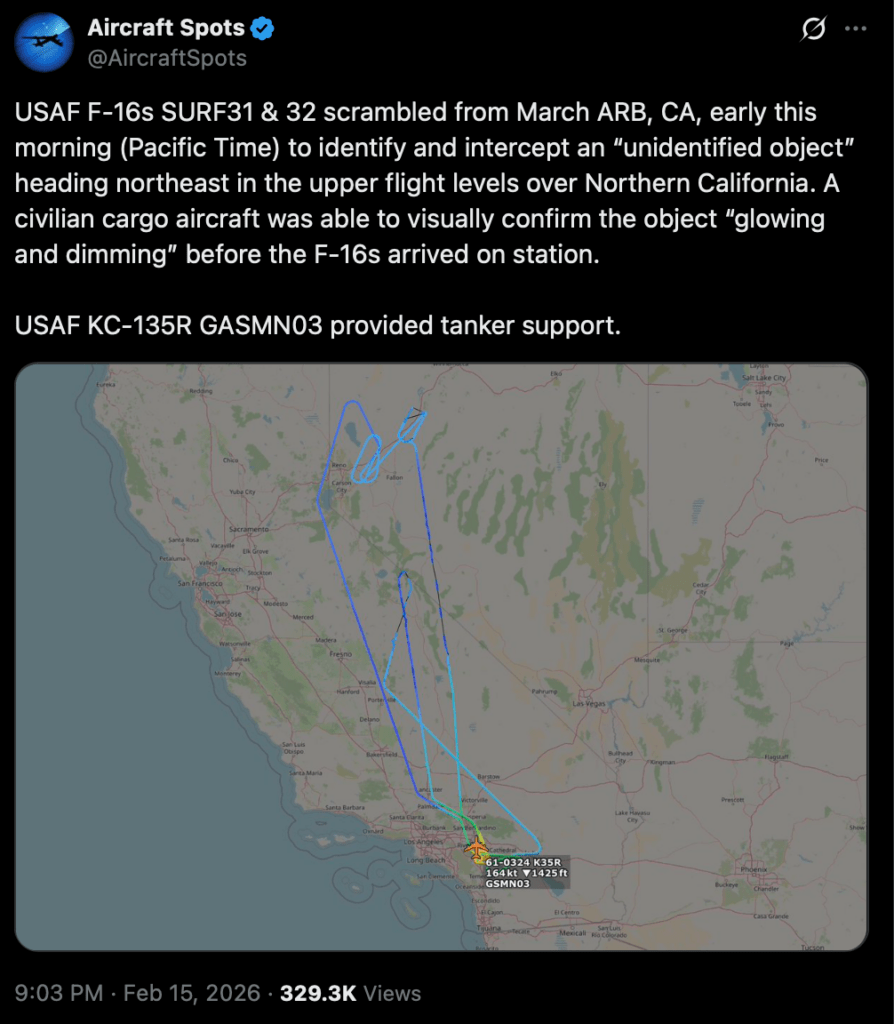
In February 2026, F-16s were scrambled after unidentified objects were reported over Nevada and later northern California. Subsequent reporting indicated that the objects were weather balloons. On the surface that might sound like an embarrassing waste of time and resources. In reality, it shows why these incidents are investigated in the first place. Unknown objects are treated as unknown until they are identified.
That may not be exciting, but it is rational.
If something unusual appears near military airspace, the first question is not whether it is extraterrestrial. The first question is whether it could be a foreign surveillance platform, a drone, a spoofing or jamming event, a missile-related issue, or some other hazard. The Department of Defense cannot ignore such possibilities. It has to respond.
There are three main reasons the DoD treats such reports seriously.
National security
Anything unidentified around military operations has to be assessed as a possible threat until proven otherwise. That is one of the central reasons AARO exists. Its mission includes helping the government detect, identify, and attribute objects of interest near sensitive areas and reduce gaps in intelligence and operational awareness.
That does not mean every strange object is dangerous. It means you do not assume safety before you know what you are looking at.
Flight safety
Even very ordinary explanations can still matter.
A balloon, sensor glitch, satellite reflection, or atmospheric effect can create confusion for pilots, trigger unnecessary responses, or expose weaknesses in training and detection systems. An object does not have to be alien to create a real operational problem. That is why unexplained sightings are still worth investigating even when they later turn out to be mundane.
Reducing intelligence gaps
The government also does not want such reports disappearing into rumor, stigma, or fragmented bureaucracy. Formal reporting structures exist so that sightings linked to military or government activity can be collected, compared, and investigated systematically rather than left to hearsay. AARO was explicitly created to bring more rigor and coordination to that process.
To sum all that up, the DoD investigates UAPs because anything unknown around military operations could be a threat, a safety risk, or a sign that American sensors and defenses are missing something important.
Has AARO found evidence of alien technology? No. It has reported no verifiable evidence of extraterrestrial activity and no verifiable evidence that the U.S. government or private industry has recovered extraterrestrial technology.
What about those mysterious videos released by the DoD?
The famous DoD videos were not released because the Pentagon decided it had proof of aliens. They became famous because they were leaked, then authenticated, then formally re-released by the DoD after years of public attention.
The basic timeline goes like this. Two of the best known clips, usually called FLIR1 and GIMBAL, were pushed into the spotlight by a 2017 New York Times story about the Pentagon’s secretive UFO program; a third, GOFAST, circulated publicly around the same period. The Pentagon later said the three videos had already been circulating after unauthorized releases in 2007 and 2017, and in April 2020 it formally authorized their release “to clear up any misconceptions” about whether the footage was real and whether there was more hidden in the clips.
It is really a mix of military encounters, internal secrecy, outside advocacy, and media amplification. Former defense official Christopher Mellon helped get the videos to reporters, while Luis Elizondo, who had been associated with the Pentagon’s Advanced Aerospace Threat Identification Program, became a public figure arguing that the incidents deserved more serious attention. That is a big part of why the clips landed as a cultural event rather than just obscure military footage.
What made the videos feel so mysterious was that they appeared to show objects behaving oddly on infrared targeting systems, with pilots reacting in real time. But “unidentified” in the official sense did not mean “alien.” It meant the object in the clip had not yet been confidently attributed at the time of release. The Pentagon’s own framing has consistently been about airspace awareness, training-range incursions, and national security, not extraterrestrial confirmation.
What happened afterward is important. AARO has since published a formal case resolution for GOFAST saying that, after detailed analysis, it had no anomalous performance characteristics. AARO assessed with high confidence that the object was around 13,000 feet up and moving in a way consistent with ordinary motion plus viewing geometry and wind effects, not some impossible high-speed craft skimming the ocean.
That does not mean every famous DoD video has been neatly solved in public to everyone’s satisfaction. Some clips remain disputed in public argument, with skeptics pointing to things like parallax, sensor artifacts, autofocus effects, compression artifacts, balloons, or ordinary aircraft, while officials sometimes leave a case unresolved because the data is incomplete. Most analyzed reports turn out to be mundane or non-anomalous, and unresolved cases are usually unresolved because the data is incomplete, not because the objects are exotic.
What has AARO actually established?
This is where the subject becomes much less glamorous than popular culture would like.
AARO may only have been established in 2022, but the U.S. government has had earlier bodies and reporting structures dealing with similar issues. That means there is now a substantial body of official material to review.
And what does that material show?
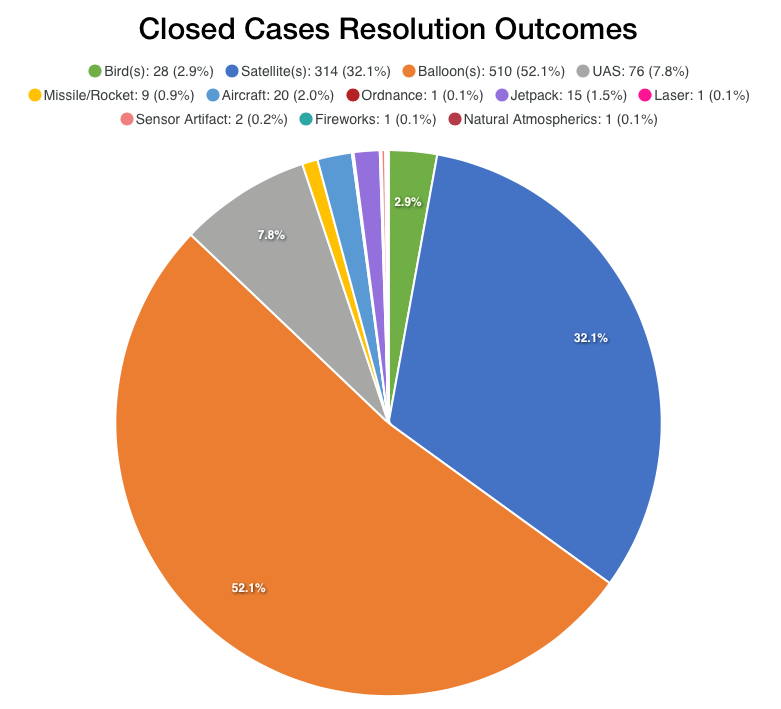
According to AARO’s public reporting trends, the most common explanation among closed cases is balloons, at 52.1 percent. The next largest category is satellites, at 32.1 percent. Together, those two explanations account for 84.2 percent of the closed cases shown in AARO’s current summary.
That is the pattern. Not alien craft, but mostly balloons and satellites.
AARO has published many case resolutions, and they follow much the same pattern. What looks dramatic at first often turns out to have a mundane explanation once the data is analyzed. You can browse those case resolutions on the AARO website.
Of course, AARO still has unresolved cases. But unresolved does not mean extraterrestrial. As I mentioned above, it means the available data is incomplete, poor quality, contradictory, or insufficient to support a confident conclusion.
In March 2024, AARO released its historical review of nearly 80 years of claims about government involvement with UAPs. Its conclusion was blunt. It found no verifiable evidence of extraterrestrial activity and no verifiable evidence of hidden alien retrieval programs. It also said that many of the claims about secret programs appeared to stem from repeated rumors, misidentified national security programs, and circular reporting within a small network of believers.
- Link to the 63-page report: “Report on the Historical Record of U.S. Government Involvement with Unidentified Anomalous Phenomena“
That matters, because one of the most persistent claims in UFO culture is not just that strange things have been seen, but that the government secretly knows far more than it admits. AARO’s review did not support that claim.
For some believers, even official denials become part of the story. The cover up is assumed in advance, which makes the claim almost impossible to falsify. That is one reason the belief can survive even when the evidence remains weak.
Which raises an obvious question: why does belief persist despite the lack of convincing evidence?
Why does the belief thrive?
This is not hard to understand. There are several reasons for it.
An unusual experience can feel deeply real
Many people do have genuine unusual experiences. They see something in the sky they cannot identify, and that experience can feel vivid, personal, and unforgettable. It is easy for “I saw something unexplained” to turn into “there must be something extraordinary behind it.”
Those are not the same claim.
Human perception is imperfect
Distance, speed, darkness, angle, stress, and expectation can all distort what people think they saw. Once memory and interpretation begin filling in the gaps, ordinary objects can start to look extraordinary.
Our brains are pattern seeking machines
Human beings are very good at finding meaning in ambiguous information. When evidence is incomplete, the mind tends to construct a story. And when the culture already supplies a ready made dramatic story, alien visitation is always waiting in the wings.
Secrecy feeds imagination
The military obviously does keep real secrets for wholly valid defense reasons. That makes sense. But secrecy also creates a vacuum, and vacuums get filled with speculation. Once people suspect that something is being hidden, even routine silence can look suspicious.
Popular culture has trained us for this story
For decades, films, television, books, documentaries, and online communities have made UFO narratives feel familiar and plausible. The idea already has a script. So when something odd is seen, many people instinctively slot it into that script.
Is there any truth to the alien claim?
So far, there is no hard and convincing evidence that investigated UAP cases represent extraterrestrial visitors.
That does not mean every report is worthless. It means unexplained is not the same thing as extraterrestrial.
The official pattern so far points in a much more ordinary direction. Balloons. Satellites. Misidentifications. Sensor problems. Incomplete data. Unresolved cases caused by missing information.
That may feel less thrilling than alien spacecraft or beings from another dimension, but it is where the evidence points.
The best approach is still the Sagan standard, which remains one of the clearest rules of critical thinking ever stated:
Extraordinary claims require extraordinary evidence.