

How do you decide what is real?
Sitting between your ears is one of the most powerful pattern-seeking engines evolution ever produced. It is astonishingly useful. It is also sometimes hilariously wrong.
One example of this is encapsulated by just one word – Pareidolia. This is where you see something that you know is not actually there at all. For example seeing a face in a cloud, Jesus on toast, or a human figure in a rock formation. The object is not actually a face or a person, but your brain recognises a familiar pattern and “fills in” the meaning.
It happens because our brains are extremely good at pattern recognition, especially faces. Being able to do this gave humans a distinct survival advantage. Spotting a face, an animal, or a threat very very quickly mattered, and so you are a descendant of people who had the ability to do this. The price we pay for this is false positives.
We are all wired up with this pattern seeking engine, it is the way we are. There is nothing wrong with you and generally most people recognise it for what it really is – an illusion. Where things take a dark turn is when people treat the perceived pattern as strong evidence that something real is there, rather than recognising that the brain is simply imposing meaning on randomness.
Yes, I’m thinking about conspiracy theories, and how some reach such conclusions. However, let’s take this a step at a time.
Words just don’t cut it, so let’s take a look at some fun examples.
You know nothing is there, yet you still see faces or people


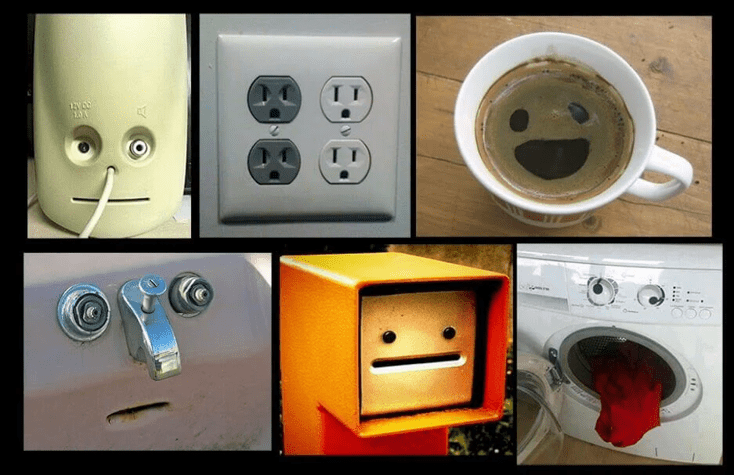

There is another word.
Apophenia
This is a word that describes our tendency to perceive meaningful connections between unrelated things.
Pareidolia is one harmless example of this.
Another aspect of this pattern detection occurs in gambling. People often imagine that they can detect patterns in the lottery numbers, or card games. However, there is no pattern, it really is just random.
The darker aspect is that conspiracy theorists can detect patterns in random data and then pull it all together to spin a narrative. The intent is not to fool you, they sincerely believe the conclusion they have reached.
When you start thinking like this and embrace what you perceive as “truth”, then you have a tendency to be prone to embrace not just one conspiracy but many.
Why is it like this, why do some interpret a pattern in random data and reach the conclusion that there is some dark conspiracy behind it all, and others don’t?
How do you think about things?
When faced with the world around you, do you react to it at a gut level, or do you analyse it?
No one person does just one exclusively, we all do a bit of both.
Analytical and intuitive thinking are two different ways your mind reaches conclusions.
Intuitive thinking is fast, automatic, experience-driven and often emotional. It gives you a “gut feeling” before you can fully explain why. Analytical thinking is slower, deliberate, conscious and more rule-based. It checks assumptions, compares alternatives, does calculations, and tries to justify a conclusion.
A simple example:
You meet someone and instantly think, “I don’t trust him.” That is intuitive thinking. You later ask, “What exactly made me think that? His behaviour? Evidence? Am I overreacting?” That is analytical thinking.
Does this mean that intuition is bad and being analytical is good?
Not at all.
Intuition can be very good when it is built from real expertise in a stable environment. For example, a firefighter, nurse, chess player, or experienced engineer may spot a pattern quickly because they have seen many similar cases before. That is not magic. It is compressed experience. Research on expert decision-making and naturalistic decision-making describes intuition as rapid, experience-based pattern recognition, especially in time-pressured domains.
- Cognitive Research: Principles and Implications: April 2026 – Intuition and deliberation in elite expertise
In other words, “trust your gut” is sometimes good advice and it is also sometimes terrible advice.
A better way to view it all is like this – Intuition is strongest when the situation is familiar, feedback has been reliable, and you have genuine experience. Analysis is strongest when the situation is unfamiliar, high-stakes, emotionally charged, statistical, or easy to misread.
But people who detect patterns in random data don’t just “Trust their Gut” they analyse it.
Analytical thinking is not just “doing logic”
“thinking harder” does not always mean “thinking better.” Sometimes people use their analytical ability to test a belief honestly. Other times they use it to defend a belief they already wanted to keep. In other words, analytical thinking can become reasoning, but it can also become rationalisation.
A recent paper by Wim De Neys reveals this reality. It argues that deliberation should not be treated as one single thing. It can perform several roles: controlling an initial response, generating a new answer, justifying a response, or regulating the whole reasoning process.
- Nature Reviews Psychology – June19, 2025: Defining deliberation for dual-process models of reasoning
The point is this, you may be tempted to think of intuitive thinking as bad and that analytical thinking is good, but the reality is that both can and do fail us.
How it should all work ideally is that your intuitive mind generates quick impressions, warnings, associations and possible answers. Your analytical mind should then decide whether those impressions deserve trust.
For everyday familiar choices, intuition is often efficient. For unfamiliar, high-stakes, emotionally loaded or evidence-heavy decisions, slow down and analyse. For expert work, use both: let intuition flag the pattern, then use analysis to check whether the pattern really fits.
Where does all this fit in with Conspiracy Beliefs?
In conspiracy thinking, the problem is usually not that the person has no analytical thinking. Often they have plenty of it. The problem is that intuition supplies the conclusion first — “something is off,” “they’re hiding the truth,” “that can’t be coincidence” — and analytical thinking is then recruited to defend that conclusion rather than test it.
So the sequence often looks like this:
- Intuition: “This feels suspicious.”
- Pattern detection: “These events must be connected.”
- Agency detection: “Someone powerful must be behind it.”
- Motivated analysis: “Now I will search for evidence that proves it.”
- Identity defence: “Anyone who disagrees is naïve, corrupt, or part of the cover-up.”
Conspiracy beliefs often begin with a fast intuitive reaction. Something feels too strange, too convenient, too threatening, or too emotionally charged to be accidental.
Humans are very good at detecting patterns and agency. Yes we are back to patterns because that plays a key role here.
Where it goes wrong is when the intuitive leap is this: “That can’t be random. Someone planned this.”
But why do some make that specific leap?
Recent research continues to link conspiracy belief with illusory pattern perception and hypersensitive agency detection — seeing deliberate hidden action where the evidence does not justify it. A 2025 British Journal of Psychology paper found that existential threat can increase outgroup conspiracy beliefs, partly through hypersensitive agency detection and illusory pattern perception.
- British Journal of Psychology, Aug 2025: Why existential threats increase conspiracy beliefs: Evidence for the mediating roles of agency detection and pattern perception
In plain English: when people feel threatened, they become more likely to see enemies, plots and hidden coordination.
A conspiracy theory can feel satisfying because it turns confusion into a story.
That is psychologically attractive. It gives the believer a villain, a plot, and a sense of special insight. A 2025 review argues that conspiracy theories should not be understood only as cognitive defects, but also as cultural tools people use to make sense of uncertainty, threat and their place in society.
- Current Opinion in Psychology, volume 68, April 2026: Conspiracy theories through the lens of collective memory
When faced with a wacky conspiracy theories you may indeed be tempted to remedy things with a few facts. You will quickly discover the teflon coating that appears to render the conspiracy theorist immune to such information.
Why?
Because the conspiracy belief is not just an error or misunderstanding of facts. It is often a way of managing anxiety, distrust and identity, and your “facts” threaten to disrupt that, hence are rejected.
What has gone wrong with the Analytical Thinking?
Analytical thinking should ask:
- “What evidence would prove this wrong?”
- “What is the simpler explanation?”
- “Am I counting misses as well as hits?”
- “Am I relying on a source that has repeatedly misled me?”
- “Does this claim require hundreds of people to remain silent?”
- “Is this actually evidence, or just suspicion?”
But conspiracy thinking often uses analysis differently. It asks:
- “How can I make this fit?”
- “What else can I find that supports it?”
- “How do I explain away contrary evidence?”
- “Who benefits?”
- “Why would they deny it unless it was true?”
That is not open inquiry, but instead is what is termed motivated reasoning.
This is why conspiracy theorists can produce long threads, charts, timelines, screenshots, “just asking questions” posts, and elaborate pseudo-investigations. The volume of reasoning can look impressive, but the direction is wrong. The conclusion is protected from falsification.
Real analytical thinking will change its mind when the evidence fails. Conspiracy thinking changes the conspiracy when the evidence fails.
For example, you will encounter goal post movements like these …
- “The date was wrong because they changed the plan.”
- “The whistleblower disappeared because they got to him.”
- “The documents proving nothing happened are part of the cover-up.”
- “The lack of evidence proves how powerful they are.”
- etc…
In other words, conspiracy theories can never fail.
There are real conspiracies
Real conspiracies exist. Watergate, corporate cover-ups, illegal surveillance, price-fixing, abuse scandals (yea you know immediately which one I mean).
The difference is that real investigations move from suspicion to evidence. Bad conspiracy thinking moves from suspicion to certainty without passing through proper evidence.
Conspiracy theorists often go wrong because intuition gives them a suspicion, and then analysis is used to defend the suspicion rather than test it.
This is not about human stupidity, instead when thinking is distorted by threat, distrust, identity, selective scepticism, pattern over-detection, and motivated reasoning, then it opens the door to falling down the rabbit hole.
What can you actually do when faced with a weird conspiracy claim?
Don’t attack, but instead explore the claim with respect (and that really will take a lot of discipline). Even if the claim is absurd, the person may have arrived there through fear, distrust, loneliness, anger, or a desire to feel informed. Mockery will not help …
- “I can see why that sounds suspicious.”
- “I agree there are real examples of governments and companies lying.”
- “I’m not dismissing you — I’m just not convinced this particular claim follows from the evidence.”
Ask questions that gently nudge the person into analytical and reflective thinking …
- “What would convince you this claim was wrong?”
- “What is the strongest evidence against it?”
- “How reliable has this source been before?”
- “Is there a simpler explanation?”
- “Are we looking at evidence, or are we interpreting suspicious gaps?”
- “If this were false, what would we expect to see?”
There is real evidence that this can help. Experimental work suggests activating reflection can reduce conspiracy belief …
- Cognition, May 2025: Reflection predicts and leads to decreased conspiracy belief
I already covered this next bit, but for completeness here it is again. Don’t dump a mountain of facts on people, it is not going to work. It comes across as an attack and motivates people to be defensive.
You can also move people away from absolutes …
- “On a scale from 0 to 100, how confident are you?”
- “What would move you from 90% to 70%?”
- “Is this the most likely explanation, or just one possible explanation?”
This lowers the emotional stakes. You are not asking them to humiliate themselves by saying “I was wrong.” You are inviting them to become slightly less certain. That is often far more achievable.
People resist changing their minds when the only available option is public humiliation. However, if you give them a dignified way out then that is a potential off-ramp …
- “I don’t think you were stupid to wonder about it.”
- “A lot of these claims are designed to sound persuasive.”
- “I can see how someone could get pulled into that.”
- “I’ve believed things before that didn’t hold up either.”
There is also one very important point, be aware that there comes a point at which it may be wise to stop. If the person is angry, performing for an audience, or jumping between claims, it is best to stop.
“I don’t think we’re going to settle this right now. I’m happy to look at one specific claim with you later, but I don’t want us to fall out over it.”
That preserves the relationship and avoids turning the belief into a loyalty test.
Let’s sum all that up.
Stay calm, preserve dignity, ask reflective questions, examine one claim at a time, and help people to move from certainty to doubt.
If somebody goes from “This is definitely true.” to “I still think something is off, but maybe that specific claim is weaker than I thought.”, then take the win.
One final bit of Human Weirdness
I brought you on a bit of a journey there, and if you have stuck with it to here, then many thanks.
Let’s now chill a bit and finish on a fun story.
Back in 1961 Yuri Gagarin was on the bus taking him to the launchpad for his famous flight. Seriously now, if you don’t know who he is, go google his name.
What is not so well-known is that he insisted that they needed to stop the bus right there because he just had to take a piss. So they stopped the bus, and he got out and urinated by the rear-right wheel. As we all now know the mission was a resounding success. Because it was it became a solid tradition for every Cosmonaut on every flight from Baikonur to do this as a good luck ritual.
Since that first flight literally every Cosmonaut has done this, and that includes NASA astronaut Scott Kelly who launched from there. He describes it and also took part.
Not all Cosmonauts are guys, so how does that work?
Female crew members participate by bringing a vial/container of urine and pouring it on the tyre.
Utterly weird, totally irrational, and yet in many ways also so very human. When you understand the engineering and truly appreciate everything that just might go wrong, then nobody was willing to tempt fate by breaking the now firmly established pattern.
That does not make cosmonauts stupid. It makes them human. Even highly trained people operating at the edge of science and engineering still carry pattern-seeking, ritual-making minds with them.
As a species we can at the best of times be a rather weird lot.