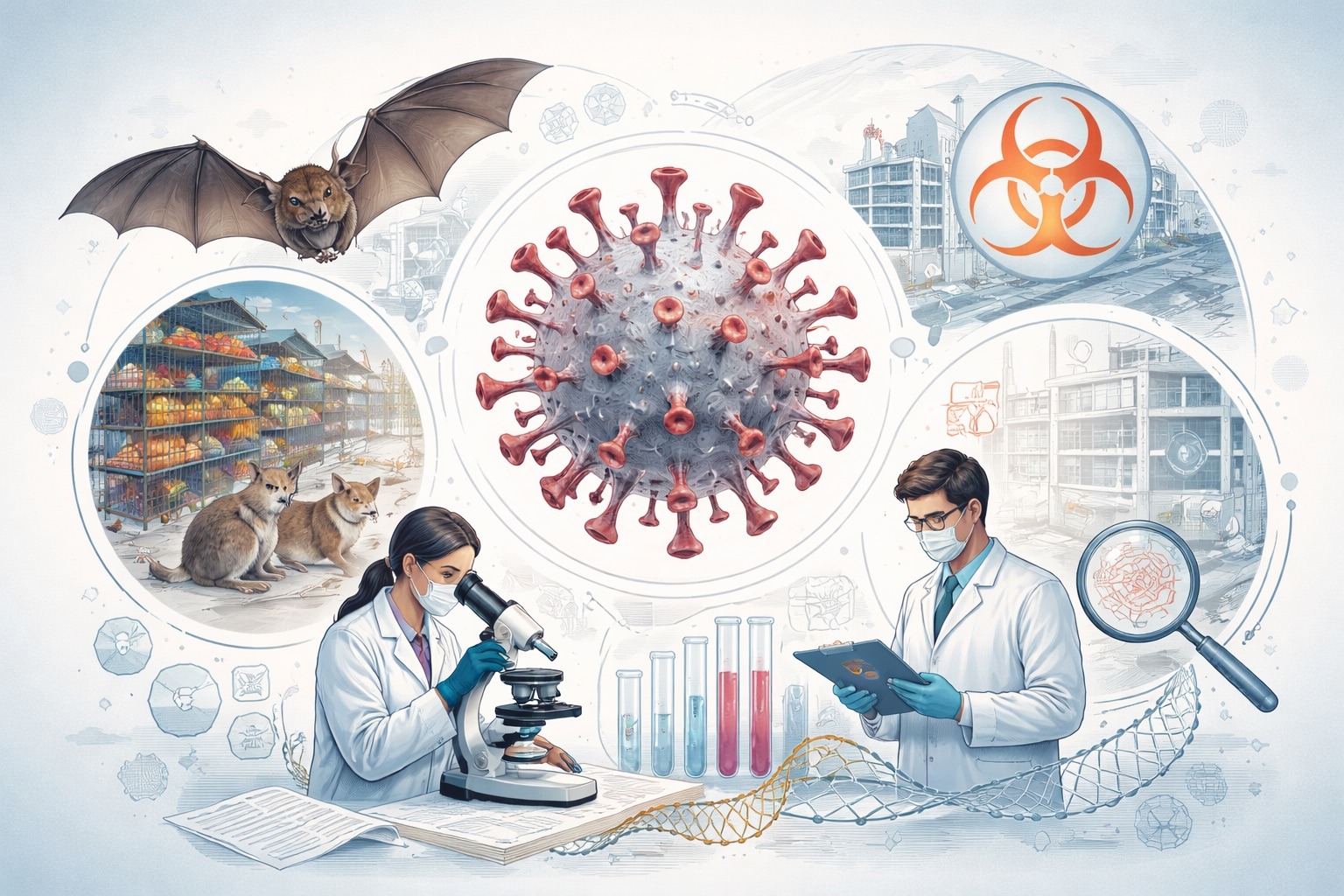
Few scientific questions have generated as much argument as the origin of COVID. Some people are convinced it must have come from a laboratory. Others insist it was clearly a natural spillover from animals. There have even been accusations that Anthony Fauci is personally responsible and should be put on trial for genocide.
It is also understandable why many people asked whether a laboratory accident could have been involved. Wuhan is home to one of the world’s leading research centers studying bat coronaviruses, and the pandemic began in the same city. When events like that coincide, it is reasonable to ask questions. The challenge is that answering those questions requires careful examination of the scientific evidence rather than speculation.
The problem is that such debate often takes place on social media or cable news rather than in the scientific literature.
Scientists approach the question very differently. Instead of starting with a preferred conclusion, they ask which explanation best fits all of the available evidence.
That is exactly what the World Health Organization’s Scientific Advisory Group for the Origins of Novel Pathogens did. Between 2021 and 2025 a panel of international experts reviewed the available research and compared the competing explanations for how SARS-CoV-2 first entered the human population.
What is the History here?
Between November 2021 and June 2025 this group of subject matter experts pored through the details of published scientific papers and reports, not to score political points, but to really understand what happened.
Understanding the origins of SARS‑CoV‑2 and how it sparked a pandemic is needed. With such an understanding comes an insight that will help to prevent future pandemics, save lives and livelihoods, and reduce global suffering.
Their report runs to over 75 pages. You can access a copy of it via the WHO website …
- WHO June 2025: Independent assessment of the origins of SARS‑CoV‑2 – Developed by the Scientific Advisory Group for the Origins of Novel Pathogens (SAGO)
- PDF here
What is also rather important is the availability of this in multiple languages.
What possible options were considered?
You can most probably take a guess, and get most, if not all of these …
- Hypothesis one: animals infected with SARS-CoV-2 passed the virus to humans
- Hypothesis two: SARS-CoV-2 was introduced into China’s animal markets from overseas through imported goods
- Hypothesis three: SARS-CoV-2 originated from an accidental lab-related event
- Hypothesis four: SARS-CoV-2 originated from the deliberate manipulation of a virus in a lab
So what is the current position on all this, do we have any clarity?
Yes, we do.
It comes via the report from last June, and also via a recent article published within Nature on Feb 26, 2026 by most of the authors of that report that sums it all up.
Let’s briefly review each of the four Hypothesis in turn.
Hypothesis one: animals infected with SARS-CoV-2 passed the virus to humans
Key Insight: This is where most of the peer-reviewed scientific evidence points to, and supports this hypothesis.
Why this one, what leads to this conclusion?
I’ll sum it up here and also directly quote from the Nature article written by the subject matter experts.
It appears to have originally come from Bats. Closely related ancestral strains have been found in horseshoe bats. Also …
Another strain called BANAL-52, which shares 96.8% of its genetic code with SARS-CoV-2, was identified in 2020 in Laos. This suggests that similar strains circulating in bats in China or southeast Asia might have spilled over to intermediate animal hosts or directly to humans.
It came via the Huanan Seafood Market in Wuhan …
More than 60% of the known earliest human cases in December 2019 involved people who worked at the market, made purchases there, lived near it or had some other epidemiological link with it
If a virus begins spreading from animals sold in a market, the earliest infections should cluster around that market. That is exactly the pattern researchers found in Wuhan in December 2019.
Two distinct variations were identified from early Huanan Seafood Market samples, hence, “This supports the idea that the virus had already been evolving in animals before it reached the market“. This suggests multiple spillover events from animals into humans rather than a single human source.
The market had intermediate animal hosts …
Metagenomic sequencing of environmental samples collected at the market has indicated that several wildlife species had been there before it was cleaned and sterilized on 1 January 2020 by the Chinese authorities in response to the outbreak. These include raccoon dogs (Nyctereutes procyonoides), hoary bamboo rats (Rhizomys pruinosus) and palm civets (Paguma larvata), all of which are known to be susceptible to the early strains of SARS-CoV-2. These animals could have been the intermediate hosts that brought the virus to the market, leading to the early cases in humans
Researchers found genetic material from SARS-CoV-2 in several locations where wildlife had been sold. Some of these samples also contained DNA from raccoon dogs, an animal known to be capable of carrying coronaviruses. This does not prove the exact animal that carried the virus into the market, but it does strongly support the idea that infected wildlife was present at the same locations where the earliest human infections appeared.
Taken together with the early clustering of cases around the market and the presence of susceptible wildlife species, this pattern is exactly what scientists expect to see when a virus spills over from animals into humans.
Finally, there is no verified evidence of COVID prior to Dec 2019 …
there is no verified evidence of the existence of human or animal cases of SARS-CoV-2 infection anywhere else before December 2019. There were retrospective reports of one or two possible cases occurring in November 2019 in Italy and France, and of the virus being detected in a wastewater sample (also in November that year) in Brazil. But in all instances, the positive test results could not be confirmed by independent labs
Hypothesis two: SARS-CoV-2 was introduced into China’s animal markets from overseas through imported goods
Chinese authorities promoted this explanation as a possible origin.
Early investigations, including the 2021 WHO–China Joint Study and a 2022 report by the WHO’s Scientific Advisory Group for the Origins of Novel Pathogens, said more evidence would be needed to support this idea. In 2023 the Chinese government promoted this explanation as the most likely origin.
However, researchers now conclude that the available scientific evidence does not support this hypothesis. Although traces of the virus were found on frozen products, these detections occurred months after the pandemic had already spread widely among humans. At that stage, contaminated surfaces could easily have come from infected people rather than the products themselves. There is also no evidence that frozen goods transmitted the virus to humans at the Huanan Seafood Market, at other Wuhan markets, or anywhere else at the start of the outbreak.
In short, the “imported frozen goods” explanation lacks supporting evidence and is not considered a likely origin of SARS-CoV-2.
Hypothesis three: SARS-CoV-2 originated from an accidental lab-related event
This is where things become very political.
The hypothesis that SARS-CoV-2 began with an accidental laboratory event cannot currently be fully assessed because key information has not been shared. The World Health Organization and its Scientific Advisory Group for the Origins of Novel Pathogens (SAGO) have repeatedly asked China to provide data such as health records of laboratory staff, biosafety protocols, and inspection reports from research labs in Wuhan, including the Wuhan Institute of Virology. According to the authors, this information has not been provided. China states that it has already shared all relevant data and suggests that investigations should also examine laboratories in other countries.
Most scientific reviews still favor a natural zoonotic origin and have found no conclusive evidence supporting a lab leak. Intelligence reports from various governments offer mixed conclusions and typically express only low or moderate confidence in either hypothesis. The authors argue that many of these reports rely on speculation rather than concrete evidence.
Overall, the lack of full transparency means the lab-related hypothesis cannot be ruled out or confirmed, and the authors say further independent investigation and access to additional intelligence reports are needed.
Hypothesis four: SARS-CoV-2 originated from the deliberate manipulation of a virus in a lab
Scientists examined whether SARS-CoV-2 could have come from a virus deliberately engineered in a laboratory using techniques such as reverse genetics. After reviewing the genome structure and relevant research, they found no evidence that experimental manipulation is a more likely explanation than natural evolution.
Coronaviruses in the same family as SARS-CoV-2 commonly evolve through natural mutation and recombination, where related viruses exchange genetic material when infecting the same host. This process often produces “mosaic” genomes, which SARS-related viruses frequently show.
Research has also identified several bat coronaviruses from Laos (such as BANAL-52) that are already capable of infecting human cells through the ACE2 receptor, suggesting that viruses with similar capabilities existed in nature before the pandemic.
Although SARS-CoV-2 contains a furin cleavage site (RRAR) that helps the virus enter cells, similar features appear in other coronavirus groups and can arise naturally through recombination. Therefore, its presence is not evidence of laboratory engineering.
Another important point comes from the genetic record itself. When scientists examine the genome of SARS-CoV-2, they do not find signs that it was assembled from known laboratory strains. Instead, its closest relatives are viruses that have been discovered in bats in Southeast Asia. If the virus had been created or heavily modified in a laboratory, researchers would normally expect to see genetic traces linking it to previously studied viruses or laboratory backbones. No such evidence has been found. Instead, the virus fits naturally into the broader family tree of bat coronaviruses that have been circulating in wildlife for decades.
Bottom line: Current scientific evidence does not support the idea that SARS-CoV-2 was deliberately engineered in a lab. Natural evolutionary processes remain the more plausible explanation based on the available genetic data.
There were also other claims
A widely promoted claim was that SARS-CoV-2 was created through U.S. research proposals, particularly the 2018 DEFUSE grant proposal submitted by EcoHealth Alliance with collaborators at the University of North Carolina and the Wuhan Institute of Virology.
While this was not a serious hypothesis proposed by a knowledgeable epidemiologist, they still decided to take a look at it because it was being promoted widely and weaponised for political reasons to discredit scientific experts. This was central to many of the accusations used to attack Anthony Fauci.
After examining the proposal and related research, the investigators concluded that these claims are based on misinterpretations and speculation. The DEFUSE proposal involved studying coronavirus proteins and developing non-replicating vaccine components, not creating or releasing live engineered viruses. The genetic elements mentioned in the proposal also do not match the viral lineage of SARS-CoV-2, making it scientifically implausible that the pandemic virus came from this work.
In addition, the DEFUSE proposal was never funded, and other research proposals cited in lab-origin theories used safe, non-replicating vaccine technologies that only present a single viral protein. Finally, experiments using SARS-CoV-2 in animals only began after the virus was identified in 2020, meaning they could not have caused the initial outbreak.
Bottom line: The reviewed evidence indicates that theories linking SARS-CoV-2 to the DEFUSE proposal or related U.S. laboratory research are based on misunderstandings and are not scientifically supported.
Here is the argument used …
- Fauci funded risky coronavirus research: As head of the National Institute of Allergy and Infectious Diseases (NIAID), Fauci oversaw grants that went to EcoHealth Alliance, which collaborated with the Wuhan Institute of Virology.
- That research allegedly involved “gain of function” work: Opponents claimed the research involved engineering coronaviruses to become more dangerous and that this work could have created SARS-CoV-2.
- The DEFUSE proposal was cited as supposed evidence: Commentators pointed to the 2018 DEFUSE proposal submitted to DARPA as proof that scientists planned to engineer a coronavirus similar to SARS-CoV-2.
- The narrative that followed: The claim became that U.S.-funded scientists created the virus and that Fauci either funded it, covered it up, or lied about it.
However, as highlighted by a deep dive into all this, if you dig into the precise details, then it all falls apart. For example, DEFUSE was never funded by DARPA. The proposal described protein studies and non-replicating vaccine approaches, not creating SARS-CoV-2. The viral genetic components in the proposal do not match the lineage of SARS-CoV-2. The experiments cited in conspiracy theories did not involve the pandemic virus before it appeared in 2019.
To some it feels credible, yet when seriously considered the conclusion is that the … “claim rests largely on misinterpretations of the proposal and of how coronavirus research works.“.
Bottom Line
Science asks which explanation best explains all the data.
Some readers may still wonder whether a laboratory accident could have played a role. That question is understandable. Wuhan is home to laboratories that study bat coronaviruses, and it is reasonable to ask whether such work could somehow have intersected with the outbreak. However, when researchers examine the available genetic evidence, the early epidemiological patterns, and the wildlife trade linked to the Huanan market, the natural spillover explanation consistently fits the data more closely than the laboratory scenarios that have been proposed.
What the available evidence reveals is this pattern
- previous coronavirus outbreaks (SARS-1, MERS)
- wildlife markets acting as spillover points
- bat coronavirus diversity in Southeast Asia
- genetic features consistent with natural evolution
In other words, natural zoonotic origin is currently the most supported explanation. As with many questions in science, the conclusion reflects the balance of evidence rather than absolute certainty.
The most important lesson from this investigation is not about assigning blame. It is about understanding how pandemics begin. If SARS-CoV-2 emerged from wildlife trade, as the evidence strongly suggests, then reducing risky animal markets and improving surveillance of emerging viruses will be essential for preventing the next pandemic.