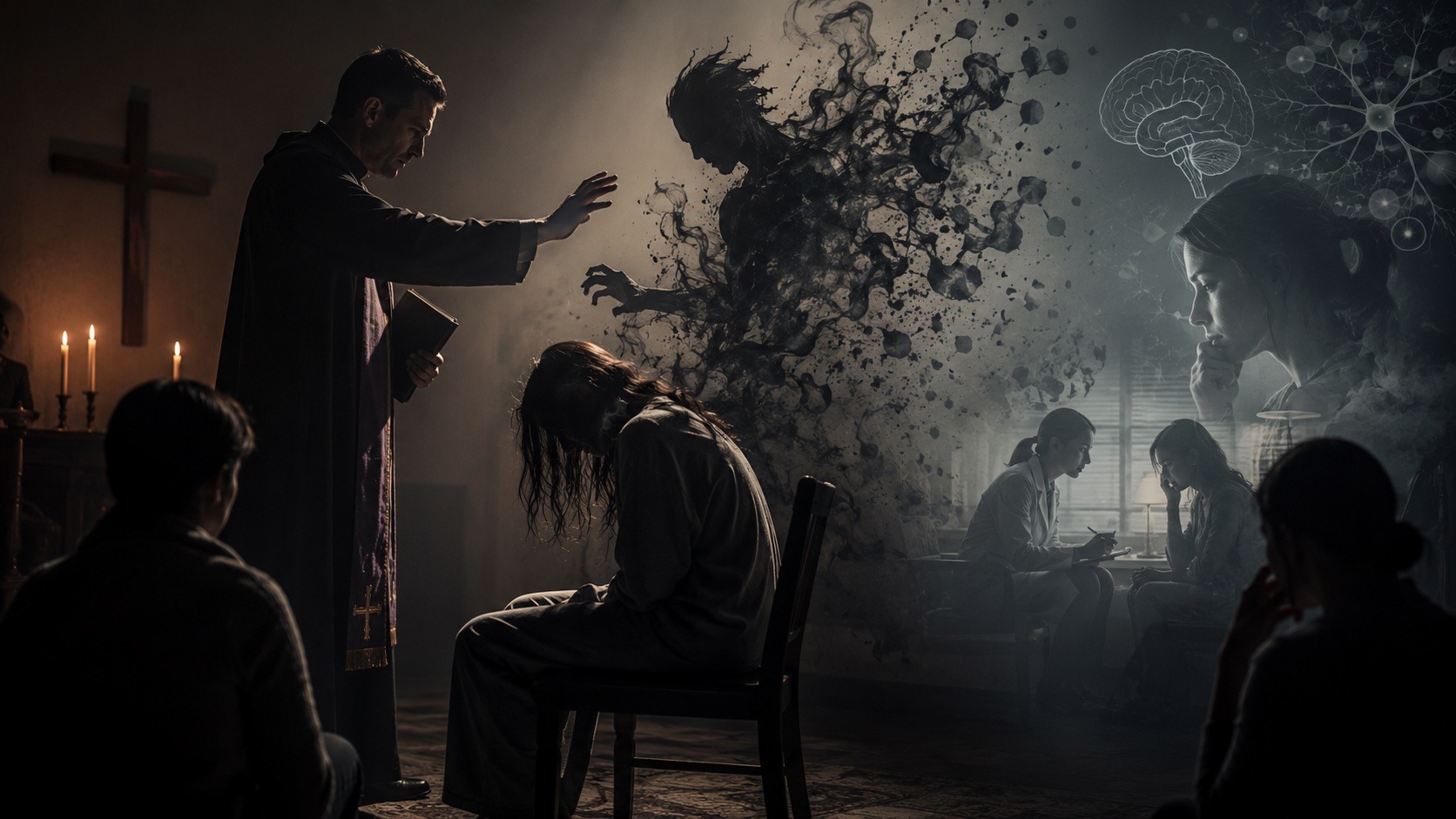
A couple of months back representatives of the International Association of Exorcists (AIE) asked Pope Leo XIV to ensure that every Catholic diocese worldwide has “one or more” trained exorcists.
There is one small issue here, demons are not real, so why would they propose this?
Let’s briefly turn to the media article reporting this …
…During the half-hour meeting, the AIE presented the pope with a detailed report warning of a “painful and increasingly widespread situation of people seriously affected by the extraordinary action of the devil as a result of their involvement in occult sects,” according to a statement released after the meeting….
…the AIE called for expanded formation at multiple levels of Church life: instruction in seminaries on the “real existence and nature of the demonic world”…
(Deep Sigh! garnished with a bit of an eye roll from me)
Exorcism is often defended as spiritual care. The problem is that when it replaces medical or psychological help, people can be seriously harmed.
There is no good evidence that demons exist.
I’ve covered all this before. It is perhaps one of humanity’s perpetual rubber ducks that will persist and never go away, and so it is appropriate to go over it all once again.
It is not just Catholicism. Many belief systems claim that unseen hidden supernatural entities are real and explain that they are fallen angels or simply spirits that can manifest or possess humans. Going hand-in-hand with this is also the concept of exorcism, not just as a horror movie trope, but as something that some really do attempt to practice.
What I have personally seen
As a teenager I was part of a pentecostal church. You can think of it as a happy clappy setup with supposedly supernatural stuff such as speaking in tongues being part of a “normal” meeting cycle.
Within that context I also saw many exorcisms. For those inside, it was all quite real and often involved people writhing around on the floor screaming while the demon was cast out. Picture in your mind the pastor standing over shouting “In the name of Jesus, I command you … “, and you will have grasped the image of the religious theatre.
But wait now, if demons do not exist, then what was happening? It all leads to a few obvious questions.
Was it a scam or did the pastor truly believe in it all?
In my own experience, the answer to that is yes, he truly and sincerely did believe that he was successfully casting out demons, he was not faking it.
What about those that he was casting demons out of, were they pretending, or did they really think they had been exorcised, and that they had been released?
Again, as best as I could tell, they also did indeed appear to be quite sure that they had been freed from a demon.
We need not question their sincerity.
About here is potentially the point at which those who truly believe this is all real, just might start posting comments along the lines of, “But I know it is real, I have seen it myself“.
As I’m illustrating here, I have also “seen” such things and I can assure you that nothing supernatural is going on, and that instead it was all psychological. When faced with that, those who believe might accuse me either of being possessed by a demon or of lying. That would be my cue to roll my eyes, and with a flourish the believer might then point and shout, “Look, see what the demon is doing to him now, there is your proof“. In response many others would facepalm, and be greeted in return by the shout of “Oh look, more demons“.
If this all sounds a bit like a Monty Python sketch, then you would indeed perhaps be correct, it can at times be that weird.
What really happens inside the Faith bubble
Having been inside the bubble I can add a few additional observations. What follows are simply anecdotal and based upon what I observed, so should perhaps be digested with a pinch of salt. Belief is vastly diverse.
The Demon of …
The pastor would often declare that Person X had a specific type of demon. For example, “Oh that guy I was just talking to clearly has a drinking demon in him“, or “The issue this chap faces is that he is possessed by a drug demon“, and so on. In other words, whenever faced with somebody who had what he perceived to be issues, he would apply a one size fits all solution, and tag the problem as a case of possession that caused whatever it might be. It was in some senses attractive to some. No longer did they have to take responsibility for their own actions, it was now the fault of a demon, and so supposedly getting rid of that wiped the slate clean.
It did in one sense work for some because it gave people a strong emotional reason for a fresh start.
Theatre
Repeat performances were common. Whenever there was a meeting in which emotions ran high, somebody might end up having a demon cast out. What was deeply weird is that it often turned out to be the most religious and devout. It did lead me to wonder why these “born again” individuals appeared to have a life that operated like Grand Central Station for demons, while the doubters remained untouched. What was even stranger is that it was very much one specific pastor who was into this demon stuff diagnosing them that way. Others counselling the same individuals encountered no such issue.
Yes, the penny dropped for me. The real revelation is that it was all BS.
Exorcism In Action
A typical exorcism would involve somebody yelling and shouting in response to being prayed over. They would then be held down while the pastor proceeded to do the exorcism. Dismiss all the movie scenes you might have watched that involved clerics reciting Latin and heads spinning, it was a lot simpler. The pastor would proceed to yell something along the lines of “In the Name of Jesus, I cast you out“. If that failed and the screaming persisted, which was often the case, he simply kept going with more of the same until whoever was being exorcised stopped the hysterics. That was deemed to be a sign of success.
Not what he thought it was
I recall one “brother”, telling a few of us how he had cast a demon out of some chap at work. As he described what had happened it became blindly clear to me that his victim had simply had an epileptic seizure. This “brother” appeared to be totally oblivious to what had actually happened and was quite convinced he had helped by casting out a demon.
It is in the Bible
Much of what happens within Christianity is socially acceptable within the various strands of belief because it is in the Bible. There Jesus is described as casting out demons and also directs his followers to do the same. Here is the quote …
28 When he came to the other side, to the country of the Gadarenes, two demoniacs coming out of the tombs met him. They were so fierce that no one could pass that way.
29 Suddenly they shouted, “What have you to do with us, Son of God? Have you come here to torment us before the time?”
30 Now a large herd of swine was feeding at some distance from them.
31 The demons begged him, “If you cast us out, send us into the herd of swine.”
32 And he said to them, “Go!” So they came out and entered the swine; and suddenly, the whole herd rushed down the steep bank into the sea and perished in the water.
— Matthew 8:28–32
And also …
Then Jesus summoned his twelve disciples and gave them authority over unclean spirits, to cast them out, and to cure every disease and every sickness.
— Matthew 10:1
Many who read these verses will embrace them as a guideline. People attempt to practice the casting out of demons because “the Bible says so”.
This can only lead you to wonder if people would go around picking up deadly snakes if the Bible told them to do so.
Oh Wait!
Well yes, it does, and so some people do, and they end up getting bitten and die.
Side Note: That verse in Mark 16:17-18 regarding picking up deadly snakes was not in the original, it was a later addition.
It is Not Just Christianity
There is something akin to the concept of possession and being released from it within most belief systems. That observation might lead some to conclude that there is something to it all, and that it just might be real. This however is really all about humans trying to not only explain, but to also deal with things that are often beyond their understanding.
Mental illness is real. Human beings do suffer from things that would in the past have been identified as demons. In every case of supposed possession, you will discover that we now do have a far better understanding of what is actually happening. Specifically, …
- hysteria
- mania
- psychosis
- Tourette syndrome
- epilepsy
- schizophrenia
- conversion disorder
- dissociative identity disorder
- etc…
Each and every one of the above would have, in the not too distant past, motivated humans to call for a cleric or priest. Those suffering would have found an explanation and some relief. For those witnessing it all, it would have not only confirmed their religious belief, but also led them to believe that they understood what had been happening. It brought comfort and perhaps some resolution, but was not really explaining what was going on in a manner that we would now understand.
To be 100% clear here, Demon Possession is not a recognised condition within DSM-5. No modern psychiatrist (except perhaps a deeply religious one) would seriously diagnose it, not because they refuse to recognise the “truth”, but instead because there are far better explanations.
What does Science Say about all of this?
There has been some meaningful scientific and academic research.
Here is a quick tour.
Psychiatry studies “possession” experiences as symptoms or culturally shaped conditions.
There is clinical literature that discusses possession-like states in relation to dissociation, psychosis, trauma, epilepsy, schizophrenia, and “possession trance disorder.” (PTD).
One 2022 clinical case study followed a person diagnosed with possession trance disorder (PTD) and warned that a supernatural framing can sometimes discourage professional treatment:
- Front Psychiatry, May 26, 2022: Trapped Between Theological and Medical Notions of Possession: A Case of Possession Trance Disorder With a 3-Year Follow-Up – This study shows that receiving a PTD diagnosis can reinforce patients’ beliefs about supernatural causation of symptoms and discourage professional treatment.
Given the above, then this next item is perhaps to be expected.
Researchers study how belief in possession affects help-seeking.
A Frontiers in Psychology study on people with schizophrenia explored how patients came to believe they were possessed and how that shaped whether they sought psychiatric or religious help:
- Frontiers in Psychology, March 19, 2021: Delusions of Possession and Religious Coping in Schizophrenia: A Qualitative Study of Four Cases
There is of course lots more.
Social scientists and anthropologists study exorcism as a real cultural practice
There are academic books and ethnographic studies on Christian exorcism, including how exorcists, priests, patients, families, and medical professionals interact. For example, Springer has a volume called The Social Scientific Study of Exorcism in Christianity.
- Link (2020, Yes sorry, paywall on this one)
Beyond what happens now, researchers are also interested in what has previously happened.
Historical “possession” cases.
A 2024 interdisciplinary review describes 52 documented possession cases from literature between 1890 and 2023, looking at psychology, medicine, anthropology, and theology.
- Journal of Scientific Exploration, Dec 28, 2023: Interdisciplinary Review of Demonic Possession Between 1890 and 2023: A Compendium of Scientific Cases
The key insight is this: scientific and clinical literature has documented possession-like experiences, but it explains them through culture, psychology, neurology, dissociation, trauma, suggestion, social pressure, and mental health. To date, it has not demonstrated supernatural causation.
In fact, I would go as far as stating this: the number of credible scientific papers within reputable science journals that have ever verified anything supernatural is exactly zero.
Fatal Cases
When an exorcism goes wrong, it often turns a spiritual practice into a devastating medical emergency, tragic abuse, or fatality. Here is a quick summary of some rather infamous examples:
- Anneliese Michel (1976): A young German woman suffering from severe epilepsy and psychosis underwent 67 intense rites of exorcism over a year. Her priests and parents stopped her medical treatment, resulting in her death from starvation and severe dehydration.
- Terrance Cottrell (2003): An eight-year-old autistic boy in Wisconsin suffocated to death during a church prayer service intended to drive out evil spirits. The pastor sat on the boy’s chest until he stopped breathing and was convicted of homicide.
- The Mast Family (2020): In Arkansas, a four-year-old girl was brutally beaten, submerged in a freezing pond, and left to freeze to death by her mother and neighbors. The family claimed it was a religious episode to remove demons.
All notable because they made the news.
Conclusion
The bottom line is simple. People who are treated as “possessed” need medical, psychological, or social support. When religious certainty replaces proper care, the result can be neglect, abuse, or death.
It is time to put these superstitious practices away. Those who believe possession is real should ask themselves why they accept that explanation while dismissing far more reasonable, evidence-based alternatives.