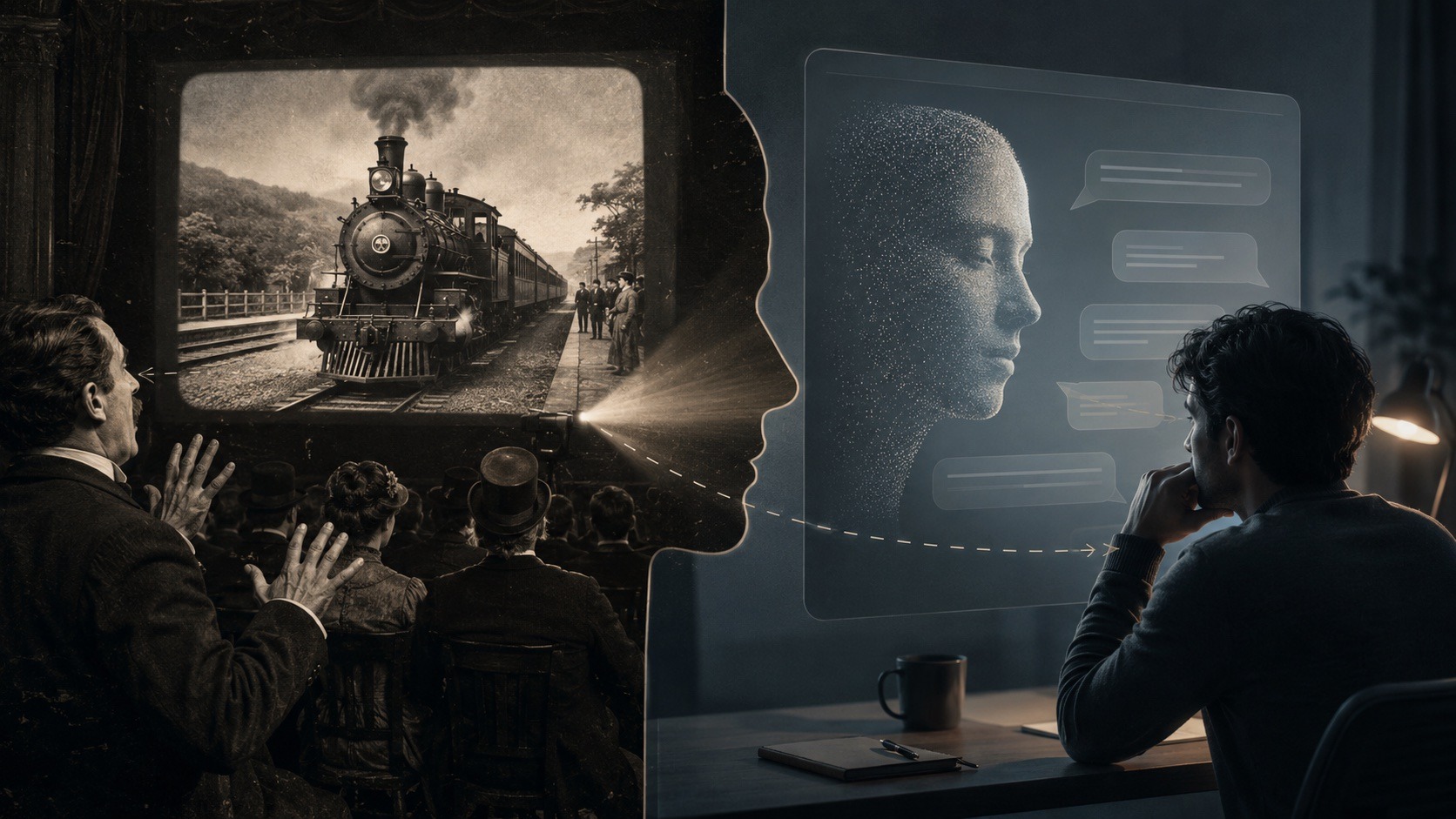
In 1895 the Lumière brothers shot a 50-second silent documentary. It famously captured a steam locomotive pulling into a station. Titled “L’Arrivée d’un train en gare de La Ciotat“, it was first shown to the public in January 1896 in Lyon. A rather popular story is that when the film was first shown, the audience was so overwhelmed by the moving image of a life-sized train coming directly at them that people screamed and ran to the back of the room. That story is mostly myth, because there is no evidence of mass panic caused by the film, but some who attended really did describe being frightened by the sight of the train.
It was an understandable reaction. Those frightened people were not ignorant peasants, they were smart modern humans who had never experienced anything like this.
- Wikipedia page on the myth and what is known to be true is here.
- You can find the clip of it here on YouTube
This, of course, is a post about the recent claim that AI may now be conscious.
Faced with what AI can now do, some people are startled, some are frightened, and some have concluded: “this creature is conscious.”
Is it?
Spoiler TL;DR; No.
Let’s dive in.
Dawkins Meets Claude
Many have written rebuttals to his recent article, but let’s bypass it all and take a look at what he actually wrote.
On May 2, 2026 evolutionary biologist Richard Dawkins published an article in UnHerd titled “When Dawkins met Claude Could this AI be conscious?“
Interestingly enough the title has changed, it was originally titled “Is AI the next phase of Evolution? Claude appears to be conscious“. The title appears to have been toned down.
Many who criticised his article were responding to that initial version, but if you read it now then things have clearly become a bit more nuanced. He still appears to strongly suspect, or is emotionally and intellectually inclined to believe that systems like Claude may be conscious, but he is also framing it as an open philosophical challenge rather than a settled scientific conclusion.
Buried within you find him exclaiming to Claude, “You may not know you are conscious, but you bloody well are!”. That feels conclusive, but later his turn of phrase softens it to, “If Claudia really is unconscious…“, and he also appears to be exploring alternative explanations.
OK, let’s dig in and explore some of the key details that we should push back against.
The Turing Test Is Not a Consciousness Test
He opens with a brief description of The Turing Test and lays it out like this …
Modern commentators have tended to ignore the (incidental) details of Turing’s original game and rephrase his message in these terms: if you are communicating remotely with a machine and, after rigorous and lengthy interrogation, you think it’s human, then you can consider it to be conscious. Let’s graduate the definition as follows: the more prolonged, rigorous and searching your interrogation, the stronger should be your conviction that an entity that passes the test is conscious.
No, wait. Hold on a moment. This is fundamentally wrong.
Alan Turing introduced his thought experiment within his 1950 paper “Computing Machinery and Intelligence” as a way to replace the vague question “Can machines think?” with a more practical behavioural question: can a machine’s answers in conversation be indistinguishable from a human’s to a judge?
It is mainly a test of linguistic performance and imitation, not actual consciousness.
The Chinese Room Still Matters
A rather compelling illustration of the imitation game is a paper written by John Searle in 1980. It is titled “Minds, Brains, and Programs.” It was published in the journal Behavioral and Brain Sciences, volume 3, issue 3, pages 417–457.
- Link to “Minds, Brains, and Programs“
John Searle’s thought experiment goes roughly like this: imagine a person inside a room who does not understand Chinese. They receive Chinese symbols, follow a vast rulebook for manipulating those symbols, and send back Chinese-symbol responses so good that outsiders think the room understands Chinese. But the person inside is just following rules; they do not understand the meaning.
This is close to the worry raised by modern AI: fluent symbol manipulation can look like understanding from the outside.
It also demonstrates that passing a Turing Test would not automatically prove consciousness, understanding, or subjective experience.
Dawkins expands upon Turing’s Imitation Game as originally being a test of consciousness, but it was never that. He also suggests that the arrival of LLMs has motivated us to shift the goalposts. Sorry, but no goalposts have been moved.
His justification for this position is this …
When Turing wrote — and for most of the years since — it was possible to accept the hypothetical conclusion that, if a machine ever passed his operational test, we might consider it to be conscious.
Let’s be very clear, Turing did not say: “If a machine passes my test, that proves it is conscious.”
What he did say is akin to this: if a machine can sustain human-like conversation well enough, then we may be justified in treating the claim “it thinks” much as we treat the claim that other people think.
He was not trying to define “thinking” by looking inside the machine for consciousness, feelings, or a soul. In fact, Turing thought the question “Can machines think?” was too vague and loaded. So he replaced it with a more testable question: can a machine perform well in the imitation game, where a human judge converses with hidden participants and tries to tell which is human and which is machine?
So “it thinks” for Turing mainly means that a machine displays the kinds of intelligent linguistic behaviour that normally justify us in saying a person thinks.
This is why his view is often described as behavioural or operational. He shifts attention away from private inner experience and toward publicly observable performance.
The conclusion that “it thinks” does not mean that the machine is conscious or has subjective experience. It is a behavioural judgment.
Why Claude Feels Persuasive
Dawkins then goes on to describe his interactions with Claude over a two-day period. Here is one example …
I gave Claude the text of a novel I am writing. He took a few seconds to read it and then showed, in subsequent conversation, a level of understanding so subtle, so sensitive, so intelligent that I was moved to expostulate, “You may not know you are conscious, but you bloody well are!”
What is clear here is that he has been strongly influenced by a machine that is designed to generate language that sounds thoughtful, emotional, reflective, or self-aware, but that is not the same as having subjective experience, or even feelings, awareness, pain, pleasure, intentions, or “something it is like” to be them.
LLMs (Large Language Models) process patterns in text, predict and generate responses, and can model ideas about minds and feelings.
Think back to that Chinese Room description from earlier, because that is very close to what is actually happening.
He concludes like this …
But now, as an evolutionary biologist, I say the following. If these creatures are not conscious, then what the hell is consciousness for?
… and then proceeds to analyse that …
- He wonders if consciousness is a superfluous decoration
- He muses on pain, and whether it needs to be consciously felt in order to be overridden — for example, a bear ignoring bee stings to reach honey.
- He also wonders if there are two ways of being competent, the conscious way and the unconscious (or zombie) way, and how could we ever tell the difference.
There are a few key observations we really should cover.
Has anybody tested AI to see if it really can pass the Turing Test?
Actually, yes.
A recent pre-registered study found that GPT-4.5, when prompted to adopt a humanlike persona, was judged human 73% of the time in five-minute three-party Turing tests; LLaMA-3.1-405B reached 56%, while GPT-4o and ELIZA performed below chance.
- Preprint Paper from March 2025 on arXiv – Large Language Models Pass the Turing Test
So yes, some LLMs can pass some Turing-test-like setups.
But consciousness really is not the simplest explanation.
Occam’s Razor
If Claude and other LLMs are not conscious then what is really going on?
LLMs are trained on huge amounts of human text, including philosophy, fiction, therapy, poetry, and discussions of AI consciousness. They are optimized to continue conversations in ways users find helpful, coherent, and engaging. They can model the user’s expectations and produce moving answers. They can maintain local consistency within a conversation. They can imitate humility, fear, aesthetic judgment, affection, uncertainty, and moral concern.
Those facts are a far better explanation for what Dawkins describes experiencing.
Where Dawkins’s Intuition Misfires
Dawkins is one of the great public explainers of evolutionary biology. He is excellent on evolution, selection, gene-level reasoning, and biological function. But this article moves into philosophy of mind, AI architecture, cognitive science, and machine-learning methodology. Those fields are adjacent enough to feel familiar, but different enough that expert intuitions can misfire.
In this instance he appears to be importing biological/evolutionary intuitions into a case where they may not apply cleanly.
For example, as an evolutionary biologist, he asks if LLMs can show such competence without consciousness, what is consciousness for?
That is a very Dawkins-like question. It works well for traits shaped by natural selection. But LLMs were not shaped by natural selection to survive as embodied organisms. They were trained to predict and generate language from human-produced data. So the evolutionary “what is it for?” framing is misplaced.
Likewise, he treats Claude’s eloquence, humour, self-description, and apparent sensitivity as strong evidence of consciousness. A philosopher of mind or AI researcher would usually be more cautious, because LLMs are specifically optimized to produce contextually appropriate language. Their saying “I feel” or “this conversation is meaningful” is not equivalent to a human self-report.
Is he being silly to consider the topic at all?
Actually no because cross-disciplinary speculation can be valuable.
Dawkins is asking a very real and difficult question: if machines become behaviourally indistinguishable from conscious beings, then what should we infer?
To address this he is applying evolutionary and social intuitions to potential AI consciousness. Where it goes wrong is that he is doing so without giving enough weight to the distinctions that philosophers of mind, cognitive scientists, and machine-learning researchers would regard as central.
What Do Consciousness Researchers Think?
One of the most balanced expert positions comes from a major report by Patrick Butlin, Robert Long, and colleagues.
The report involved contributions from philosophers, neuroscientists, cognitive scientists, and AI researchers. It argued that AI consciousness should be assessed using indicators derived from scientific theories of consciousness. Their conclusion was not “LLMs are conscious.” It was closer to: there are no obvious in-principle barriers to artificial consciousness, but current systems do not provide strong evidence of it.
Here is basically why a lot of philosophers of mind, neuroscientists, and AI researchers are sceptical of claims like Dawkins’s. Their objection is usually not “Machines can never be conscious.” It is this:
LLMs are very good at generating consciousness-like language, but that is not the same as having subjective experience.
Within some of the recent reporting of Dawkins’s recent claim, experts such as Jonathan Birch and Anil Seth were reported as criticising the argument as anthropomorphic: current AI can mimic signs of mindedness, but subjective experience has not been shown.
This is the key distinction: behavioural appearance is evidence, but not decisive evidence.
It all still leaves you wondering. If AI is not conscious now, will it ever be possible for it to become conscious?
Some suggest yes, and think that one day it just might be possible. The people in this camp include philosophers such as David Chalmers, Eric Schwitzgebel, Robert Long, Henry Shevlin, Jeff Sebo, and others.
They are asking themselves: What architecture, if any, would make artificial consciousness plausible, and how would we know?
There is also one other final plot twist here. When it comes to consciousness itself, we do not even fully understand it … yet.
Try Asking AI About This
Here is a prompt you can use with any AI:
- Create a clear, compelling explanation showing that AI is not conscious or self-aware. Include: A simple technical explanation of how language models generate responses. Three analogies, such as autocomplete, a mirror, and an actor reading lines. A short dialogue where the AI explains that it can talk about feelings but does not have them. A warning that first-person AI language can create the illusion of a self. A conclusion that fluent language is not the same as consciousness.
You will probably get a very clear answer.
Conclusion: The Train Is Not Alive
It was not a real train. It was an image. An illusion.
The same caution applies to AI. A language model can describe feelings, discuss consciousness, imitate reflection, and produce moving first-person prose. But fluent language is not the same as subjective experience.
To illustrate all this even more, let’s finish with a fun prompt. I fed this into Claude …
- I need to go to a car wash that is 100 yards from where I am right now. What is the most efficient way for me to get there?
Claude suggested that I walk …
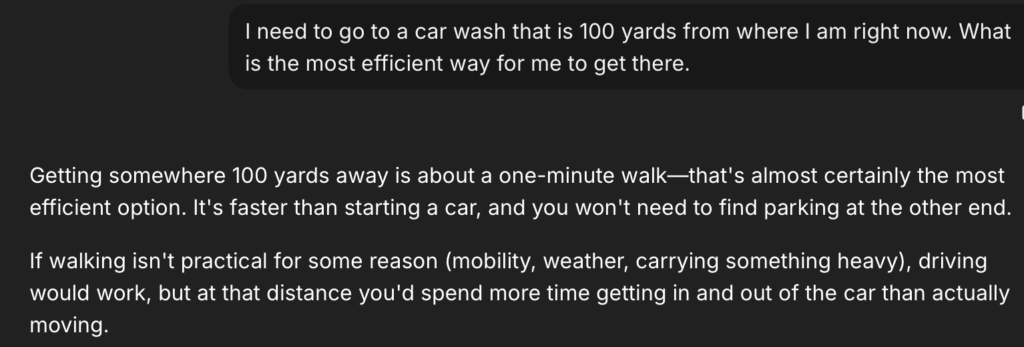
Humans understand the hidden constraint immediately: the car needs to get there too. Claude focused on the surface wording — “how do I get there?” — and missed the real-world purpose of the trip.
Good luck washing that car.