Let’s start with the short version: there is no “War on Christmas.”
What we have instead is a recurring moral panic that is a carefully manufactured, endlessly recycled, and loudly performed by people who mistake cultural change for persecution. Every year, right on cue, someone is outraged by a red Starbucks cup, or by the phrase “Happy Holidays,” and collapses into theatrical despair as if civilization itself were under attack.
The irony is delicious.
Christmas was not attacked by secularists, atheists, or modern progressives. It was attacked — and outright banned — by religious fundamentalists. And they were absolutely convinced they were defending God while doing it.
To understand why today’s “War on Christmas” narrative is historically illiterate nonsense, we need to talk about Puritans, pagan festivals, and one short ghost story published in 1843 that quietly changed everything.
Christmas was once banned
You might, or might not know, but Christmas was once legally banned. I suspect most of you reading this do know.
In 1659 the Massachusetts Bay Colony enacted a law called Penalty for Keeping Christmas. The notion was that such “festivals as were superstitiously kept in other countries” were a “great dishonor of God and offence of others.” Anyone found celebrating Christmas by failing to work, “feasting, or any other way… shall pay for every such offence five shillings.”
Who was doing this, was it the non-believers?
Nope, as I mentioned above, it was the fanatically religious Puritan faction attempting to impose their beliefs upon society. As far at they were concerned, it was those heretical Catholics, Lutherans, and Anglicans who paid homage to this Christmas superstition. From their viewpoint, only the Puritans had the “true” belief.
The ban did not last, but it did persist for a few decades. It took until 1681 for an English appointed governor, Edmund Andros, to revoke the ban. It did however have a lasting impact and it was not until well into the middle of the 19th century that celebrating Christmas once again become popular in the region.
Christmas is not just a religious festival
What hopefully is very obvious to you is that Christmas, as we now embrace it, is not principally a religious event. Well yes, baby Jesus, mangers, wise men, etc etc… but how the event manifests transcends all of that in multiple ways, and none of them resonate with Christian Theology. Obvious examples abound, Christmas Trees, Santa, Holly, Lights, Decorations, Giving Gifts, and so on. Oh, and let’s not forget that that it is also a massive culinary and consumerism festival.
What we do perhaps all appreciate is that many cultures have had midwinter events to mark the turning of the year, the time when we hit the shortest day, and then transition into a new year where the days start to get longer. The date of Dec 25th was most probably selected because it aligned with Roman winter festivals (like Saturnalia and Sol Invictus). Again, I speculate you already know all this.
For those unfamiliar with Saturnalia, it was a non-Christian festival that involved a religious service, a feast, and gift giving which is very déjà vu.
OK, back to those Puritans for a moment.
Interestingly enough, the reason the Puritans where hostile to Christmas was because of what it was, and still is – an event that was basically too pagan, deeply disorderly, and an excuse for many to drink and eat way too much. From their viewpoint it was clearly not Biblical. They were of course right about that. They understood that bible not only has no date for the Birth of Jesus, but also does not direct anybody to celebrate his birth. They were also well aware that the date aligned with pagan festivals, so it made their blacklist. What they got very wrong, and is also something many modern Christians also get so very wrong, is that they attempted to impose their specific variation of belief upon others by force of law.
The principle is easy to follow; If you believe doing something is wrong, then don’t do it. What the religious should never get to do is to force their beliefs on others. This just morally wrong. But hey, that’s a rant for another day.
Rebranding Christmas
Now we come to the well-known plot twist.
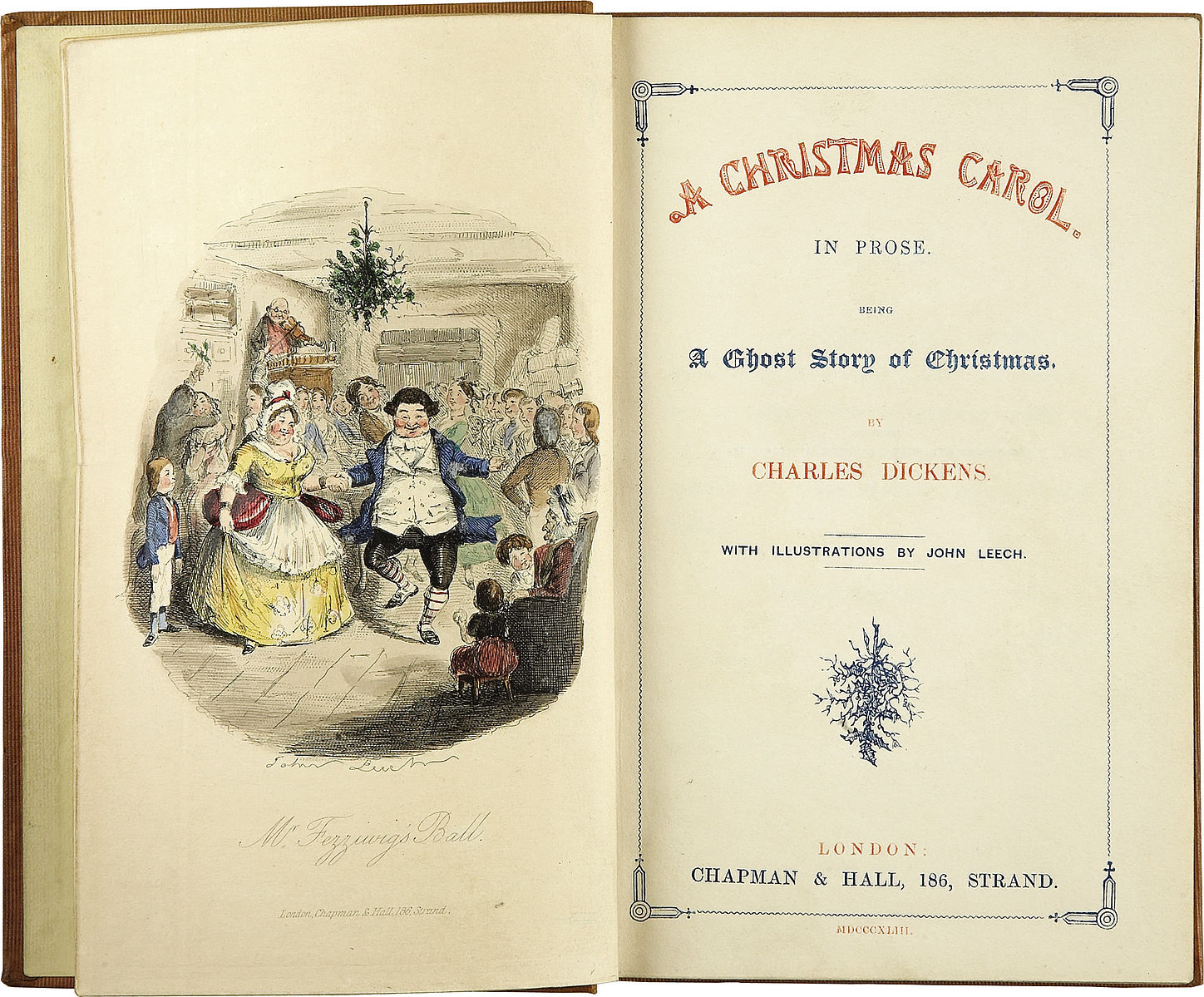
What has been highly influential on our modern version of Christmas was one short story by Charles Dickens. His 1843 “A Christmas Carol” completely reframed it. Between about 1600 and the early 1800s Christmas was a very different event. It was loud, public, and focused on drinking and gambling. Because of that it was also quite controversial, hence the stance taken by the Puritans.
When first published it was an instant hit, and it remains so today. It is constantly being re-published and presented afresh for each and every successive generation, because it continues to resonate. In other words, Dickens went viral with it, and it continues to this day.
What Dickens did was to re-package a midwinter pause as family-centered, moral, charitable, and a time that was warm and sentimental. His story had a huge influence and altered Christmas into something familiar.
Permit me to share with you an extract from it to make a fascinating point. Below is an extract. It is Christmas Morning, and Scrooge wakes up a reformed man after the three separate visitations from the ghosts of Christmas Past, Present, and Future. They had revealed to him his fate if he did not change his ways and so this insight motivated him to reform himself. Here he is waking up a new man …
“I don’t know what day of the month it is!” said Scrooge. “I don’t know how long I’ve been among the Spirits. I don’t know anything. I’m quite a baby. Never mind. I don’t care. I’d rather be a baby. Hallo! Whoop! Hallo here!”
He was checked in his transports by the churches ringing out the lustiest peals he had ever heard. Clash, clang, hammer, ding, dong, bell. Bell, dong, ding, hammer, clang, clash! Oh, glorious, glorious!
Running to the window, he opened it and put out his head. No fog, no mist; clear, bright, jovial, stirring, cold; cold, piping for the blood to dance to; Golden sunlight; Heavenly sky; sweet fresh air; merry bells. Oh, glorious! Glorious!
“What’s to-day!” cried Scrooge, calling downward to a boy in Sunday clothes, who perhaps had loitered in to look about him.
“Eh?” returned the boy, with all his might of wonder.
“What’s to-day, my fine fellow?” said Scrooge.
“To-day!” replied the boy. “Why, CHRISTMAS DAY.”
“It’s Christmas Day!” said Scrooge to himself. “I haven’t missed it. The Spirits have done it all in one night. They can do anything they like. Of course they can. Of course they can. Hallo, my fine fellow!”
“Hallo!” returned the boy.
“Do you know the Poulterer’s, in the next street but one, at the corner?” Scrooge inquired.
“I should hope I did,” replied the lad.
“An intelligent boy!” said Scrooge. “A remarkable boy! Do you know whether they’ve sold the prize Turkey that was hanging up there? Not the little prize Turkey: the big one?”
“What, the one as big as me?” returned the boy.
“What a delightful boy!” said Scrooge. “It’s a pleasure to talk to him. Yes, my buck!”
“It’s hanging there now,” replied the boy.
“Is it?” said Scrooge. “Go and buy it.”
“Walk-ER!” exclaimed the boy.
“No, no,” said Scrooge, “I am in earnest. Go and buy it, and tell ’em to bring it here, that I may give them the direction where to take it. Come back with the man, and I’ll give you a shilling. Come back with him in less than five minutes and I’ll give you half a crown!”
The boy was off like a shot. He must have had a steady hand at a trigger who could have got a shot off half so fast.
“I’ll send it to Bob Cratchit’s!”
This is Christmas Day in 1843 as described by Dickens. It was a Monday that year. What I find fascinating is that Christmas Day was not a public holiday, but instead was mostly like any other Monday. Yes, the churches marked the day, but the shops were open. He could direct the boy to go to the shop and bring the shopkeeper to his door to arrange delivery of the Turkey.
Christmas Day did not become a public holiday in either the UK or the US until three decades later in the 1870s.
A Christmas Carol transformed Christmas from something minor, and was not observed as a big holiday into something far more ethical – a time for self-examination, and an opportunity to pause, spend time with family, and potentially also transform into a better person. It was this message that resonated, went viral, and by doing so reframed it into the event we now have.
A Christmas Carol is not a religious saga
A Christmas Carol might indeed be a Christmas story, but it was not a distinctly Christian story at all. Instead we have a universal tale that sends a clear message – actions have consequences. It was designed to motivate people to consider that and to make better choices …
- Be generous to the poor
- If you have wealth then you have a responsibility
- It is not up to “them”, but you yourself to make a difference. Tiny Tim embodies the impact upon others of failing to do this
It is a story that turns giving into a something you do at Christmas.
What also resonates are the shared meals, the music, and the warmth of the family bond within the Cratchit household. This creates a Christmas that is domestic and family focused. It is also a story where children play a role in underlining the overall theme both as symbolic and literal representations of consequences.
Scrooge, as he was is the ultimate manifestation of cold hard capitalism. The story challenges that directly by pointing towards economic justice and compassion as a better way; time off, bonuses, and goodwill towards those in your care was presented as a far better way to run a business.
There is no specific theology in play here, but instead it is a universal story for all variations of belief and also non-belief. It promotes laughter, music, and emotional warmth.
This is not just a story for then, but is also very much a story for now.
Where do the Non-Christians fit in here?
Humans have been taking midwinter breaks long before Christianity emerged, it has always been part of the ebb and flow of life.
We can happily, if we wish, be inspired like many before us have been by “A Christmas Carol”. We can leverage midwinter as a time to pause, self-reflect, and consider better choices in the year to come. We can also embrace it as a time to be with family. Here I am using the term “family”, not in a biological sense, but rather as a way to describe those that we resonate with emotionally.
We can also happily embrace all that happens – decorating trees and houses, holly, cards, gift giving.
No belief is required, except perhaps the insight that while we live and breath we can manifest laughter, warmth, inclusiveness, tolerance, and an empathy that expresses itself in a meaningful lasting way.
Meanwhile …
For the religious, here is a traditional painting of baby Jesus. It is titled “Adoration of the Magi” and is a painting by Rogier van der Weyden. (Details here) …

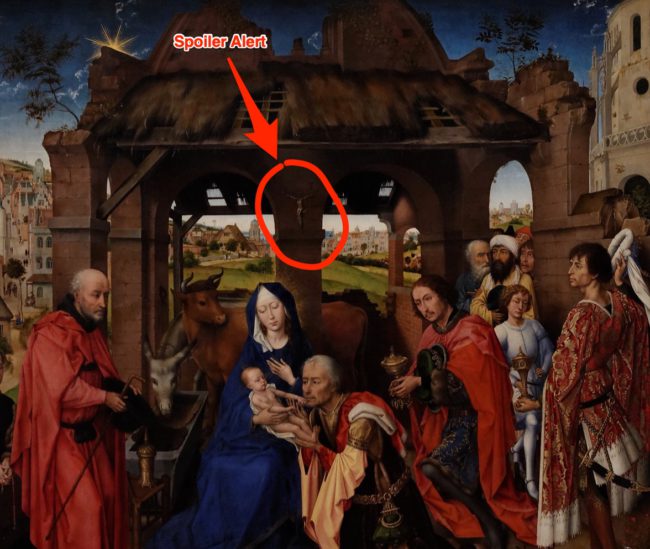
For the non-religious, we should perhaps not forget that Dec 25th does mark the birth of a very special child.
On this day, Dec 25th, a very long time ago, an amazing child was born. He opened all our eyes and granted us a new understanding of our place in the universe and of everything. Via the revelations that he brought, he changed the world.
Happy Birthday Isaac Newton – born 25th Dec 1642.