It’s not a typo, so no, I don’t actually mean Nun, but rather people who identify as “None”, and yet at the same time also religious.
“The Nones” are people who say they have no religious affiliation. When asked about religion by pollsters, the answer they give is “None” or “Nothing in particular”. So what does this actually tell us?
Understanding who the nones are is becoming increasingly important because this is no longer a small demographic. Via Pew’s Religious Landscape Survey this is now about 29% of the US population. To put that another way, using a rough US headcount of adults, that’s 71.7 million adults; that makes them the fastest growing and one of the largest “religious” categories in the nation.
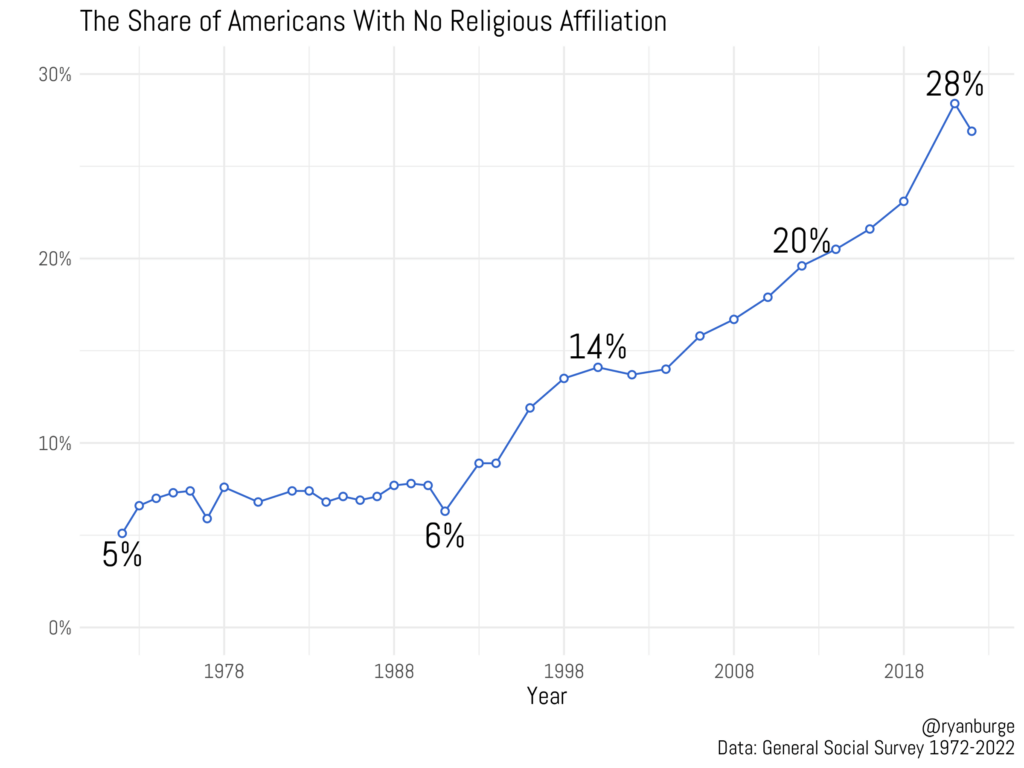
When a group reaches nearly one-third of the adult population, its influence inevitably extends into voting patterns, cultural norms, workplace expectations, education policy, and public debate.
Understanding who they are helps to answer why this group is rapidly rising and also what the actual impact might be.
Is their rapid rise a story about a cultural shift towards secularisation, or disillusionment with religion? Perhaps it is about individual spiritual autonomy, or is something else going on?
A good first step to truly understand this is to ask who the nones really are.
Surveys can be tricky things, especially when it comes to trying to measure religious affiliation. For example, suppose you asked somebody what their religion is, and they respond by giving you just one word – “Catholic”. How should you then interpret that, what have they actually told you.
Here are a few of the many possibilities:
- They could be telling you that they were brought up Catholic, don’t actually practise or go to Mass, but recognise it as part of their cultural inheritance.
- They could perhaps be telling you that they tick that box because on some special occasions they will do the expected and attend, but normally don’t.
- There are also of course people who do believe, find both comfort and belonging, so they attend on a weekly basis and also go to confession.
In other words, in reality it is a rather broad spectrum that can include people who do not go to Mass, don’t actually believe or practise any of it, and perhaps never did, but still use the label if asked because that is how they were brought up. Then, at the other end, are the genuinely devout who find meaning and purpose, and so they fully participate.
So what have you learned with the answer “Catholic” to the question?
Not very much.
This remains true for all such answers including “None”. People are complicated and so all attempts to fit people into specific categories might indeed tell you what label they prefer, but it does not tell you what they actually believe.
There has been some new research conducted by sociologist Philip Schwadel of the University of Nebraska–Lincoln. He looked into who the Nones actually were and has discovered a rather surprising degree of diversity.
What might be assumed about Nones?
If somebody told you that they were a “None”, then you might assume that what they were telling you is that they don’t believe that there is a god, or at best that they are agnostic.
Pause that thought.
There are Religious Nones
The study itself is titled “The Social and Political Perspectives of Believing and Non-Believing Religious Nones” and was published on January 9, 2026.
The reason for this study is obvious:
Sociologists point to important social and political distinctions within religions yet we generally treat the roughly one-in-three Americans with no religious affiliation (aka Nones) as a homogeneous population.
With the Nones now being nearly one-third of Americans it is time to fix that.
What was Done?
There was more data dig into, so Mr Schwadel examined 16 measures ranging from attitudes on capital punishment to government spending and political intolerance.
“We tend to think of these people as all atheists,” Schwadel, Happold Professor of Sociology, said. “I see in popular discourse, people often conflate the non-religious with atheists, but very few of them are atheists. The biggest takeaway is that we treat these people as one group, but as 28% or so of Americans, they have tremendous diversity.”
In previous studies he had already worked out that amongst the religiously unaffiliated, 35% believe in God, 28% believe in a higher power, 21% are agnostic and 16% are atheists. What he was specifically interested in understanding were the religious Nones.
For details from 2020 on that here is the paper – The Politics of Religious Nones
Via the latest paper we gain a bit more of an understanding. You might perhaps assume that as a group the Nones align in their thinking on other topics. What he has revealed is that they don’t …
Results show that across 16 different social and political perspectives (e.g. racial resentment, traditional gender roles, political intolerance, capital punishment, school prayer, abortion, and confidence in government), Nones who believe in God are notably different than other Nones, and often more similar to believing religious affiliates than to other Nones.
Further Thoughts
When faced with people not understanding something you clearly do, we might laugh.
For example, many of the deeply devout often don’t truly grasp that there are people like myself who hold no supernatural beliefs.
I might be stopped on the street with some guy waving a bible in my face asking if I have accepted Jesus. I explain that I’m an Atheist and that I don’t believe there is a Jesus to accept or even a god to believe in. His immediate rebuttal is, “Ah, so you worship the devil instead“. I then have to patiently explain that I do not share those theological assumptions.
If you have had these conversations then you know how it pans out; as far as he is concerned I secretly believe, and apparently I’m just not being honest about it because the bible says that everybody believes, no exceptions.
It is perhaps laughably silly and oh so mockable.
However, the point is this, we can see others making assumptions about what atheism is, and they are oh so very wrong. It may also be distinctly easy for us to also make assumptions regarding who the Nones are.
What the study makes clear is that there are religious as well as non-religious Nones, and interestingly enough, the Nones who believe in God are notably different than the other Nones, they are often more similar to the religiously conservative for many things. It’s just that they reject the traditional label.
The key finding is not merely that Nones are diverse. It is that belief in God among the unaffiliated predicts social and political attitudes in ways that closely resemble traditional religious affiliation.
Further Reading
- The published Peer-reviewed paper (Jan 2026): The Social and Political Perspectives of Believing and Non-Believing Religious Nones – Paywalled.
- Press release provided by University (Feb 2026): New research shows God-believing ‘nones’ align more closely with religious Americans