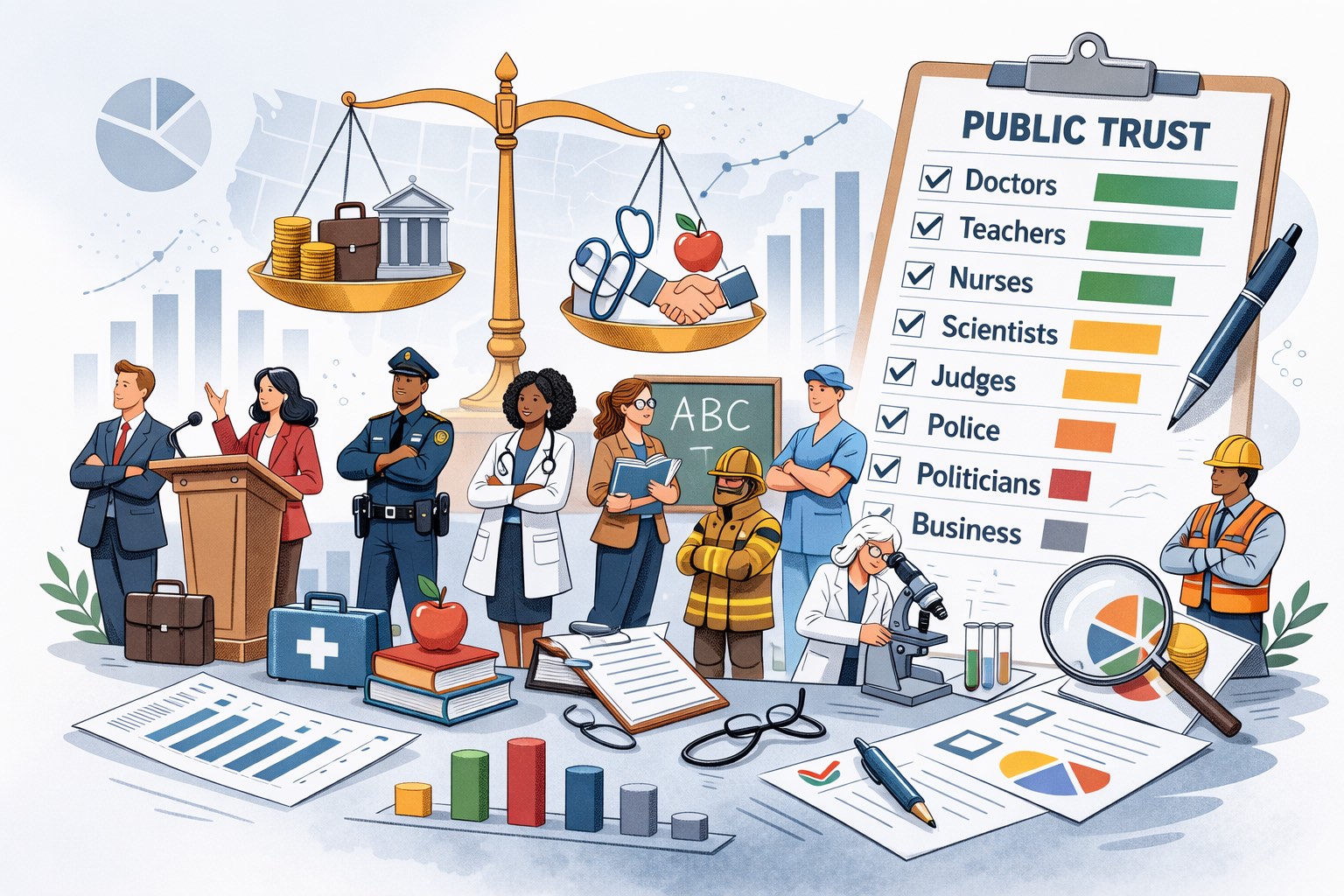
Where I’m really going here is to ask this question: How can you personally work out which polls to trust?
First, let’s get into the Gallup poll that answers the question in the title.
Since 1976, Gallup has published a chart that highlights the public’s views of the honesty and ethical standards for 21 occupations. The latest data gathering was in Dec 2025, and so the results gathered were published in January.
As you might guess, some professions are highly rated, and others not so much.
For each profession in the list, people were asked …
Please tell me how you would rate the honesty and ethical standards of people in these different fields — very high, high, average, low or very low.
The list included 21 professions, and so here is how it panned out …
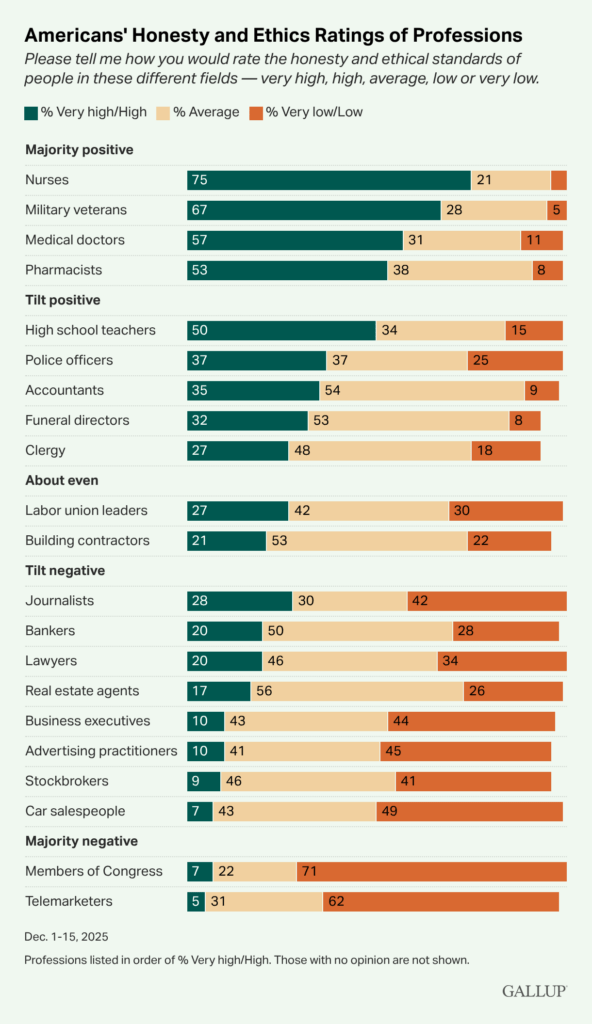
So there you go then, the winner is:- “Nurses”.
As a non-surprise close to the bottom are Members of Congress. While Telemarketers is at the bottom with an even lower ranking, it can be argued that Members Of Congress really does merit last place. Note that they scored 71% as Very Low and nobody else achieved that.
The fact that the vast swathes of the population think so poorly of their representatives is interesting because these same people choose them. I suspect the way it works is that most believe their local guy to be the one lone voice of sanity and that all the others are totally corrupt and just out for themselves.
Beyond that, when it comes to honesty and ethics, then you have a few non-surprises: Tilting negative were … car salespeople; advertisers; lawyers.
However others really were a surprise: Doctors and Pharmacists were high, but not as high as I might have expected.
Where things also become a bit clearer is when you slice it all up using a political lens, like this …
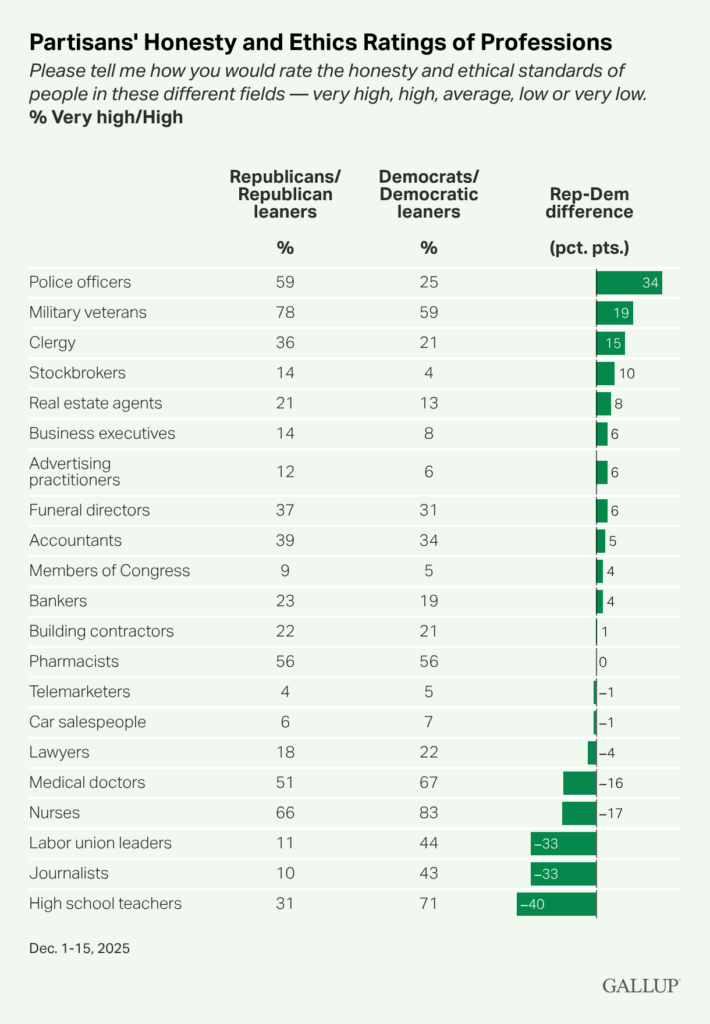
What is fascinating about the above is that the people who strive to tell you the truth, journalists, and the people who strive to educate your kids, high-school teachers, rank very poorly with Republican leaning people.
I guess it’s understandable if you lean into a religious belief that opposes evolution and science being taught, and tune into Fox News or Newsmax as “Truth”.
One other fascinating observation concerns the clergy. That’s the one profession that claims to hold the high moral ground when it coms to honesty and ethics, and yet overall they raked rather poorly at 27%.
The vast majority are clearly not buying their generic claim about being honest and ethical.
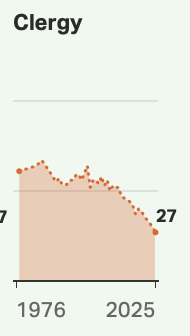
As you can see from the above, it has been going rapidly downhill over the last few decades.
What could have possibly caused this?
I’m sure the sexual abuse on an almost global industrial scale and the associated cover-up has played no role at all, neither have the revelations via the 2015 movie like Spotlight, nor the daily torrent of pastors and youth leaders being arrested for sexually molesting kids, impacted this … right?
Interesting as these numbers are, where I am actually going here comes up next – Is this survey truly accurate?
How can we know, what cognitive tools can we deploy to work this out?
One Immediate Challenge
The entire US population, via the Census Bureau, is just over 342 million (February 2026), yet the Gallup survey only sampled 1,016 people to gain the latest update to this survey. This quite naturally leads to a rather obvious question – do the opinions of those 1,016 people truly represent the views of the other 342 million?
The rather surprising answer is potentially yes. I say potentially because the reliability of a survey depends far more on methodology, than sample size.
Public opinion polling doesn’t rely on surveying huge percentages of the population. It relies on what is known as statistical sampling theory.
In this specific instance a random sample of roughly 1,000 adults means that your margin of error is approximately 3 percentage points and the confidence level that this is right is 95%
What does that mean?
In practise it works out like this – If the survey reports that 75% of Americans feel very positive regarding the honesty and ethics of Nurses then the true percentage for all 342 million people is probably somewhere between 72% and 78%, and 95% of the time that will be right.
What if we bumped the data size, what happens then?
If you instead surveyed 2,000 adults, then the margin of error drops of roughly 2 percentage points.
You might also wonder what is and is not a good methodology.
How people who participate in surveys are selected needs to be done using random sampling so that bias can be eliminated. For example Gallup traditionally uses probability sampling, That is much stronger than self-selected internet polls which would be far less reliable.
You also need to statistically adjust to reflect census demographics such as age, gender, race, etc…
How you phrase the survey questions is also a huge factor. Get it wrong and you will greatly influence and so corrupt the numbers.
For example, if faced with the following, then the framing is clearly nudging you is a specific direction …
“Do you agree that the government’s reckless spending is harming hardworking families?”
A reputable organization such as Pew or Gallup would never ask a distorted question like that. Instead it would be balanced and neutral like this …
“Do you think current government spending is too high, too low, or about right?”
The point is this, subtle wording changes (even just swapping one adjective) can swing results by 10–20 percentage points so be wary of surveys that nudge you towards a specific answer.
I’m building up to this next point.
Which Surveys can you trust?
Obviously reputable organisations can be trusted, for example Pew and Gallop, but what if it is not a survey by them, but from some other source you are not familiar with?
You can spot problematic surveys by asking yourself questions like these:
- Does the question contain adjectives (radical, reckless, corrupt)?
- Does it assume facts not in evidence?
- Does a question combine multiple issues?
- Is the survey measuring opinion — or trying to create it?
- Is the full questionnaire publicly available?
High-quality pollsters will publish full PDFs of every question in context, and so this allows independent scrutiny. If that is not available then you can instantly dismiss the poll as highly dubious.
Here are some examples of the bad ones …
- Rasmussen Reports: They are frequently criticised by academic analysts for question framing
- Trafalgar Group: They have a reputation for not being transparent about their methodology. Yes they got 2016 and 2020 right, but overall have a mixed accuracy record.
Polling generally works well for broad, stable attitudes, especially when clear, well-defined questions are it play, but like many things in life it can be used for both insight, but also abused to manipulate and sway. It is important to understand which is which. It also has its limits and as a tool will fail to predict for low-turnout elections or in contexts where opinions are rapidly shifting.
Let’s wrap all this up.
5 Key Insights
Insight 1 via analysts at Gallup:
“Polls are a snapshot, not a prediction.”
In other words, polls measure opinion at a moment in time, not what will necessarily happen later.
Insight 2 via analysts at Pew:
“The margin of error is not the margin of truth.”
As we have all seen, even statistically rigorous polls can miss real-world outcomes due to turnout, late swings, or systemic bias.
Insight 3
“Polling doesn’t tell you what people think — it tells you what they say they think.”
Subtle but important. This highlights social desirability bias, framing effects, and the gap between stated preference and actual behavior.
Insight 4 via Nate Silver
“The average of many imperfect polls is usually better than one perfect poll.”
This explains why aggregation reduces random error and house effects, hence a poll of reputable polls can be more reliable than any of the individual polls.
Insight 5
“A poll is only as good as the question you ask.”
Simple, but foundational. Wording can change results dramatically. Yes, I covered it earlier, but here it is again because this really is commonly and deliberately abused.
Finally
When Gallup asked people about the honestly and ethics for various professions, they very wisely decided to not include pollsters in that list.