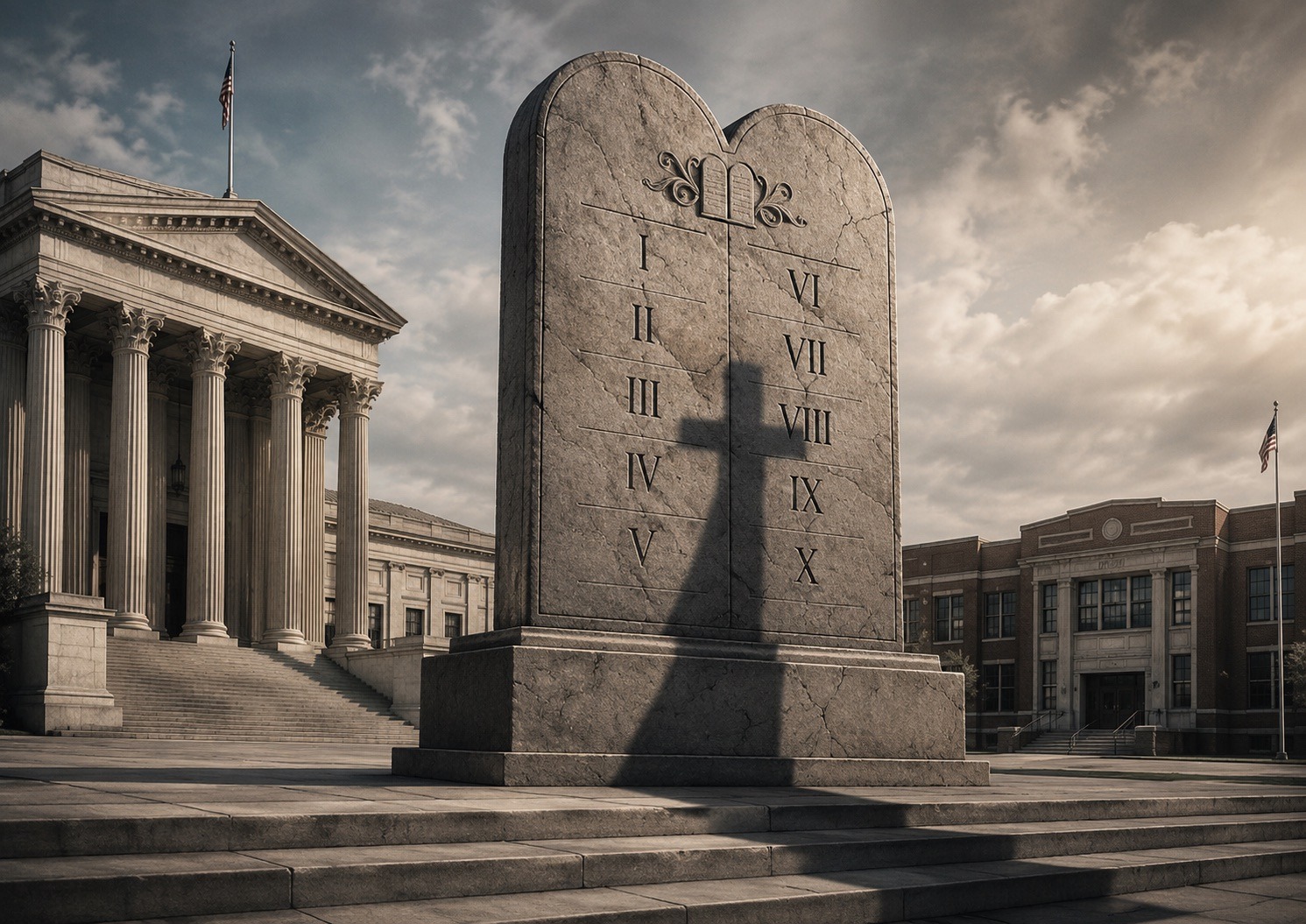
On a rather regular basis you will come across yet another push to erect a 10 Commandments monument on public land such as outside a courthouse. A common variation has also been the push to display 10 Commandments posters within schools.
Here are a few recent examples:
- Amarillo Tribune, May 27: 10 Commandments monument unveiled at City Hall
- Texas, May: Victory! Lake Travis ISD Will Post 10 Commandments Soon…(in a few weeks)
- etc…
Much of it is constitutionally suspect, and in schools it is especially hard to defend under the First Amendment.
OK, so far all of this is familiar and well-known. There are however a few rather interesting and surprising nuances to all of this that many are not aware of, so let’s go over that.
Which 10 Commandments?
There is no one universal list of 10 Commandments.
There is a version listed within the Book of Exodus, and then over in the Book of Deuteronomy there is a similar but different version. Same Bible, same translation, but different.
Beyond that, different religious traditions have different lists. Jews, Catholics, Lutherans, and most Protestants divide the commandments differently. For example, “You shall have no other gods” and “You shall not make graven images” are treated as separate commandments in many Protestant traditions, but these are combined in Catholic and Lutheran numbering. To keep the total at ten, Catholic/Lutheran traditions split the coveting commandment into two.
There are also a lot of other complications.
There are multiple and quite different Bible translations, for example old-English King James or a more modern English version. There are hundreds of English Bible translations and editions in circulation. We live in a world where there is an abundance of acronyms to pick one such as KJV, NKJV, NIV, ESV, NRSV, NASB, NLT, CSB, RSV, CEV, GNT, NET, etc… so if you wish to erect a monument, then which English version do you pick?
Word choice matters. Do you ban killing, or just murder? Some translations use “kill” and some use “murder”. One is unlawful, but the other includes war and capital punishment.
Do you pick Sabbath or Lord’s Day because once again this varies by translation. One is Saturday and the other is Sunday. Obviously the original intent was Saturday. Most Christians treat Sunday, not Saturday, as the sacred day, which already shows that re-interpretation is doing a lot of heavy lifting.
Within the Protestant version graven images are banned via the second commandment, but the Catholic and also Lutheran list tones that down and includes it as part of the first as a general ban on idolatry. This revolves around a huge historical theological argument. Protestant iconoclasts objected to statues and images in churches. Catholics and Orthodox Christians defended sacred art, arguing that honouring an image is not the same as worshipping it as a god.
The bottom line is this. When somebody puts up “the Ten Commandments,” they have to start making rather a lot of decisions:
- Which english translation?
- Which numbering?
- Whose version, Jewish, Catholic, Lutheran, Protestant?
- Which Biblical version, Exodus or Deuteronomy?
- “Kill” or “murder”?
- “Sabbath” or “Lord’s Day”?
- Include the graven images text or minimise it?
- etc…
That choice is not neutral, and it never can be. In practice, many of the monuments you see being promoted use a Protestant-style version, which is one reason critics argue they it is not merely a generic moral heritage. They represent a particular religious tradition’s presentation of the text – an interpretation.
For lots more detail you will find that the Wikipedia page on the Ten Commandments is a good primer.
The push for Monuments was mostly Hollywood’s fault
Really?
Yes really, so permit me to explain.
In the early 1950s, Minnesota juvenile judge E. J. Ruegemer promoted the Ten Commandments as a way to combat juvenile delinquency. He worked with the Fraternal Order of Eagles, a large civic/fraternal organisation, to distribute copies of the commandments.
The Eagles began placing small Ten Commandments plaques in public spaces: parks, courthouses, city halls, schools, and state buildings. These were often presented as civic gifts intended to promote morality and respect for law.
Cecil B. DeMille who was making the now famous 1956 Ten Commandments movie saw all this, and realised that this was a huge publicity opportunity. He connected with the Eagles’ campaign because it created exactly the kind of public religious spectacle that would help promote the film. Sources describe the arrangement as mutually beneficial: the Eagles promoted the moral/religious message, while DeMille and Paramount gained public attention for the movie.
The Eagles were using small plaques, but DeMille craved far more publicity and decided to ramp it all up. DeMille pushed for and got monoliths. Paramount benefited from the publicity, and actors from the film appeared at some unveilings. Charlton Heston and Yul Brynner were associated with these events, making the displays feel less like local religious notices and more like national cultural events.
DeMille’s movie gave Americans a powerful shared image: Moses, stone tablets, divine law, national destiny, moral drama. The monuments borrowed that imagery. They were not just lists of rules; they became cinematic symbols of “God’s law” standing in the public square.
The stage was also set for all this by the era. The 1950s was a time of “religion versus godless communism” messaging. This was the same era when “under God” was added to the Pledge of Allegiance in 1954 and “In God We Trust” was adopted as the U.S. national motto in 1956. Ten Commandments monuments fitted that mood perfectly: public religion as patriotism, morality, and anti-communism.
So while it did not completely originate with DeMille, what he did for the sake of publicising a movie gave the entire concept a huge boost.
Without DeMille and the publicity for the movie it is highly probable that Judge Ruegemer’s initiative would have quickly faded and been forgotten.
Unfortunately, because of the movie, here we are now in 2026 with religious fanatics still continuing to promote these monuments and displays.
They Are Not Moral Rules. They Are Mostly Religious Rules
Because they are commonly presented as a set of legal rules what is often not appreciated is that they are primarily religious rules.
Let me show you by taking the commonly promoted Protestant variation and going through it line by line.
1. You shall have no other gods before me.
Very explicitly just a religious rule. It commands loyalty to just one God. A secular legal system cannot ethically or morally demand that citizens must worship one deity, and that is especially true in a society where citizens hold many different beliefs, including no belief at all.
2. You shall not make idols / graven images.
Again, this is very explicitly a religious rule. It prohibits the creation of sacred images or objects of religious veneration. There is also a rather delicious irony here: erecting giant stone tablets in a public square, treating them as a symbol of divine authority, and demanding civic respect for them comes uncomfortably close to doing the very thing this commandment warns against.
3. You shall not take the name of the Lord your God in vain.
Yep, just another religious rule. It only makes sense if the state is in the business of policing reverence toward a particular deity.
4. Remember the Sabbath day, to keep it holy.
Yet again, just another religious rule. Whose Sabbath, and what does keeping such a day holy actually mean? Traditionally it has been interpreted as a mandate for one day per week to be a special day and that you can’t work that day. The rather glaring flaw is that there are professions where you must have somebody on duty every day; doctors, nurses, firefighters, etc. not working that day would be deeply immoral.
Once upon a time England had laws mandating Church of England attendance (roughly 1552 until about 1689). It did not work out well and proved impossible to enforce consistently. For centuries, it created bitter religious divisions.
That leads directly here.
Yes, mandatory Church of England attendance and the fierce persecution of religious dissenters were the direct catalysts that drove the Pilgrims to sail to America. And, the Pilgrims and Puritans in New England were just as strict as the English government they fled from. They had learned nothing and passed laws making church attendance at their type of church strictly compulsory and also enacted much more. All physical work, traveling, cooking, and recreation were legally banned. It was a crime to fast-walk, play sports, or run on Sundays. Even a captain returning home from a three-year sea voyage was famously put in the stocks for publicly kissing his wife on his doorstep on a Sunday morning.
FFS.
Up until 1994 England also had a weird law that banned the selling most goods on Sundays to preserve the Sabbath, but they carved out exceptions for newspapers and magazines. This meant that you could buy Playboy on Sunday, but could not buy a Bible because selling that was a criminal offence.
Once you start down this “Keep the Sabbath Holy” track via civil law, you end up in a totally crazy place.
5. Honour your father and mother.
This is the first attempt at something that is not explicitly religious. Good luck following this if your parents are abusive.
6. You shall not murder.
Literally every variation of a legal system has had some variation of this.
7. You shall not commit adultery.
… unless your name is Trump or Ken Paxton, or one of the many others who are worshiped by Evangelicals and hence get a free pass for this one.
8. You shall not steal.
… again unless your name is Trump, then all bets are off.
9. You shall not bear false witness against your neighbour.
That sounds OK, so what’s the problem here?
It is not uniquely biblical. Every functioning legal system needs rules against false testimony. Ancient non-biblical societies also punished false accusation and perjury.
It often gets expanded into a broader moral rule: do not lie, slander, gossip, deceive, or damage another person’s reputation. That wider meaning is valuable morally, but it goes beyond ordinary law. The state can punish perjury or defamation in some circumstances; it cannot realistically criminalise every lie, exaggeration, rumour, or unkind statement.
There is a wider irony here as well. In courts, people have commonly been asked to swear on the Bible to tell the truth, despite the New Testament explicitly warning against swearing oaths at all. So yes, we do irony all the time, we use a Bible to solemnly perform an act that the Bible itself tells believers not to perform.
One further thought on this. Sometimes lying can be the moral option: “Hi Mr ICE officer, I most definitely have not seen my Mexican neighbours, they are not hiding in my house“.
10. You shall not covet.
This last one is deeply weird. It is an attempt to codify a thought crime. Law is by design aimed at punishing actions. It cannot sensibly punish envy, jealousy, or wanting what someone else has. There is no meaningful way to police or enforce this.
That’s it, the big 10.
What you have is not a legal code. They are a religious covenant code that has been garnished with some moral rules that happen to overlap with ordinary law. That is why calling them “the foundation of law” is very misleading. A large chunk of them is about religious belief and practice, not neutral public law.
What is Missing?
A great deal.
If the claim that it was whispered into the ears of Moses by the all knowing creator of the universe was actually factual then what we would have is something far more inspirational and insightful.
Can we do better?
Indeed we can.
Here are a few very obvious examples:
- Equality before the law: There is no command saying the powerful and powerless must be treated equally.
- Consent: There is no clear command about sexual consent, coercion, or bodily autonomy.
- Protection of children: “Honour your father and mother” protects parental authority more than children’s welfare.
- Ban on slavery: The commandments do not prohibit owning human beings. In fact, the wider biblical law assumes slavery exists.
- Rights of women: The text reflects a patriarchal world. In the coveting commandment, a wife is listed alongside house, servants, ox, donkey, and possessions.
- Freedom of religion: The first commandments do the opposite: they require exclusive worship of one God.
- Freedom of speech: “Do not take the Lord’s name in vain” is a religious speech restriction, not a general principle of free expression.
- Democracy or accountable government: There is nothing about voting, representation, limits on rulers, or consent of the governed.
- Due process: There is no presumption of innocence, right to defence, rules of evidence, or protection from arbitrary punishment.
- Compassion for outsiders: “Neighbour” can be read generously, but the commandments themselves do not clearly state universal human rights.
- Care for the poor: There is no direct commandment saying feed the hungry, house the homeless, or protect the vulnerable.
- Environmental responsibility: No rule about stewardship of land, animals, pollution, or future generations.
The most striking omission is probably this: there is no commandment saying “You shall not enslave another human being.” For a list often presented as the supreme moral foundation of civilisation, that is a huge gap.
What is even worse is that within the Bible you will find explicit instructions on whom you may enslave, and also how to correctly beat your slave (Exodus 21:20-21). Apparently if the slave is still alive a few days after the beating then that’s all OK.
You can keep going with this.
There is also no commandment saying:
- You shall not rape.
- You shall not torture.
- You shall not abuse children.
- You shall not wage aggressive war.
- You shall not persecute people for their beliefs.
- You shall treat men and women as equal moral persons.
- You shall not use power to exploit the weak.
That does not mean the Ten Commandments contain nothing worthwhile. “do not murder,” “do not steal,” and “do not bear false witness” are obviously important. But as a moral or legal framework, the list is partial, ancient, patriarchal, and heavily religious.
The Ten Commandments prohibit worshipping the wrong god, saying the wrong sacred words, and wanting your neighbour’s donkey. What they most certainly do not do is to prohibit slavery, rape, child abuse, tyranny, torture, or discrimination. That makes them a religious artefact, and also a very incomplete moral guide.
Why are some so obsessed with promoting something that is so deeply flawed and incomplete?
One last thought
The obsession with public Ten Commandments displays is not really about law. It is about religious ownership of public space. And when the loudest champions of these monuments routinely excuse lying, cruelty, corruption, adultery, and abuse of power, it becomes hard to avoid the obvious conclusion: they are not erecting a moral code. They are erecting a brand logo for people who treat the commandments as optional for themselves.