Asking people what they believe and why can be an interesting conversation. What makes it rather challenging are several things. For some it is very closely integrated in as part of the core of who they are. This means that just asking can be perceived as a threat, hence some can be very defensive. Honesty is also an issue. Asking why might indeed result in reasons being presented, but often those are not why people actually believe, but instead are simply the justifications that were added in later. The honesty challenge is not just about what is said to others, but also about what we say to ourselves. The one person that is most successfully fooled is ourselves.
None of this is a new revelation. Even Shakespeare made the observation that life is just a stage play and that we all fall into a specific acting role …
All the world’s a stage,
And all the men and women merely players;
They have their exits and their entrances,
And one man in his time plays many parts,
His acts being seven ages. At first, the infant,
Mewling and puking in the nurse’s arms.
Then the whining schoolboy, with his satchel
And shining morning face, creeping like snail
Unwillingly to school. And then the lover,
Sighing like furnace, with a woeful ballad
Made to his mistress’ eyebrow. Then a soldier,
Full of strange oaths and bearded like the pard,
Jealous in honor, sudden and quick in quarrel,
Seeking the bubble reputation
Even in the cannon’s mouth. And then the justice,
In fair round belly with good capon lined,
With eyes severe and beard of formal cut,
Full of wise saws and modern instances;
And so he plays his part. The sixth age shifts
Into the lean and slippered pantaloon,
With spectacles on nose and pouch on side;
His youthful hose, well saved, a world too wide
For his shrunk shank, and his big manly voice,
Turning again toward childish treble, pipes
And whistles in his sound. Last scene of all,
That ends this strange eventful history,
Is second childishness and mere oblivion,
Sans teeth, sans eyes, sans taste, sans everythingAs You Like It, spoken by the melancholy Jaques in Act II Scene VII Line 139.
Shakespeare was not the first to make this observation, but is perhaps the most well known.
OK, I’m getting a tad off topic.
Pew Polling
Roughly one year ago in Feb 2025 Pew published the full results of the latest iteration of their vast Religious Landscape Study. It is perhaps the most accurate measure of religion because of its size. They polled more than 35,000 Americans in all 50 states about their religious affiliations, beliefs and practices, along with their social and political views and demographic characteristics. The insights gained are fascinating as are the trends. Because they have been updating this on a regular basis we also gain an insight into what has been happening over time.
That last major update was for data collected in 2023-24.
- If deeply curious, then you can find the full 389 page (yes really, 389 pages) report dated Feb 26, 2025 here
- Alternatively, you can simply browse the headline items from here.
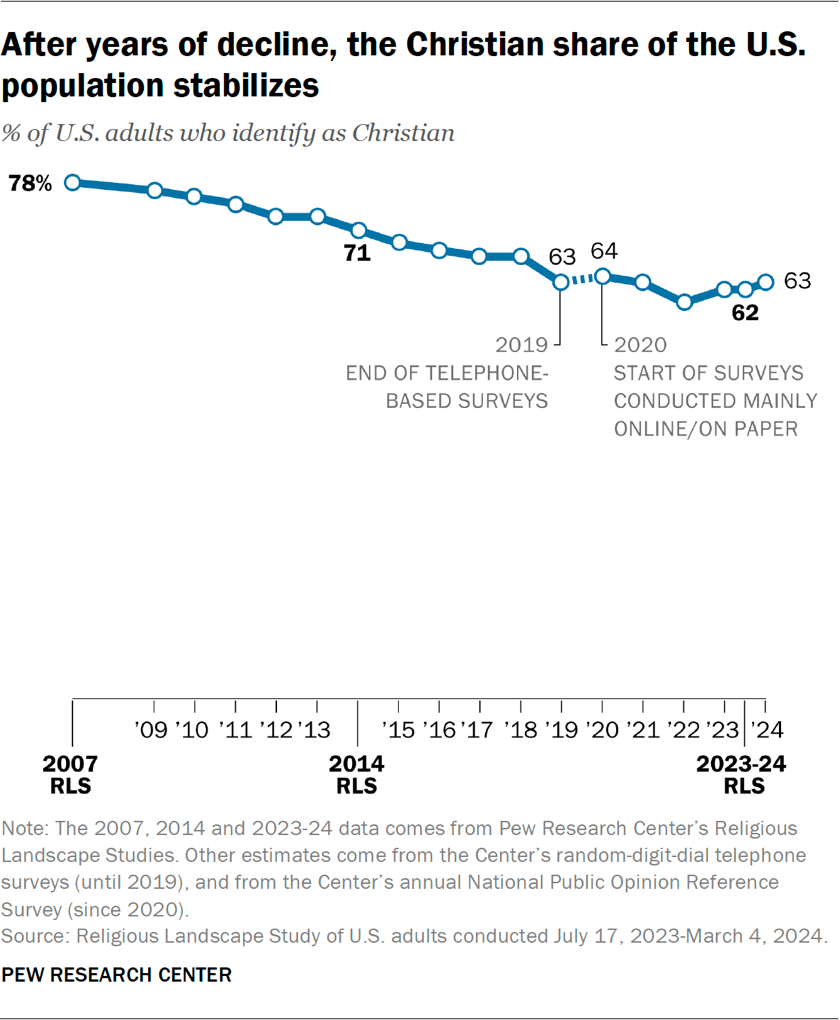
The big ongoing insight is the reveal that religion was in decline, but that the decline appeared to have levelled off since 2020…
… and of course related to that was the associated rise of what is often called NONEs (the people who reply “None” when asked what religion they are)…
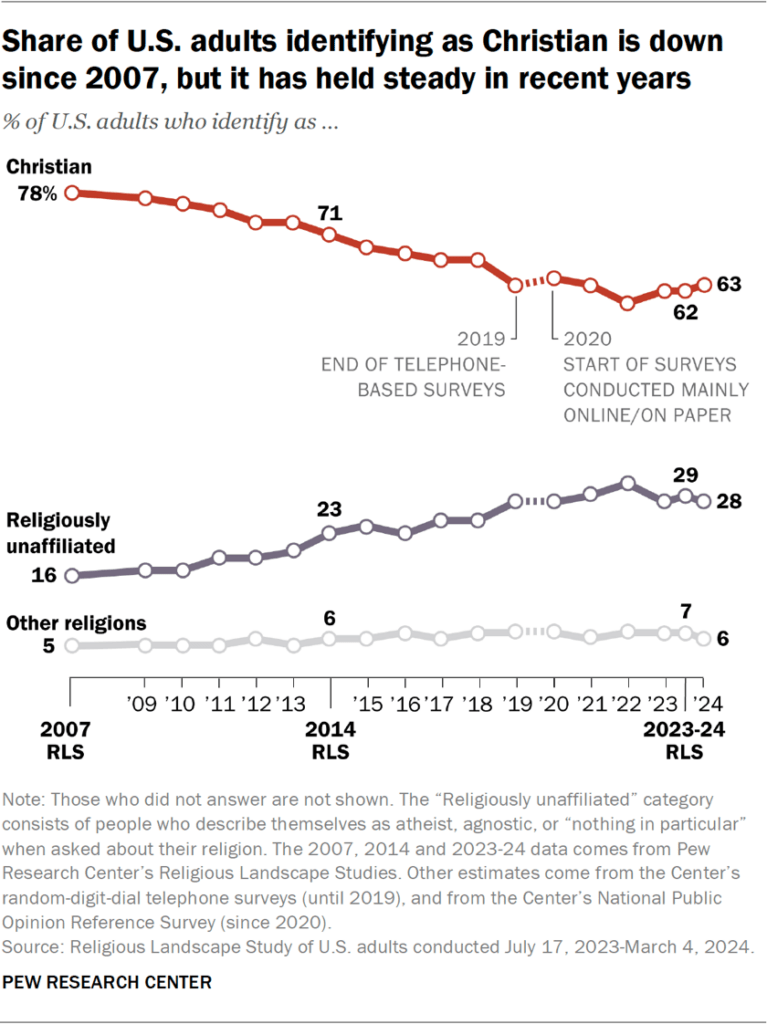
If like me you once identified as “Christian” and now identify as “None” they you also are part of this story.
That however was one year ago, and relates to data for 2023-24, so have things changed since then?
Pew Update Dec 8, 2025
Pew issued an update dated Dec 8 2025.
Their update is this chart …
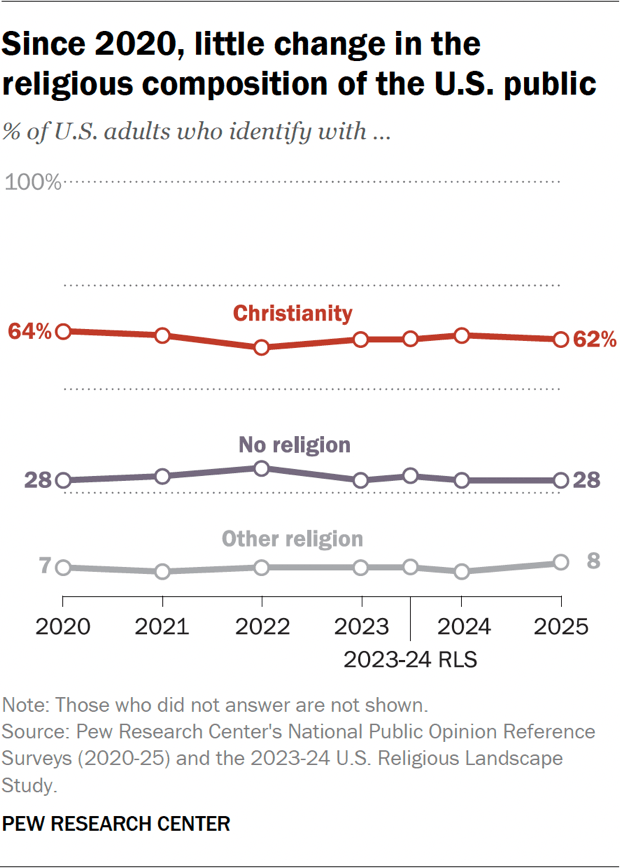
… and so they explain things like this …
So, what is happening with religion among young adults today? Some media reports have suggested there may be a religious revival taking place among young adults, especially young men, in the U.S. But our recent polls, along with other high-quality surveys we have analyzed, show no clear evidence that this kind of nationwide religious resurgence is underway.
On average, young adults remain much less religious than older Americans. Today’s young adults also are less religious than young people were a decade ago. And there is no indication that young men are converting to Christianity in large numbers.
What that latest update reveals are two patterns.
Pattern 1 – Stability across generations
…each birth cohort looks pretty stable in recent years. There is no evidence that any birth cohort has become a lot more or less religious since 2020.
For instance, in the 2025 NPORS, 83% of the oldest adults identify with a religion. That’s almost identical to the share measured in the 2020 NPORS (84%).
Similarly, among the youngest adults we track across recent surveys, 55% now identify with a religion. That’s about the same as what we found in 2020 (57%).
In other words, there has been some bouncing around from year to year, as is to be expected in survey research. But there is no clear trend of either increasing or decreasing religiousness since 2020.
Pattern 2 – Religion declines with each generation
young adults are much less religious than older people.
In the 2025 NPORS, for example, 59% of the oldest Americans say they pray every day. By contrast, 30% of young adults born between 1995 and 2002 say they pray daily.
And 43% of the oldest Americans say they go to religious services at least once a month. Among people born between 1995 and 2002, 26% say they attend services at least monthly.
The second would suggest that over a longer time span it is inevitable that religious affiliation will continue to decline as the older more religious generations pass away and are replaced by the younger less religious generations. That’s a change that works itself out over decades rather than years.
What does it really tell us?
When somebody is asked to tick a box on a survey, then what exactly are they telling you?
The problem is obvious.
If for example I tick the box marked “Catholic”, am I doing so because I identify with that as part of my cultural inheritance or am I telling you that I really do believe it all?
Even if I believe, do I actually practise, for example do I faithfully attend Mass each and every week like Joe Biden, or do I simply give it an occasional nod by turning up at Easter and Christmas to hang out with the rest of the family.
The point is this – replying to the survey with a specific label does not reveal very much beyond measuring how popular a cultural association with a strand of belief actually is.
Pew does recognise this issue, hence they do also attempt to probe a bit deeper by asking about practise and also actual beliefs.
Take for example the following chart and compare the percentages on the left (those that identified with a belief), and contrast it with the right hand, those that actually pray daily …
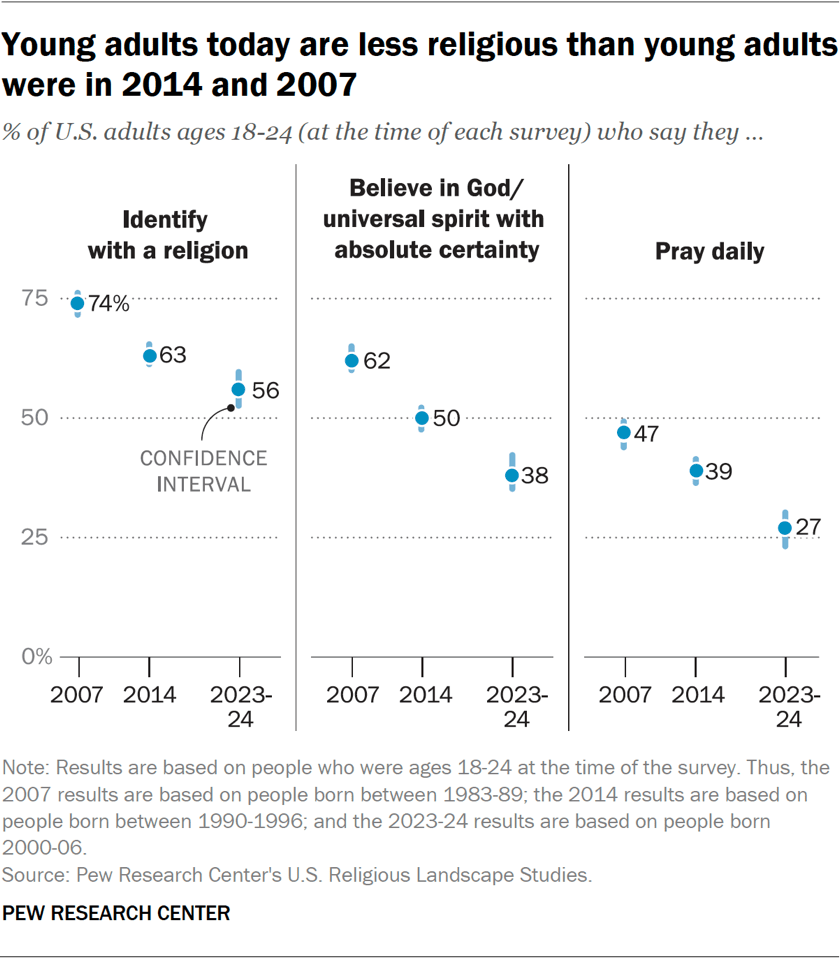
Within the last main survey that used data gathered in 2023-24 …
- 56% of 18-24 year olds identify with a religion …
- … but only 38% of them actually believe in a god …
- … and only 27% of them actually pray daily to that god, the other 29% don’t.
You would perhaps assume that identifying with a specific strand of belief (the 56%) would consist of people who actually believe there is a god, but no, only 38% of them do, the other 18% who use a religious label to identify themselves don’t actually believe with any certainty that there is actually a god.
Now that is fascinating, and is perhaps also explained by people using the label to identify with a specific religious culture, but don’t buy into any of the religious dogma.
For example …
- “I am Christian” could potentially translate to – I believe myself to be a good person, and nothing more than just that.
- “I am Christian” could also potentially translate to – I identify with this group because that is where all my friends / family hang out. That’s a social club, not a system of belief.
The interesting twist here is what can best be described as Schrodinger’s Christians. These are people who are deemed to be both Christian and also Not Christian at the exact same time by others. Let’s work a quick example …
- If you ask an Evangelical, “How many Christians are there?“, then you might get a number or percentage that includes every variation of belief to ensure that the number is as large as possible.
- If you then asked that same person, “Are Catholics real Christians?“, then it is highly probable that this same person might also tell you, “Ah no, they are not real Christians“.
It tends to be the fanatically religious who do this. In other words, for them 20% of the US population (roughly 53 million people), are deemed to be both Christian (when an inflated number is needed), and also at the same time, not Christian, when you drill down a bit more.
Rinse and repeat across the various strands of belief.
Why do those that truly believe do so?
The human religious experience is at its core emotional. People don’t believe because there is evidence, but instead align with a belief because of what they feel.
It is where they feel at home, “These are my people, my tribe, they support me and I support them“.
Religions are powerful partly because they are effective conductors of emotion, offering meaning and purpose.
Humans are social creatures, and religious community is one very common manifestation of this.
The Real Threat – Christian Nationalism
Freedom of thought grants people the freedom to believe whatever they wish. Where things go very wrong for everybody is when the deeply religious come to the conclusion that they must force their specific religious rules on everybody.
The big threat we face is encapsulated by the term “Christian Nationalism”.
Christian nationalism is an ideology that fuses religious identity (Christianity) with national identity. Here are some classical beliefs you might come across. The claim that the U.S. was founded as a “Christian nation.”. It was not, anybody telling you it was is lying to you. Here you will also encounter a push for laws and government that mirror their specific beliefs. This quite naturally creates a lot of social friction because other beliefs, secularism, or even just liberal interpretations of democracy are seen as threats.
The core issue is that Christian nationalism tends to prioritize religious identity over constitutional principles like freedom of religion or separation of church and state. Studies reveal that strong adherence to Christian nationalist beliefs correlates with support for authoritarian policies, disregard for electoral outcomes, and acceptance of political violence to achieve ideological goals.
Let me be wholly clear here: being Christian is not a threat, it is the fusing of religion with nationalist ideology and seeking political dominance that is.
Rather ironically, it is separation of church and state that will preserve our religious freedom, and it is Christian Nationalism that will destroy it.
Christianity isn’t the threat — Christian nationalism is: when faith wears a crown and runs the government, democracy loses.
Bottom Line
Take the high-level Pew numbers with a pinch of salt, because it really is complicated and most people are not as religious as the numbers might suggest, and also, be deeply wary of the Christian Nationalist fanatics who wish to impose their beliefs on you.