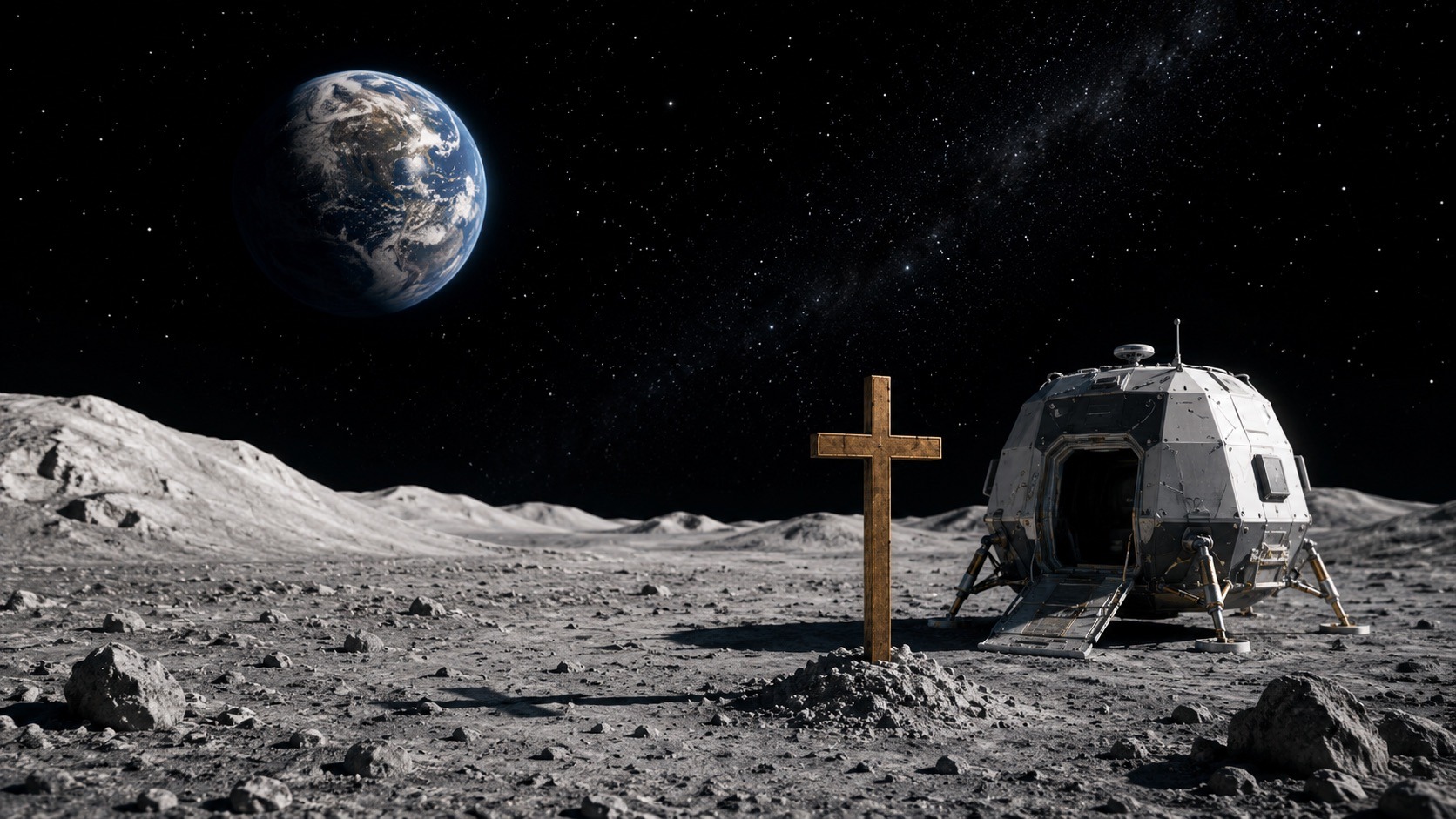
It has been reported that Iowa native Justin Park would very much like to place a cross on the Moon, and that he has started an organized campaign to make it happen.
It sounds so utterly crazy that my initial reaction was to assume that this is satire and that The Onion has got a good one here that has successfully fooled a few people. Nope, it is quite real, here is the Talking Points Memo reporting on this …
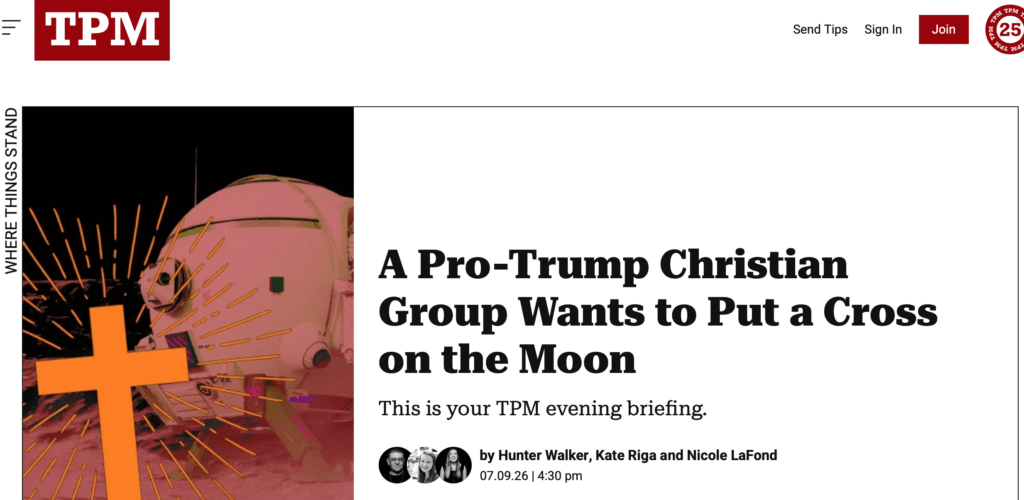
The TPM report led me to what Park calls the “Cross on the Moon Coalition”. He also gave an interview to the Catholic Messenger, the newspaper of the Diocese of Davenport.

… and there we also learn what his thinking is on this …
… [I] think that we’re going to be living in space, within a generation or two, and we definitely want to get out in front of this and lead with our virtues and our values, and that really starts with Jesus Christ … Putting a cross on the moon kind of sanctifies the lunar surface, and it’s our best foot forward … and hopefully we’ll create a culture based on Biblical teachings.”…
“Sanctifies the lunar surface.” … !!!
Beyond the obvious WTF reaction, what is that actually supposed to mean?
To sanctify something means to make it holy or dedicate it to God. Park’s coalition describes its mission as an attempt to “consecrate the heavens” and remind humanity that God is supposedly king of the universe.
No physical transformation would take place, of course. Hammering a metal cross into the lunar soil would not alter the Moon in any measurable way. What Park is really describing is symbolic religious marking: placing Christianity’s emblem there as a declaration that the Moon—and humanity’s future in space—should be associated with his religion.
There is also a rather unavoidable theological problem. If God created the Moon, why does it require Justin Park, a commercial lander and a $40 million metal cross to make it holy?
There is also one other very obvious question – how will it be funded?
Doing this would cost a great deal. Very few individuals—Elon Musk and perhaps Jeff Bezos aside—have pockets deep enough to fund it.
He has a ready answer …
“lunar landing companies usually quote about $1.2 to $1.3 million per kilo, and that’s for a ride share.”
“We raised about a quarter of a million, so we’ve got a ways to go,” said Park. “The idea is really to find a big space advocate who hasn’t found the Lord yet. Ideally, we would want to convert someone like Elon Musk. The world would just be a whole lot better if we could evangelize Musk and then make him into an evangelist …”
According to a September 2025 report by the San Francisco Standard, approximately $225,000 of the coalition’s then $227,000 total consisted of two bitcoins supplied by Park himself. Donations and merchandise had generated only about $2,000.
Imagine if you will, a fanatically religious Elon Musk with all the resources he has … as in, “Yikes!” on steroids.
Lest you wonder, Musk has increasingly used Christian language, describing himself as a “cultural Christian” and praising the teachings of Jesus. However, he also says that he is not particularly religious, and his beliefs remain eclectic and difficult to place within any conventional denomination.
Putting up Crosses
Park’s coalition appears to be among the first organized campaigns to pursue the idea seriously, but it is not the first time somebody has imagined putting a cross on the Moon. Back in November 2004, SpaceDaily published a detailed proposal for a “Lunar Crucifix”: an enormous illuminated cross stretching across the Moon’s Earth-facing side. It discussed solar panels, nuclear power and constructing long lines of lights on the lunar surface. There is, however, one rather important catch: the article was satire. It was mocking the influence of fundamentalist Christianity during George W. Bush’s presidency rather than launching a genuine space project.
What is different here is that this latest initiative appears to be dead serious.
There is also a long history of placing crosses in remote and symbolically important locations. Beyond ordinary church, memorial and roadside crosses, there are some striking examples.
The summit of Mount Everest
Yes, really. When Edmund Hillary and Tenzing Norgay made the first confirmed ascent in 1953, Hillary left a small cross in the snow that expedition leader John Hunt had given him. Tenzing left chocolates as a Buddhist offering. It was a tiny object rather than a permanent monument, but it was placed at the highest point on Earth.
On Alpine mountaintops
Large summit crosses are now common across Austria, Germany, Switzerland and northern Italy. One of the earliest documented examples was installed on the Kleinglockner in Austria in 1799, during an expedition sponsored by the prince-bishop of Gurk.
The lunar proposal follows the same basic impulse. Place the cross somewhere exceptionally high, remote or difficult to reach so that the location amplifies its symbolic importance. What makes the lunar proposal different is its enormous expense and its placement on a world that belongs to no religion or country.
Why Do Humans Do This?
Beyond familiar roadside memorials, placing a cross on a mountain summit, beneath the sea, in Antarctica or on the Moon turns it into a much larger statement. The remoteness, danger and difficulty add meaning.
The motives are a mixture of things you can most probably guess correctly:
- Memorial: remembering people who died in that place, especially explorers, climbers, sailors or accident victims.
- Thanksgiving: marking survival, a successful expedition or what participants regard as divine protection. The ultimate socially acceptable good-luck charm.
- Consecration: symbolically dedicating a place to God or asserting that Christianity reaches even the most remote parts of creation.
- Witness: creating a visible declaration of faith intended to inspire others.
- Possession and dominance: sometimes the cross implies, intentionally or otherwise, “we have reached this place and marked it with our religion.”
- Legacy: wealthy sponsors or ambitious organisations may want to create something spectacular that will outlast them.
- Publicity: an extreme location attracts attention, donations and media coverage in a way that an ordinary religious monument would not.
There is also a strong psychological element. Humans have always marked boundaries, summits and newly reached places with flags, cairns, plaques and religious objects. It is a way of turning an indifferent landscape into a place connected with human identity and meaning.
But on the moon?
Well yes, but this lunar cross proposal is especially controversial because the Moon is not anyone’s national territory. Supporters may see the cross as a peaceful expression of faith. Critics see it as religious territorial marking on a shared celestial body, rather like planting a denominational flag where humanity as a whole has an interest.
Will it actually happen?
Is it realistic or is it really (to borrow a term), a bit of a moonshot.
No, it is not realistic.
Why?
There are technical challenges.
It must unfold from a lander, drill itself into lunar soil, operate an antenna and transmit video. Every mechanism adds mass and possible failure points, on top of the considerable risk that the commercial lander itself crashes or tips over.
Nobody on Earth would ever see the cross directly, even through a telescope. Its entire audience would experience it through the project’s camera feed, and that assumes that the camera functions correctly.
The coalition has produced an animated illustration showing how it imagines the cross being delivered and deployed:
Another much larger obstacle is money.
The coalition reportedly had raised only about $250,000, against an estimated $40 million mission cost, and so that is well under 1% of the target. As noted earlier, almost all of that consisted of Park’s own bitcoin. Only about $2,000 had come from actual donations and merchandise.
There is just no way this guy is raising close to $40 million by selling sweatshirts, and his idea of converting Elon Musk to fund it is also … well put it this way, he has his head in the clouds.
Would It Be Legal?
No international treaty appears to prohibit placing a religious symbol on the Moon simply because it is religious. The Outer Space Treaty prevents countries from claiming sovereignty over the Moon, but it does not ban peaceful monuments or symbolic objects.
That does not mean Park could simply buy a rocket ticket and start drilling. Space activities conducted by private organisations must be authorised and supervised by their home country, and a US mission would be subject to launch and payload review. The most likely answer is therefore yes, provided it received the necessary approvals.
The more difficult objection is ethical and cultural: should one privately funded religious group permanently mark a celestial body in which humanity as a whole has an interest?
Beyond all that, the full-sized, independently funded version is highly unlikely to happen on Park’s present timetable. A miniature cross carried as somebody else’s payload is considerably more plausible.
One Last Thought
The central question is not whether humanity can put a cross on the Moon. Given sufficient money, it almost certainly can. The question is why anyone would consider it a worthwhile use of $40 million.
There are families without homes, children without food, refugees without safety, schools without resources and diseases without adequate funding. Against that background, spending tens of millions to advertise one religion on an uninhabited world looks less like practising Christianity than purchasing the most expensive billboard in history.
For now, however, Park’s project remains exactly where his hopes of converting Elon Musk appear to be: some considerable distance above the ground.
Also, given the behaviour of many Christians these days, I’d not be surprised if he went into full Capricorn One mode and simply faked a landing and live feed, then kept all the money raised.