
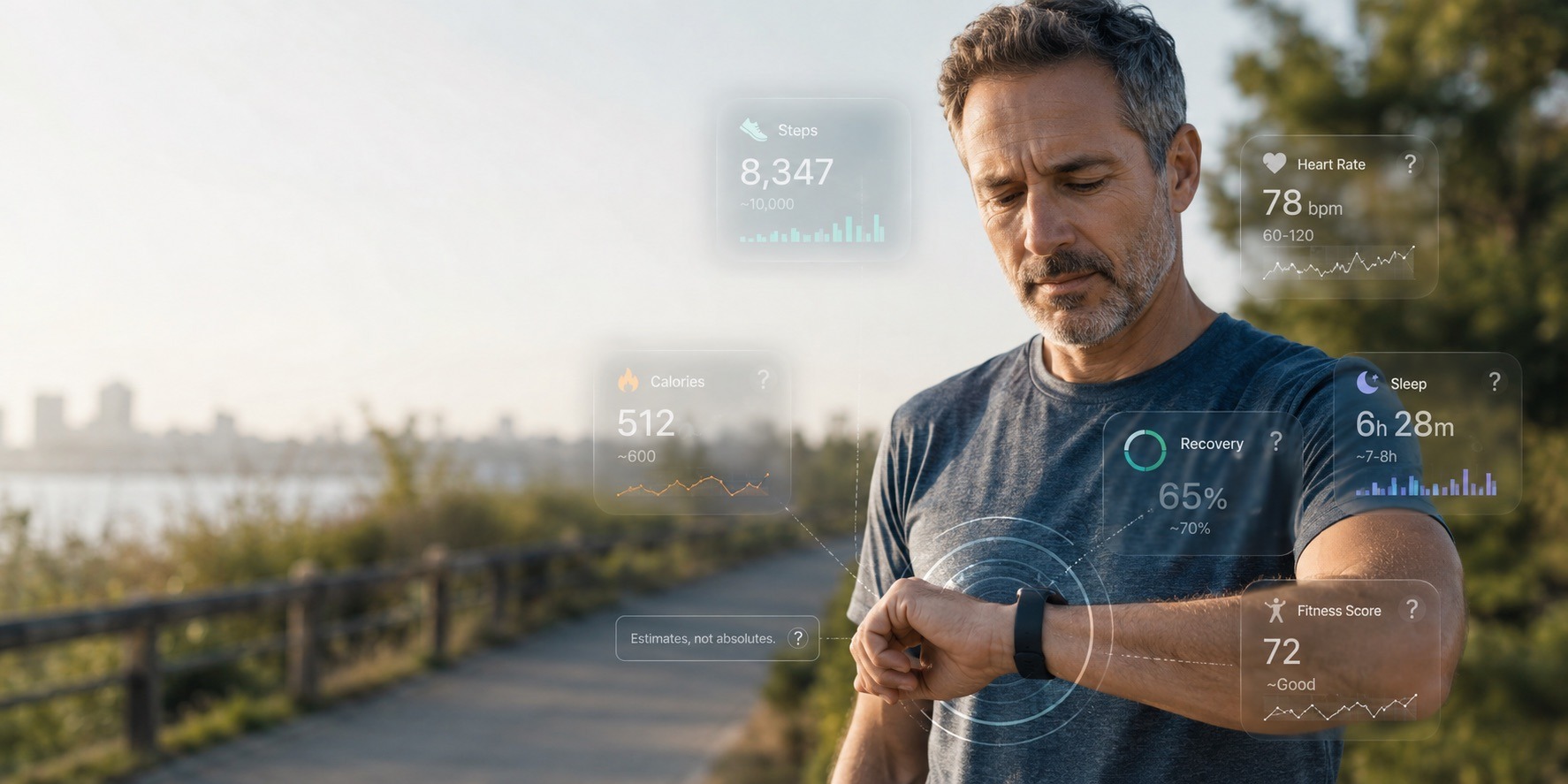

Many of us now wear fitness trackers. I include myself here. I’ve been using one for a few years to track just how active I am and will take specific steps (yes, pun intended), to ensure I meet specific activity goals. Recently I’ve begun to have doubts about what it is telling me.
First, what are these goals?
Via my employer, my health plan provider optionally tracks fitness and offers rewards. If I score enough points each week I get rewarded. Each day it ranks my cardio and also number of steps then allocates a score. This is wholly understandable. Presumably, the logic is that the more active I am, the less I may cost them over the long term. It is also a model that is becoming increasingly common.
In practical terms, fitness helps to lower the risk of the expensive, long-running conditions: heart disease, stroke, type 2 diabetes, some cancers, high blood pressure, falls, frailty, back/joint pain, poor sleep, depression and anxiety. If a health plan can nudge people into being healthier, it may benefit too.
What I do find truly weird is that one of the rewards I can get is a voucher for a discount on a pizza.
To be clear, I’m in it for the long-term benefits and not just the pizza. Even without the rewards, I’d be doing this.
Recently I’ve begun to question just how accurate my fitness tracker really is. I made the discovery that I could very easily hack the step count by waving my arm about and fool it into increasing the measured value. I have also always wondered how a device on my wrist can accurately detect various sleep stages.
A few weeks back I came across an article by Hunter Bennett within The Conversation titled “6 ways your smartwatch is lying to you, according to science“. It confirmed my suspicions.
For a bit of context, Hunter is an exercise science academic at Adelaide University, so this is all very much his area of expertise, and the article was published April 19, 2026.
Summing up Hunter’s Article
What does he say?
Here is a quick summary of it all.
His article explains that smartwatches and fitness trackers can be useful, but their numbers should not be treated as precise measurements.
His key point is that many popular metrics are estimates, not direct measurements. Calories burned can be wrong by more than 20%, especially during strength training, cycling or high-intensity exercise. Step counts are generally useful but can be inaccurate when arm movement is limited. Wrist-based heart rate readings work better at rest or low intensity, but become less reliable during harder exercise.
Sleep and recovery scores are also limited. Smartwatches can usually tell when you are asleep or awake, but they are much less accurate at identifying sleep stages such as deep or REM sleep. Recovery scores are often based on heart rate variability and sleep data, both of which can be inaccurate when measured from the wrist.
VO₂max estimates can also be misleading because watches cannot directly measure oxygen use. They often overestimate fitness in less active people and underestimate it in fitter people.
Overall, the article’s advice is to use smartwatch data as a rough guide for long-term trends, not as a daily verdict on your health or performance. How you feel, how you perform, and how well you recover may often tell you more than the watch does.
Once I digested his insights, then yes, it all makes perfect sense.
That sleep score was of interest to me so I did a deep dive into that, not because I had a specific concern, but because I was curious.
Sleep Score – what does science tell us?
Via the tracker on my wrist I get a daily chart that is supposedly of all my sleep stages during the previous night and also a score on how well I slept.
Yes, but how does it know?
It doesn’t, and is instead using what it can measure to work out an estimate.
Movement plays a role. The tracker’s accelerometer detects how much your wrist is moving. If you are very still for a long period, especially during your usual sleeping hours, it may infer that you are asleep. This is why trackers are usually fairly good at detecting broad “asleep vs awake” periods, but can mistake lying still in bed for sleep. For example, if you are lying still while listening to something or watching a movie, the tracker may mistake that for sleep.
Heart rate also plays a role. During sleep, your heart rate usually drops and becomes more stable. The tracker uses optical sensors on the wrist to estimate your pulse. A sustained fall in heart rate, combined with reduced movement, strengthens the guess that you are asleep.
Many trackers also estimate heart-rate variability, or HRV — the variation in time between beats. HRV patterns change across sleep and wakefulness, and can help the device estimate whether you are in lighter or deeper sleep.
Breathing and oxygen patterns also factor in. Some devices estimate breathing rate and blood oxygen variation. These can give extra clues, especially about disturbed sleep, though wrist oxygen readings are often imperfect.
What you have is all an estimate. Variations of patterns in movement, heart rate, HRV and sometimes breathing help such devices to classify periods as something like: light sleep; deep sleep; REM sleep; and of course awake.
As a contrast, a sleep lab will use sensors that record brain activity, eye movement, muscle tone and breathing. Your wrist tracker does not measure brain waves, so it cannot truly detect REM or deep sleep directly.
Are sleep researchers curious about the accuracy of fitness trackers for sleep measurements?
Indeed they are, and as you might expect they run tests that involve using fitness trackers within a sleep lab context and then compare the results from both the tracker and also their official measurements.
Here are a couple of recent papers in which sleep researchers did exactly this, and yes the results are exactly what you might anticipate:
- Oxford Academic Sleep Advances, March 22, 2025 – A performance validation of six commercial wrist-worn wearable sleep-tracking devices for sleep stage scoring compared to polysomnography …
…While wearables do not match PSG in clinical accuracy and should not replace it for diagnostic purposes, their accessibility, ease of use, and potential for real-time monitoring make them valuable for observing sleep patterns outside the sleep clinic. As wearables continue to evolve, these devices may offer increasingly valuable insights into sleep architecture and quality, especially when used to complement PSG assessments or track individual sleep trends over time. However, users must remain aware of the inherent inaccuracies in wearable data, as these devices do not replace PSG for clinical diagnoses. Future improvements in the wearable algorithms may further bridge the gap with PSG.
- JSM Journal of Sleep Medicine, April 30, 2023 – Validation of the Samsung Smartwatch for Sleep–Wake Determination and Sleep Stage Estimation …
GW3 demonstrated high performance in sleep detection but moderate performance in wake determination and sleep stage estimation compared with PSG results, which were comparable to previously reported results for other consumer wearable devices.
For further confirmation, Dr Dean J. Miller, who is a member of a research group at Central Queensland University, has distilled his insights within an article titled “How do sleep trackers work, and are they worth it? A sleep scientist breaks it down” back in June last year. There he concludes:
most modern sleep trackers do a decent job of estimating your total sleep each night. Some are more accurate for sleep staging, but this level of detail isn’t essential for improving the basics of your sleep.
In summary, the devices are useful for spotting sleep timing, broad sleep duration, restlessness, and trends over time. However, when it tells you that “you had exactly 47 minutes of deep sleep” or “your REM sleep was poor last night.”, that might or might not be correct.
You can answer questions such as “Am I sleeping longer?”, “Am I waking up more?”, “Does alcohol, late caffeine, stress, illness or exercise affect my sleep?”. Just take the sleep stage stuff as interesting, and don’t get hung up about it.
Sleep is only one measurement. What about the others? Which numbers are useful, and which ones deserve a raised eyebrow?
What I think you really need is a quick guide rather than a deep dive into each, so here you go.
This is what you need to treat with an appropriate degree of caution
- Sleep stages: Yes, we just covered this in detail. “Deep sleep”, “REM sleep” and sleep scores are estimates, not brain-wave measurements.
- Stress scores: Usually inferred from heart-rate variability. The problem is that it might not be just stress related. Other factors can also come into play, such as alcohol, illness, poor sleep, caffeine, dehydration, or even just sensor fit.
- Exact step count: Useful directionally, but not precise, especially if pushing a trolley/pram, carrying things, or walking without normal arm swing. As I mentioned earlier, I’ve also realised that I can hack my step count by swinging my arm to fool the device into increasing my step score.
- VO₂max / fitness age: Useful as a rough trend, but be aware that this is not a true lab measurement of oxygen use.
- Recovery/readiness scores: These combine several estimated metrics, so the final score can sound more authoritative than it really is.
- Exercise heart rate: Wrist sensors can struggle during hard intervals, strength training, sweat, loose fit, cold weather or lots of arm movement.
- Calories burned: Often quite inaccurate. That matters because it could be wrong enough to nudge you towards eating decisions that you should not be making.
What about the measurements that work well?
This is what you can most probably trust to be more accurate
Don’t let the above fool you into thinking that fitness trackers are basically technological astrology. What they are best at is nudging behaviour and showing trends, not giving laboratory-grade measurements.
Here is what they are generally good at:
- Tracking general activity: Step counts, active minutes and movement reminders can show whether you are more or less active than usual.
- Spotting long-term trends: Even if a number is not perfectly accurate, the trend may still be useful if the device measures it consistently.
- Motivation: Goals, streaks and reminders can encourage walking, exercise and better routines.
- Resting heart rate trends: Resting heart rate is usually more reliable than exercise heart rate and can reveal changes in fitness, stress, illness or fatigue.
- Sleep timing: Trackers are usually better at estimating when you fell asleep and woke up than at judging sleep quality.
- Training consistency: They can help you see whether you are exercising regularly, increasing volume, or overdoing it.
- Basic cardio workout guidance: During steady exercise, heart-rate readings can be useful enough to guide effort, especially if you compare them with how you feel.
Is it worth having a fitness tracker?
It can only ever be a personal choice, but it’s a “yes” from me. Having used one now for a few years, I can report that it has motivated me to become more active.
It is useful to keep an eye on trends and levels of activity, just don’t get hung up on the specific numbers because they are often not precise. A drop in resting heart rate over months, more active minutes, or better consistency is meaningful. A device saying you burned 487 calories, or had 19 minutes of deep sleep, or need exactly 72 hours off should be treated as what it really is – a rough guess.