
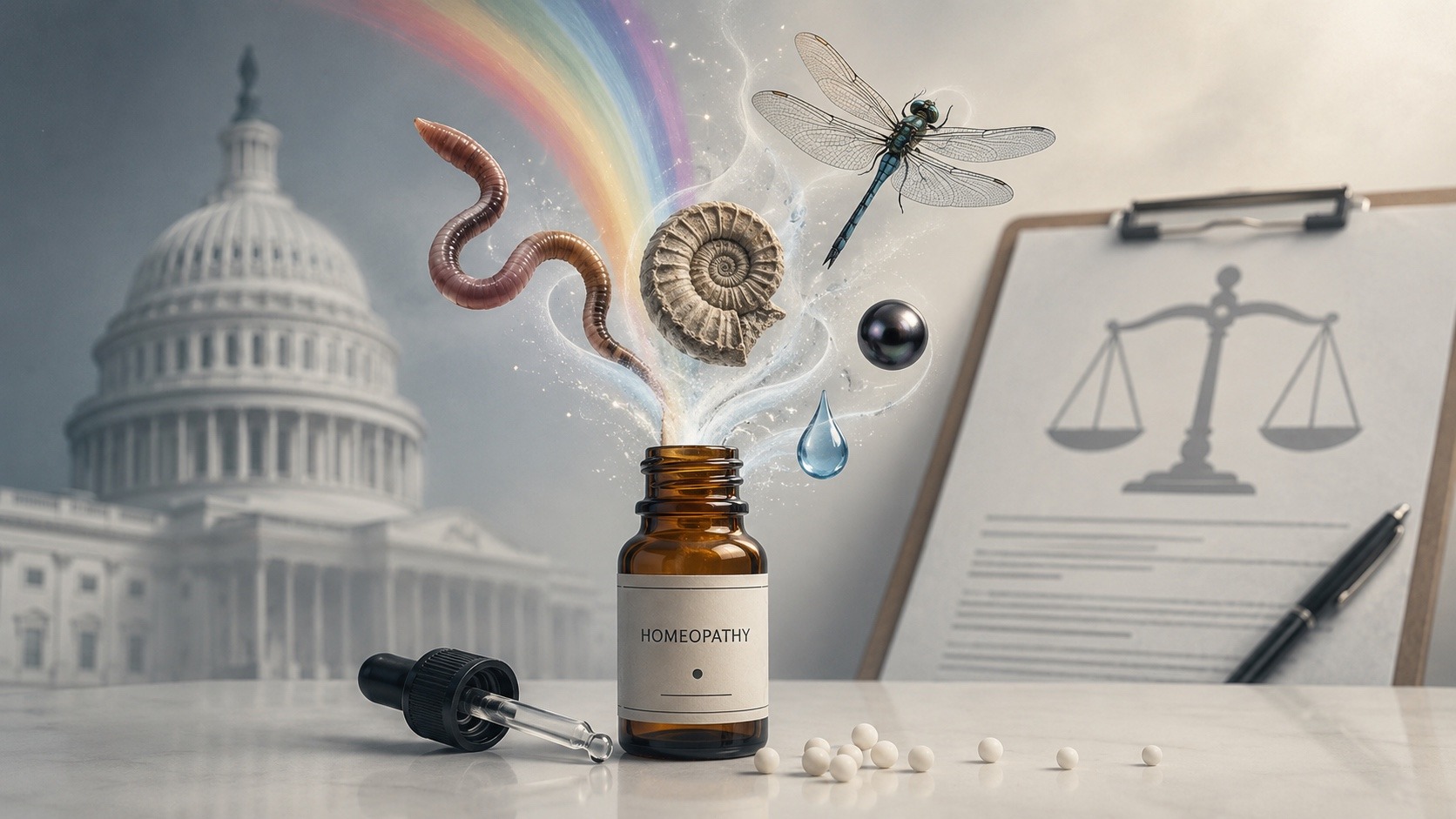

We live in a world cluttered with quackery, pseudoscience, and outright fraud. Some of it is slick and sophisticated. Some of it is laughably silly.
Today’s example falls into the latter category: homeopathy.
This would be funny enough if it were merely a private market in magical sugar pills. The problem is that Senator Mike Lee of Utah has introduced legislation to build an FDA framework for homeopathic medicine, supposedly to protect Americans’ access to “natural health solutions”.
Before we get to that, we need to be clear about what homeopathy actually is.
What Is Homeopathy?
If you turn to the Wikipedia page, you quickly discover a few of the basics:
- It is generally regarded as pseudoscience
- It was conceived in 1796 by the German physician Samuel Hahnemann
- The core belief is that “a substance that causes symptoms of a disease in healthy people can cure similar symptoms in sick people” – “like cures like“
For example, if you have trouble sleeping, then your homeopathy remedy will probably have been made using caffeine, a substance that causes you to stay awake.
How does this remedy supposedly work?
What you get is basically an extremely diluted version of the substance that supposedly caused the complaint, hence if “like cures like” it will supposedly fix you. What many do not appreciate is that this is a dilution on a logarithmic scale. A typical remedy can be as “potent” as 30C or might even be 100C.
What does that actually mean?
Here it is step by step.
Take 1 part of the raw ingredient and add 99 parts of water, and then vigorously shake by 10 hard strikes against an elastic body. This is called “succussion”. This is 1C. Now take 1 part of the 1C and add 99 parts of water, do the same and you have 2C. Keep repeating until you get to 30C.
The claim is that a solution that is more dilute is described as having a higher potency, and so these more dilute substances are considered by homeopaths to be stronger and deeper-acting remedies.
To help you wrap your head around this, a 12C solution is equivalent to a “pinch of salt in both the North and South Atlantic Oceans”. 13C is one drop of that diluted in all the water on the planet.
By the time you get to 30C, what you are given contains no active ingredients at all. What is truly bizarre is that this remedy is supposed to be magically infused with the property of the ingredient you started with, while somehow “forgetting” everything else the water ever came into contact with. (Hint: the secret of plumbing is that it’s not all water).
If you are now beginning to think, “But that’s absurd” then you are only beginning to get it. What should now be clear is that this is not about some herbal remedy that just might do something. Instead, it is magical thinking.
Am I biased?
Not at all.
If you want the institutional consensus, it is not subtle.
CDC — US Centers for Disease Control and Prevention
The CDC specifically rejects “homeopathic vaccines” or nosodes as substitutes for vaccination. It says there is no credible scientific evidence or plausible scientific rationale supporting such claims.
Source: CDC Yellow Book, “Complementary and Integrative Health Approaches”
FDA — US Food and Drug Administration
No homeopathic product is FDA-approved. Homeopathic products in the US have not been reviewed by the FDA for safety and effectiveness to diagnose, treat, cure, or prevent disease. The FDA also warns that some products may pose safety risks and that using them instead of proven treatment can delay effective care.
Source: FDA, “Homeopathic Products”
NIH / NCCIH — National Center for Complementary and Integrative Health
The NCCIH advises people not to use homeopathy to replace proven conventional care or delay seeing a clinician. It also says homeopathic products should not be used as substitutes for conventional immunisation.
Source: NCCIH, “Homeopathy: What You Need To Know”
NHS / NHS inform
NHS inform says there is no good-quality evidence that homeopathy works, and no good-quality evidence that it is effective for any health condition. It also notes that NICE does not recommend homeopathy for any health condition.
Source: NHS inform, “Homeopathy”
NHS England
Homeopathy is included within NHS England’s “items which should not be routinely prescribed” policy framework. This covers medicines with safety concerns, lack of robust evidence of clinical effectiveness, poor cost-effectiveness, or low NHS funding priority. Prescribers are advised not to start new patients on such items and to deprescribe where possible.
Source: NHS England, “Items which should not be routinely prescribed in primary care”
NHMRC — Australia’s National Health and Medical Research Council
The NHMRC concluded that there are no health conditions for which there is reliable evidence that homeopathy is effective. It advises that homeopathy should not be used for conditions that are chronic, serious, or could become serious, and warns against rejecting or delaying proven treatment.
Source: NHMRC Information Paper, “Evidence on the effectiveness of homeopathy”
EASAC — European Academies’ Science Advisory Council
EASAC concluded that homeopathic claims are scientifically implausible, and that there are no known diseases for which there is robust, reproducible evidence that homeopathy is effective beyond placebo. It recommends that public health systems should not reimburse homeopathic products unless efficacy and safety are shown by rigorous testing.
Source: EASAC, “Homeopathic products and practices”
To sum all that up: homeopathy is not supported by good-quality evidence as an effective treatment, should not replace conventional care, should not replace vaccines, and where regulated, regulation does not imply proven clinical effectiveness.
Translation: it is all BS.
Homeopathy is weirder than you can truly appreciate
To illustrate this point, I have listed below some of the deeply weird things used within some homeopathy remedies.
Freeman’s Homeopathic Online Pharmacy lists a vast range of homeopathic remedies. They are based in Glasgow in the UK and have been in business for more than 60 years. They claim …
All our remedies are prepared in strict accordance with the British and German Homeopathic Pharmacopoeias under Specials Manufacturing Licence from the Medicines and Healthcare products Regulatory Authority (formerly the Medicines Control Agency) of the UK Government. We have held this licence since 1973 and are regularly inspected to ensure the highest standards of Good Manufacturing Practice and Quality Control are employed at all times.
Sounds impressive.
Hold that thought and prepare to have your mind blown.
From their A to Z list of remedies, which you can find here, I found the following. The categories are mine, I simply picked items from their A to Z list.
Category 1) Weird Animals
- Anax Imperator (Dragonfly) … Which part of the dragonfly, the wings or the body?
- Androctonus amurreuxi (Scorpion) … a remedy with a sting in the tail?
- Acarus Siro (Flour Mite) … it starts off very small and then that gets diluted?
- Boar (Wild Boar, Sus Scrofa) … if it is tame would that make any difference, or does it have to be wild?
- Boa Constrictor (Adeps Boae) … presumably for when your symptoms are feeling a bit constricted?
- Black Browed Albatross (Diomedea Melanophris) … bad luck if you get this one around your neck.
- Bombyx Mori (Silkworm, Silkmoth) … is this for silkier skin, or moth-related anxiety?
- Daddy Long Legs (Pholcus Phalangioides) … finally, a treatment for people suffering from too many knees.
- Earthworm (Helodrilus Calig, Lumbricus Terr) … Ugh!
- Dormouse (Glis Glis) … Again Ugh!
- Erinaceus Europus (Hedgehog) … for symptoms that are a bit prickly?
- Feline Flea (Cat Flea) … because apparently even the parasites need diluting.
- Pygocentrus Nattereri (Red Piranha) … one tiny bite of nonsense, diluted beyond recognition.
- Sanguis Soricis (Rat Blood) … there is no single version of rat blood, there are lots of species with different types, so what does this even mean?
You might indeed wander into a pharmacy and buy “Lumbricus Terr“. The name sounds sciency, but what you have actually purchased is ultra dilute earthworm.
Category 2) Weird Objects
- Ammonite (fossil) … Yes, really, a fossil
- Black Pearl … is this one really expensive, and how exactly do you dilute a black pearl?
- Drainage … I have no idea how they turn this into a remedy.
- Epoxy Putty … what is this supposed to cure?
- Fluorescent Light … a cure for what exactly?
- Fairy Liquid … must it be this brand, or will a generic brand work?
- Hair Dye (mixed) … will different colours have different effects?
- Hoover Dust … From whose house?
- Hydrochloric Acid … They really do need to seriously dilute this one
- Light (Halogen) … Will it be a stronger remedy if it is a low wattage bulb?
- Microwave … Only tiny little waves work then?
- Nitroglycerinum (Glonoinum,Glonoine) … Boom
- Nitrous Oxide (Nitrogenium Oxy) … Are you laughing yet?
- Nasal Mucosa … Seriously, double ugh!
- Opal (Black) … The colour makes a difference!
- TNT (Trinitrotoluene) … again, Boom!
- X-Ray … I can see the scam here
- Laser Beam … to zap what exactly?
- Granite (Lapis Granatum Murvey) … a rock solid cure for?
- Coronary Artery … belonging to who exactly?
- Pineal Gland … I’m beginning to wonder who they chopped up
- Placenta (Human) … ugh!
- Rain Water … will a light shower be OK, or does it need to be a thunderstorm?
- RNA … If you understand what RNA actually is, then you will appreciate just how vague this actually is.
- Semen (human) … I really don’t want to ask about this one
- Trilobite (Elrathia Kingii) — fossil … for symptoms that have been troubling you since the Cambrian?
- Tyrannosaurus Rex (fossil) … Because nothing says modern medicine like diluted dinosaur.
- Weeds (mixed) … This is also very vague. How do they decide what is and is not a weed?
Category 3) Colors (yes seriously, a color)
What does this even mean and what exactly do you use this to supposedly treat?
If you buy “blue” then what exactly is the source. Is it made of anything random that is “blue”?
- Blue … feeling sad? Try diluted blue, because apparently colour now counts as medicine.
- Indigo … for people who felt blue, but wanted something more pretentious.
- Orange … yes the colour not the fruit. Vitamin C not included.
- Pink … presumably for conditions that are not quite red enough.
- Spectrum (Rainbow) … finally, a remedy for people suffering from insufficient refraction.
- Red … diluted rage, perhaps?
- Lux Ultraviolet (Ultraviolet Light) … so now we are diluting invisible light as well.
- Yellow … for when cowardice needs a homeopathic solution?
Category 4) Endangered Species (How exactly did they get their hands on any of these?)
The World Wildlife Fund might have a few concerns here:
- Haliaeetus Leucocephalus (American Bald Eagle) … because apparently even national symbols can be diluted into nonsense.
- Orangutan (Pongo Pygmaeus) … I’m sure the orangutan consented to becoming a sugar pill.
- Snow Leopard (Panthera Uncia) … rare, endangered, and now apparently medicinal when diluted into oblivion.
- Gorilla Blood … because “please prove this was ethically sourced” feels like the least of the questions here.
Category 5) Unusual Food
- Blue Cheese (Stilton) … I do have to wonder how old it needs to be?
- Chocolate … Would that be milk chocolate or dark chocolate?
Can you actually order these?
You can indeed.
This is not satire. These are all very real homeopathic remedies listed by Freeman’s. Some may not be current stock, but that hardly rescues the concept. Just be grateful that they are ultra-diluted solutions, so the original molecules of earthworm and rat blood are gone.
But Why?
Homeopathy remains popular for the same reason many ineffective ideas survive: it feels as though it works, even when controlled evidence demonstrates that it does not.
Here is a quick summary of what really happens:
Many illnesses improve on their own.
Colds, aches, mild stomach problems, rashes, fatigue and stress symptoms often fluctuate naturally. If someone takes a remedy at the low point and then improves, the remedy gets the credit.
Regression to the mean.
People often seek help when symptoms are unusually bad. Statistically, the next few days are likely to be better anyway. That improvement can look like proof.
Homeopathic consultations often feel better than ordinary medicine.
A homeopath may spend a long time asking about sleep, mood, personality, diet, stress and life history. Many people feel listened to in a way they do not always feel in a rushed GP appointment. The emotional value of that encounter can be misread as evidence that the remedy itself works.
“Natural” sounds safer.
Homeopathy benefits from the marketing glow around “natural”, “gentle”, “holistic” and “non-toxic”. Ironically, many homeopathic remedies are so diluted that there is effectively nothing pharmacological in them; but the branding makes them feel benign and wise.
It lets people avoid frightening medical uncertainty.
Conventional medicine often says: “We don’t know yet”, “This may take time”, “There are risks”, or “This condition has no easy fix.” Homeopathy tends to offer a more comforting story: your body is out of balance, this remedy is matched to you, healing will follow. That certainty is emotionally attractive.
A friend saying “it worked for me” is psychologically powerful. A systematic review saying “no reliable evidence” is abstract. Humans are story-driven, not naturally trial-driven.
Confirmation bias protects the belief.
When symptoms improve, homeopathy gets the credit. When they do not, people may say the remedy was wrong, the dose was wrong, they need a constitutional remedy, the condition is “detoxing”, or it will take longer. The belief becomes hard to falsify.
The danger is not usually that a highly diluted homeopathic pill directly harms someone. The greater risk is that people delay real diagnosis or effective treatment, especially for serious, progressive, infectious or inflammatory disease. That is why the Australian NHMRC concluded there is no reliable evidence that homeopathy is effective and warned against using it for chronic, serious or potentially serious conditions.
In plain terms, homeopathy survives because it is wrapped in empathy, ritual, anecdote, hope and clever timing. It does not need to actually do anything pharmacologically to feel convincing.
Which brings us to the reason this matters now.
Mike Lee’s Pseudoscience Protection Bill
On June 5, 2026, Republican Senator Mike Lee of Utah introduced legislation with the goal of building an FDA framework for homeopathic medicine. This is supposedly to protect Americans’ access to natural health solutions.
- The bill is called the Homeopathic Drug Product Safety, Quality, and Transparency Act.
If you have not already done so, then about here would be the right place for you to proceed to face-palm.
The basic problem is that it treats homeopathy as if it is a special category of medicine that deserves a special regulatory pathway, rather than as a product category making medical claims that should have to prove safety, quality and efficacy like other drugs.
The most revealing part is that Lee’s own announcement says the bill would:
- recognise homeopathic drug products as distinct from ordinary pharmaceuticals;
- clarify that they are not new drugs;
- exempt them from the normal premarket approval process;
- create separate safety and quality standards;
- exempt finished homeopathic products from required lab tests to evaluate the strength of each active ingredient;
- create a homeopathic advisory committee.
This is not “science-based regulation“. It is more akin to building a decorative regulatory greenhouse around a dead plant.
The bill’s political trick is that it talks about safety, quality and transparency, which sounds reasonable, while weakening the most important question: does the product actually work?
Hint: No, because it is all BS.
If a product is basically sugar pills plus a story, the honest regulatory position should be: “You may sell it as a comfort product, but do not market it as medicine unless you can prove medical benefit.”
What makes the bill especially irritating is the rhetoric around it. Tuberville is quoted claiming homeopathic remedies can “yield miraculous results”, while supporters describe homeopathy as “safe, holistic, and effective” and even invoke “healthcare freedom”. That is the usual manoeuvre: turn a dispute about evidence into a culture-war argument about freedom. But consumers are not made freer by being sold bogus medical claims that have not been properly demonstrated. They are made less informed.
If there is going to be legislation, then it needs to do something like this:
Homeopathic products can remain on sale, but labels must prominently state: “No credible evidence shows this product treats or prevents disease.”
Any disease-specific claim should require the same standard of evidence as any other medical claim. Products for serious conditions, children, sterile use, injectable use, or infectious disease should face strict enforcement.
Lee’s bill is striving to do the opposite: preserve access, protect the category, and create a bespoke pathway that risks legitimising ineffective products. That is not consumer protection. It is quackery protection dressed up as liberty.
Final Thought
To criticise homeopathy, I do not need to march you through every clinical trial showing that it fails. I only need to point at what is being sold: diluted earthworm, diluted rainbow, diluted fossils, diluted Hoover dust, diluted urine, and diluted semen.
At some point, the defence collapses under the weight of its own absurdity.
If people want to buy magical sugar pills as a private comfort ritual, that is their choice. But the moment those products are marketed as medicine, the standard should be simple: prove that they work.
Lee’s bill does not do that. It builds a special shelter for claims that cannot survive ordinary scrutiny.
Homeopathy says dilution increases potency. Fine. Let’s apply the same principle to this bill: dilute it until not a single active word remains.