
This is Christian Nationalist Reality Check #3. It is part of an ongoing series examining how religious language is used in modern politics.

This is the third part of what will be a weekly series, you can find the previous (second) posting here …
Across modern politics there is a pattern that is becoming hard to miss. Certain kinds of claims appear again and again, often wrapped in religious language, moral urgency, or cultural anxiety. They sound powerful in the moment. They appeal to faith, to fear for our children, or to the belief that our nation is under spiritual attack. And because they touch deep emotions, they can spread quickly.
This is part of a weekly series that examines prominent claims from the previous seven days, not to sneer, but to analyze what the rhetoric is doing, ground it in constitutional and historical reality, and offer a liberating insight.
The goal is not to defeat belief, but to strengthen your discernment. Weaponized religion in politics harms both democracy and sincere faith. Understanding the mechanics that it operates by will help to liberate and free us from it.
Below are five from this past week. Each is worth reviewing as a standalone lesson and will equip you with a reasonable rebuttal.
1. When Fear of Becoming a Minority Becomes a Political Argument
The claim
What It’s Doing
The claim being made here is simple but powerful. William Wolfe is arguing that millions of immigrants must be deported so that his children will not grow up as minorities in their own country. On the surface this sounds like concern for family and cultural stability. Underneath, however, the argument is doing something very different.
It reframes immigration not as a policy debate but as a demographic threat. The message is that the presence of people from different backgrounds is inherently dangerous because it might reduce the relative numbers of people like him. The focus is not on crime, economic impact, or border management. The focus is on maintaining a particular ethnic or cultural majority.
This kind of rhetoric works because it taps into a deep human instinct. People naturally want their children to feel secure and to belong. When someone suggests that your children may become outsiders in their own country, it triggers anxiety about loss and displacement. It turns demographic change into something that feels like a personal threat.
Reality Check
Once you step back, the logic quickly falls apart.
The United States has always been a country shaped by immigration. At various points in history people said the same thing about Irish immigrants, Italian immigrants, Jewish immigrants, and many others. Each wave was described as a civilizational threat that would destroy the country’s identity. Each time those fears proved wrong. The newcomers became part of the nation, and the nation itself grew stronger and more diverse.
The idea that children are harmed by living in a country where they are not the majority is also strange when you think about it. Millions of Americans already grow up as minorities depending on where they live. A white child in parts of Los Angeles or Houston may be in the minority at school. A Black child in rural Iowa may be the only Black student in the class. The experience of being surrounded by people who are different is not a tragedy. It is simply part of living in a pluralistic society.
More importantly, the United States was never designed to belong to a single ethnic group. Its founding principle is that citizenship is based on shared ideals and laws, not ancestry. The country works precisely because people from many backgrounds can belong to it at the same time.
Discernment
There is also a deeper Christian problem with this kind of argument.
Christian teaching consistently warns believers against defining human worth or belonging by tribe or bloodline. In the New Testament, the apostle Paul famously wrote that in Christ there is neither Jew nor Greek. The early church struggled intensely with the question of whether faith was tied to a particular people or culture. The answer that emerged was radical for its time. The gospel was not the property of one nation or ethnicity. It was for everyone.
Scripture repeatedly commands believers to welcome the stranger. Jesus himself spent much of his ministry crossing social and ethnic boundaries that others tried to enforce. The parable of the Good Samaritan deliberately makes the outsider the moral example.
That does not mean a country cannot have immigration laws or debate how many people it can responsibly absorb. Those are legitimate policy questions. But turning immigration into a project of preserving ethnic dominance is something very different. It replaces the Christian idea of neighbor love with a fear of demographic change.
It also sends a troubling message to millions of fellow citizens who are already part of the country. If the goal is to make sure some children never become minorities, it implies that other people’s children are permanently outside the circle of belonging.
Bottom Line
Concern for your children’s future is natural and understandable. But building that concern on the fear of other people’s presence leads down a dangerous path. A healthy country is not one where one group must remain the majority forever. A healthy country is one where people of different backgrounds can live together under the same laws, with equal dignity and equal rights.
That vision is not only consistent with the American idea. It is far closer to the heart of the Christian message as well.
2. When Faith Is Used to Exclude
The claim
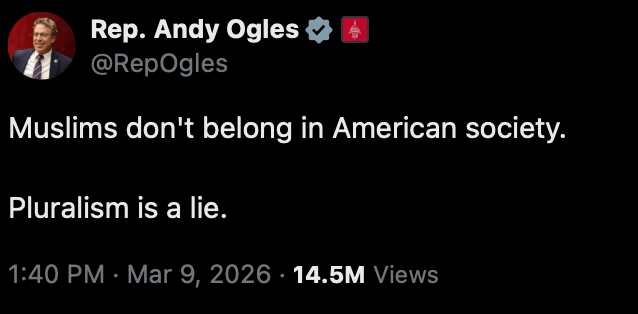
From time to time a political figure will say something that sounds blunt and confident but collapses the moment you examine it. One recent example came from Rep. Andy Ogles, who posted the following via social media (Twitter) …

What It’s Doing
The statement is trying to redraw the boundaries of who counts as a legitimate member of society. It suggests that America should belong only to one religious group and that people of other faiths are somehow outsiders.
It also dismisses pluralism, which is simply the idea that people with different beliefs can live together under the same laws. By calling pluralism a lie, the claim attempts to delegitimize the very framework that allows religious freedom to exist.
In short, it replaces the idea of citizenship with the idea of religious purity.
Reality Check
The United States was deliberately built on religious pluralism.
The Constitution contains no religious test for public office. The First Amendment protects the free exercise of religion and forbids the government from establishing one. That structure was not an accident. Many of the early settlers had fled religious persecution in Europe and understood exactly what happens when one religious group tries to dominate the state.
Muslims are not outsiders to American society. They have lived in the United States for generations. Muslim Americans serve in the military, run businesses, teach in universities, practice medicine, and hold public office. Millions are ordinary citizens raising families and contributing to the country just like everyone else.
Pluralism is not a lie. It is the operating system of the American constitutional order.
Countries that reject pluralism tend to slide toward theocracy or authoritarian rule, where one group decides who belongs and who does not.
Discernment
Christians who take their faith seriously should be especially cautious about rhetoric like this.
Jesus repeatedly crossed the boundaries that religious tribalism tried to enforce. In the parable of the Good Samaritan, the moral hero of the story is a member of a group that many Jews of the time despised. Jesus used that story precisely to challenge the idea that compassion and moral worth belong only to one tribe.
The New Testament also makes clear that the kingdom of God is not defined by ethnicity or nationality. Paul wrote that in Christ there is neither Jew nor Greek. The gospel consistently breaks down the walls that human beings try to build.
If Christians demand that people of other religions do not belong in society, they are not defending Christianity. They are abandoning the very teachings that define it.
Christian faith calls believers to witness, persuasion, and love of neighbor. It does not authorize the exclusion of entire groups of people from public life.
Bottom Line
The claim that Muslims do not belong in American society is not a defense of faith. It is a rejection of both the Constitution and the basic moral instincts of Christianity.
Pluralism is not a lie. It is the framework that allows people of many beliefs, including Christians, to live freely.
The real test of a society is not how it treats the majority, but how it treats those who believe differently. A confident faith does not need to expel others in order to survive. It simply needs to live out its values with integrity.
3. When Faith Becomes a Political Claim
The claim
On a regular basis the following claim pops up. It sounds confident and righteous but quietly rewrites both history and the gospel at the same time. The recent example comes from Lorenzo Sewell.
Lorenzo Sewell declares in a YouTube clip to Sean Feucht that “this is a Christian nation that was meant to be led by Christians.“
At first glance that may sound comforting to some believers. It suggests that Christianity holds a special place in public life and that the country has a clear spiritual identity. But when you slow down and look at what the claim is actually doing, the picture becomes more complicated.
What It’s Doing
This kind of statement blends religion with political authority. It frames national identity in explicitly religious terms and suggests that leadership should belong primarily to people of one faith. In other words it moves Christianity from being a voluntary belief shared by citizens into something closer to a qualification for governing.
That shift matters because it subtly implies that Christians are the rightful stewards of the nation while others are outsiders or guests. Jews, Muslims, atheists, and even Christians who disagree politically are pushed to the margins.
It also turns Christianity into a political identity badge. Instead of asking whether a leader is wise, honest, or capable, the test becomes whether they claim the correct religious label.
Reality Check
Historically and constitutionally, the United States was not founded as a Christian state.
Many of the founders were personally religious, but they were also deeply aware of the religious conflicts that had torn Europe apart for centuries. Their solution was not to establish a national church but to prevent the government from favoring one religion over another.
The Constitution contains no reference to Christianity. In fact it explicitly forbids religious tests for public office. Anyone can serve regardless of their faith.
The First Amendment goes even further by protecting both freedom of religion and freedom from government imposed religion. That protection was designed so that people of many different beliefs could live together without the state declaring one of them to be officially correct.
In practice the country has always been religiously diverse. Christians have been the largest group, but America has also always been home to Jews, Muslims, skeptics, and people of many other traditions. The system was built to make room for all of them.
Discernment
Christians who take the teachings of Jesus seriously should actually be cautious about claims like this.
Jesus never tried to build a political state or require governments to be run by his followers. When asked about political authority he famously said to give to Caesar what belongs to Caesar and to God what belongs to God. That statement drew a clear line between faith and political power.
The early church also spread without controlling governments. Christianity grew through persuasion, service, and witness rather than through political dominance.
There is also a moral issue. If Christians demand that only Christians should lead, they are effectively asking the government to privilege their faith above others. That is exactly the kind of religious favoritism that Christians themselves have suffered under in other parts of the world.
A healthier Christian approach is to focus on character rather than religious labels. Scripture repeatedly emphasizes justice, humility, honesty, and care for the vulnerable. Those qualities matter far more than whether a politician claims a particular identity.
Christians can and should participate in public life. But they do so as citizens among citizens, not as rulers of a religious state.
Bottom Line
The claim that America was meant to be led by Christians is not supported by history, the Constitution, or the example of Jesus.
The founders built a system where people of every faith and none could share the same civic space. And the Christian faith itself has always been strongest when it relies on persuasion and example rather than political power.
A country where everyone has equal standing before the law is not a threat to Christianity. It is one of the reasons Christianity has been able to flourish freely in the first place.
4. When Every War Becomes Armageddon
The claim
What It’s Doing
When someone says that a modern political conflict is a sign that we are on the brink of Armageddon, they are doing more than offering a theological opinion. They are framing a current political event as part of a divine script. The effect is powerful. If a war is part of God’s end times plan, then questioning it begins to look like questioning God himself.
This kind of rhetoric also creates urgency and emotional intensity. If the world is about to enter its final chapter, then ordinary political discussion no longer feels appropriate. Compromise, diplomacy, and careful analysis are replaced by a sense that events must unfold exactly as predicted. In practice this turns complicated geopolitical situations into spiritual dramas where one side represents God and the other represents evil.
It is a very effective way of shutting down critical thinking.
Reality Check
Predictions about the imminent arrival of Armageddon have been made for centuries. They have appeared during the fall of Rome, the Crusades, the Black Death, the Napoleonic wars, both World Wars, the Cold War, the Gulf War, and many conflicts in the Middle East. Each generation has been told that the final battle is just around the corner.
Yet history keeps moving.
The Book of Revelation itself is written in highly symbolic language that scholars across Christian traditions interpret in many different ways. Many theologians see it as a message of hope to persecuted early Christians rather than a detailed map of modern geopolitics. It does not provide a checklist where contemporary nations can be neatly inserted into the text.
Even Jesus warned against people claiming to know when the end was about to arrive. In the Gospel of Matthew he said that no one knows the day or the hour. That includes pastors, politicians, and commentators on television.
Treating every Middle Eastern conflict as a countdown to Armageddon has consistently proven wrong.
Discernment
Christians do believe that God is sovereign over history. But the Bible never calls believers to interpret every war as a prophetic signal. Instead it repeatedly calls them to humility and faithfulness in the present.
Jesus taught his followers not to obsess over the timing of the end but to live faithfully until it comes. In Acts, when the disciples asked whether the kingdom would be restored at that moment, Jesus answered that the timing was not for them to know.
More importantly, Jesus consistently pointed his followers toward peacemaking. In the Sermon on the Mount he called peacemakers blessed and taught his followers to love their enemies. That teaching does not disappear whenever a conflict appears in the news.
Christians should therefore be cautious about people who confidently claim that a specific war fulfills biblical prophecy. Such certainty often says more about modern political loyalties than about Scripture itself.
Faith calls believers to wisdom, humility, and a commitment to peace, not to treating war as proof that prophecy is unfolding.
Bottom Line
Declaring that a current war signals the arrival of Armageddon may sound dramatic, but history shows that these predictions almost never age well. They tend to inflame political passions, simplify complex conflicts, and give spiritual cover to positions that should be debated on their real merits.
Christians do not need to read every headline as a prophecy update. The call of the Gospel is much simpler and much harder at the same time. Live faithfully, pursue peace, and leave the timetable of the end of the world to God.
5. When Politics Gets Called Witchcraft
The claim
Lance Wallnau says that New York City Mayor Zohran Mamdani and the Democrats are under the spell of witchcraft: “It’s a manipulative and controlling and dominating spirit.”
What It’s Doing
Calling political opponents “under the spell of witchcraft” is not really an argument about policy or governance. It is a rhetorical move that reframes political disagreement as spiritual warfare.
Once a claim like that is accepted, ordinary debate becomes impossible. If a politician is simply wrong about taxes, policing, housing, or immigration, then citizens can argue, present evidence, and vote accordingly. But if that politician is supposedly under demonic influence, then disagreement becomes a battle between God and dark spiritual forces.
That shift has a powerful psychological effect. It discourages critical thinking and replaces it with fear and loyalty. If people believe their political opponents are literally controlled by evil spirits, then compromise or dialogue begins to feel like betrayal.
In other words, this language is not about explaining reality. It is about mobilizing a political tribe.
Reality Check
There is no credible evidence that politicians are controlled by witchcraft or supernatural spells. Political movements form because of ideology, economic interests, cultural values, and voter preferences.
New York City politics in particular is shaped by factors such as housing costs, immigration patterns, public transportation, crime policy, and economic inequality. These are complex civic issues, not supernatural events.
Throughout history, accusing opponents of sorcery or demonic influence has often appeared in moments of social tension. Medieval Europe had witch trials. Early modern politics sometimes blamed disasters on witches or heretics. Those accusations usually tell us far more about the fears of the accusers than about the people being accused.
Modern democratic societies function best when disagreements are addressed with facts, debate, and evidence rather than spiritual accusations.
Discernment
Christians who take their faith seriously should be cautious about this kind of language.
The New Testament repeatedly warns believers against making reckless accusations about spiritual forces. In the Gospels, Jesus condemns those who casually attribute the work of others to evil spirits. In the letter of James, Christians are told that wisdom from above is peaceable, gentle, and open to reason.
The fruit of the Spirit listed by Paul includes patience, kindness, and self control. Accusing political opponents of witchcraft does not display those qualities. It replaces humility with suspicion and fear.
Christians are also called to bear witness to truth. That means engaging the real world honestly. If a mayor or political party promotes policies that Christians believe are harmful, the proper response is to explain why, using moral reasoning, evidence, and persuasion.
Calling opponents witches may excite a crowd, but it does not reflect the character or teaching of Christ.
Bottom Line
Claims that political opponents are under the spell of witchcraft are not serious explanations of political reality. They are a tactic that turns ordinary disagreement into spiritual panic.
Christians and non Christians alike should resist that move. Democracy works best when citizens debate ideas rather than demonize each other.
If a policy is wrong, explain why it is wrong. If a leader is mistaken, show the evidence.
Blaming witchcraft might energize a rally, but it does not bring anyone closer to truth.
Lessons Learned: How to Spot the Pattern and How to Respond
Here is a summary from this week.
1. Demographic Fear
Summary: This pattern turns demographic change into a threat by arguing that certain groups must remain the majority in order for the country to remain stable.
When it works: It works when people feel anxious about cultural change and believe their children’s identity or belonging is under threat.
How to respond: Bring the conversation back to shared citizenship and remind people that the strength of pluralistic societies has always come from integrating many groups rather than preserving one permanent majority.
2. Religious Exclusion
Summary: This pattern redraws the boundaries of belonging by claiming that people of certain religions do not truly belong in society.
When it works: It works when audiences equate national identity with a single religious tradition and begin to see other faiths as outsiders.
How to respond: Point out that constitutional systems are built on religious freedom and that pluralism protects the rights of believers as much as it protects everyone else.
3. The Christian Nation Narrative
Summary: This pattern claims that the nation was intended to be governed primarily by Christians and that political authority should therefore favor one faith.
When it works: It works when religious identity becomes a political badge and people assume shared belief guarantees moral leadership.
How to respond: Ground the discussion in constitutional history and remind believers that the strength of Christianity has historically come from persuasion and example rather than political privilege.
4. Apocalyptic Politics
Summary: This pattern interprets modern conflicts as signs that the world is on the brink of biblical Armageddon.
When it works: It works when people feel that history is moving toward a dramatic climax and want current events to fit into a divine storyline.
How to respond: Remind people that predictions of the end have appeared in every generation and that even the teachings of Jesus warn against claiming to know when the end will arrive.
5. Spiritualizing Political Opponents
Summary: This pattern reframes political disagreement as spiritual warfare by claiming that opponents are influenced by demons, witchcraft, or dark spiritual forces.
When it works: It works when audiences are already primed to see politics as a battle between good and evil rather than a debate about policy.
How to respond: Bring the discussion back to evidence, policy, and reasoning and point out that demonizing opponents prevents the kind of honest debate that democracy requires.
A Simple Checklist for Discernment
When you encounter a dramatic political claim that uses religious language, it helps to pause and ask a few simple questions.
- Is this argument appealing primarily to fear about identity or cultural change rather than discussing real policy?
- Is it trying to define who belongs in society based on religion, ethnicity, or ancestry?
- Is it claiming divine authority for a political position in a way that shuts down debate?
- Is it framing current events as proof that prophecy is unfolding right now?
- Is it portraying political opponents as spiritually evil rather than simply wrong?
If several of those signals appear at once, you are not hearing careful theology or responsible political analysis. Instead you have detected religion being used as a political tool.
Once you recognize the pattern, it becomes much easier to step back from it.
Your discernment begins with that simple moment of recognition.
These patterns will continue to appear. When they do, the objective should not be anger but clarity: Your goal is not to win arguments, but to see clearly.